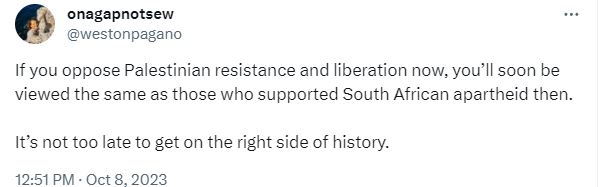
Today I’m deviating from my usual Climate Movement Monday post to offer some info regarding what’s happening now between Palestine and Israel. We in the United States, whose government gives Israel’s military $3.8 billion per year, have been fed a narrative about the conflict between Israel and Palestine. We have been programmed to believe it’s a complex situation rather than clear-cut apartheid akin to South Africa. It can be intimidating to speak out on behalf of Palestinians because of the knee-jerk charges of anti-semitism, but the morality of the situation demands we do just that.

A boy waves a Palestinian flag, at the Israel-Gaza border, during clashes with Israeli troops, at a protest where Palestinians demand the right to return to their homeland, east of Gaza City, April 1, 2018.
(Reuters /Mohammed Salem)
I encourage you to read this October 7 piece from Haggai Matar “Gaza’s shock attack has terrified Israelis. It should also unveil the context. The dread Israelis are feeling after today’s assault, myself included, has been the daily experience of millions of Palestinians for far too long.”
Here’s an excerpt: “In Gaza, meanwhile, the ongoing siege is continuously destroying the lives of over two million Palestinians, many of whom are living in extreme poverty, with little access to clean water and about four hours of electricity a day. This siege has no official endgame; even an Israeli State Comptroller report found that the government has never discussed long-term solutions to ending the blockade, nor seriously considered any alternatives to recurring rounds of war and death. It is literally the only option this government, and its predecessors, have on the table.”
And for more background on the situation, Indigenous organizer, Kelly Hayes of Truthout, had an in-depth conversation with Palestinian American organizer, Lea Kayali, on Kelly’s “Movement Memos” podcast (transcript provided) in May 2021. The title of this episode is “What the Mainstream Media Never Told You About Palestine.”
 Tracy Abell
Tracy, thanks for raising this mine-filled issue of the Palestinian struggle.
LikeLiked by 1 person
A belated thank-you for reading, Rosaliene.
LikeLiked by 1 person
The Palestinians were never given a voice in the establishment of the Jewish homeland they were just supposed to ~cease to exist~ for everyone else’s convenience because the world felt bad about what the Nazis had done to the Jewish people. Fixing the injustice of genocide with more genocide.
LikeLiked by 2 people
Oops, I wasn’t logged in.
LikeLike
Thank you, Melanie, for your thoughtful comment. Your final sentence ” Fixing the injustice of genocide with more genocide.” sums it up. I appreciate you taking the time to read and comment.
I also read your additional comment and feel sad about how carefully people feel they must tread when discussing Gaza. For the record, I am firmly on the side of the oppressed and hopeful for a Free Palestine despite the ratcheting up of genocidal mania. My heart is breaking but I also believe that somehow, someday, Palestinians will be free.
LikeLiked by 1 person
I feel the need to clarify that I’m not on any side in this conflict. What the Hamas militants did was horrendous. I’m heartsick at the fear, pain and loss of life happening to people, families, who have suddenly found themselves in a full-blown war. I’d hoped to see peace prevail in my lifetime between Israel and the Gaza Strip. That a compromise understandably difficult for both, could have been reached to save lives. Now it feels like a far-off dream.
LikeLike