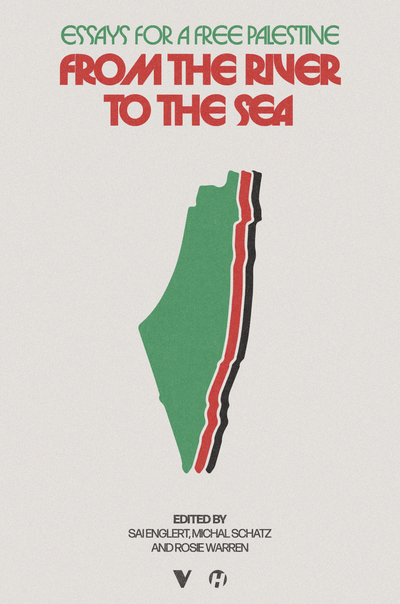
As mentioned before, Haymarket Books is offering a free ebook of “From the River to the Sea: Essays for a Free Palestine.”
I’m going to share an excerpt from the essay “No human being can exist” by Saree Makdisi (25 October 2023) which focuses on the treatment Palestinians receive when interviewed by Western journalists and the impossible task of a “[making] up for seven decades of misrepresentation and willful distortion in the time allotted to a sound bite.”
What we are not allowed to say, as Palestinians speaking to the Western media, is that all life is equally valuable. That no event takes place in a vacuum. That history didn’t start on 7 October, 2023, and if you place what’s happening in the wider historical context of colonialism and anticolonial resistance, what’s most remarkable is that anyone in 2023 should be still surprised that conditions of absolute violence, domination, suffocation, and control produce appalling violence in turn. During the Haitian revolution in the early nineteenth century, formerly enslaved people massacred white settler men, women, and children. During Nat Turner’s revolt in 1831, insurgent enslaved people massacred white men, women, and children. During the Indian uprising of 1857, Indian rebels massacred English men, women, and children. During the Mau Mau uprising of the 1950s, Kenyan rebels massacred settler men, women, and children. At Oran in 1962, Algerian revolutionaries massacred French men, women, and children. Why should anyone expect Palestinians–or anyone else–to be different? To point these things out is not to justify them; it is to understand them. Every single one of these massacres was the result of decades or centuries of colonial violence and oppression, a structure of violence Frantz Fanon explained decades ago in The Wretched of the Earth.
What we are not allowed to say, in other words, is that if you want the violence to stop, you must stop the conditions that produced it. You must stop the hideous system of racial segregation, dispossession, occupation, and apartheid that has disfigured and tormented Palestine since 1948, consequent upon the violent project to transform a land that has always been home to many cultures, faiths, and languages into a state with a monolithic identity that requires the marginalization or outright removal of anyone who doesn’t fit. And that while what’s happening in Gaza today is a consequence of decades of settler-colonial violence and must be placed in the broader history of that violence to be understood, it has taken us to places to which the entire history of colonialism has never taken us before.
I highly recommend reading this essay in its entirety, along with the rest of the book. It’s not easy reading, but it’s vital that we acknowledge what’s happening. We must never stop talking about Palestine.
 Tracy Abell
This is important to remember: “Every single one of these massacres was the result of decades or centuries of colonial violence and oppression, a structure of violence Frantz Fanon explained decades ago in The Wretched of the Earth.”
LikeLiked by 2 people
Yes, thank you for highlighting that. I fervently wish that those who believe this all began on October 7th would do a little reading to better understand the historical context of colonialism. And the obvious apartheid that Palestinians face! I mean, I thought South Africa had taught all of us what that oppressive system entails which means that, at least, should be a no-brainer. *sigh*
LikeLiked by 1 person
*sigh*
LikeLiked by 1 person
Pingback: Excerpt from “From the River to the Sea: Essays for a Free Palestine” – Sweaters & raindrops