My plan for today after last night’s multiple police attacks on student encampments around the country was to write (some more) about police response to peaceful protest, further connecting the dots between the many proposed “Cop Cities” around the U.S. Instead, I’m going to delay my post in order to share a must-read piece from Sarah Kendzior: There’s a Sniper on the Roof of the School Where I Studied Authoritarianism. (You can learn more about Sarah here.)
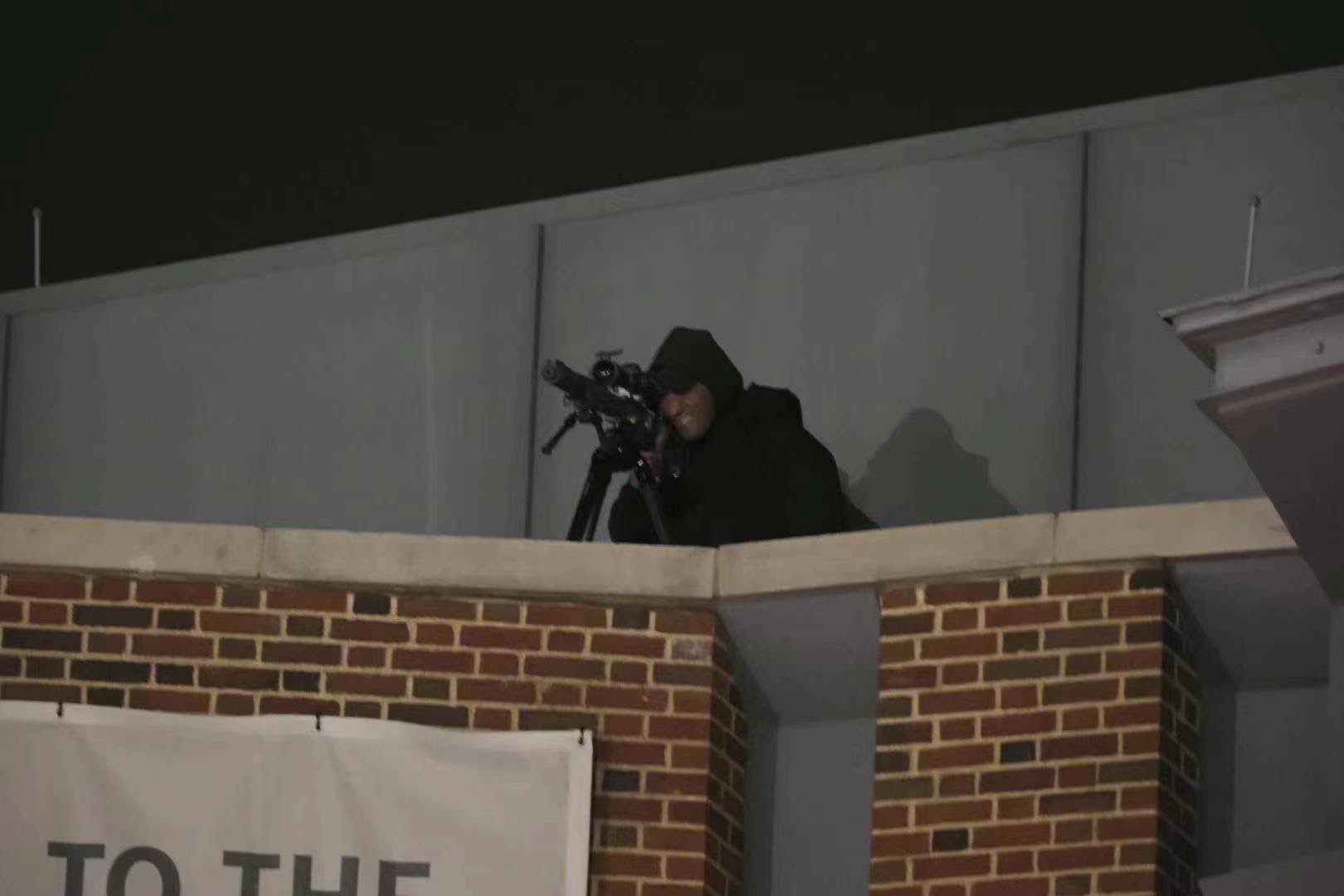
Sniper on roof at yet another university: Ohio State 4.25.24
Kendzior’s piece begins with this:
There are snipers on the roof of the school where I got my MA.
There are police beating students at the school where I got my PhD.
At each school, I studied authoritarian regimes and how they brainwash people into believing that state brutality is not only expected, but deserved.
That last sentence bears repeating: “… authoritarian regimes [ ] brainwash people into believing that state brutality is not only expected, but deserved.” We’re witnessing this in real time as people on social media sites and network news cheer on the brutalization of students making the very humane and reasonable demands that their tax dollars and their tuition NOT finance a genocide. Those gleeful and bloodthirsty responses to the violence aimed at students reveal a profound lack of humanity and an eager acceptance of authoritarianism.
Kendzior’s piece goes on to say:
The concrete demands of the students have been drowned out by smears from powerful officials — like Benjamin Netanyahu, who compares the students to German Nazis; or fanatical Zionist Senators like John Fetterman, who compares the students, many of whom are Jewish, to the neo-Nazis of Charlottesville who chanted “Jews will not replace us.”
The campus war is a propaganda war. [emphasis mine]
Ryan Grim of The Intercept wrote yesterday that “Americans who get their news primarily from cable are the only people who believe that Israel is not committing a genocide in Gaza, according to according to a new survey that examined the relationship between attitudes toward the war and news consumption habits.” Make no mistake, the cable news programs are following the Biden administration’s guidance on how they present information. They want us to believe that the students and Palestinians are the “terrorists” in this equation, distracting us with false claims of antisemitism so that we won’t look at the blood-soaked hands of Biden plus the Democrats and Republicans who’ve come together in a show of genocidal unity.
Kendzior goes on to write about the students of Gen Z:
Older people either rapturously proclaim that Gen Z will save America or demonize them as entitled. They are portrayed as saints or sinners, but rarely as human beings with a diverse array of opinions.
Every young generation faces this sneering dismissal. It happened to the Boomers, Gen X, and the Millennials too.
But there’s something cruel about ascribing great responsibility or great blame to a generation that has, in their short lives, endured a global plague, rising autocracy, the loss of civil rights, school shootings, catastrophic climate change, multiple economic crashes, and other atrocities often prefaced with the word “unprecedented”.
Each time I read those words, tears fill my eyes. Not only have we placed an incredible burden on these courageous and principled young people, many are ridiculing their humanity and willingness to fight for others. It’s grotesque. Instead of being physically attacked by the police and verbally attacked by strangers, these young people deserve our gratitude and support (bail funds listing here).
I’ll stop now, but encourage you to read Sarah Kendzior’s piece in its entirety. None of us are safe with this rapid acceleration of authoritarianism.
Solidarity! ✊🏽
 Tracy Abell
Tracy, thanks for sharing Sarah Kendzior’s very powerful article. Her observation/warning stood out for me: “But if there is a definitive story of the past decade, it is how the net of oppression has widened. Whether through covid, climate change, or the loss of hard-won rights: we are all targets, we are all disposable.” Solidarity!
LikeLiked by 1 person
Thank you for reading and highlighting that vital point, Rosaliene. It’s especially chilling knowing that today the House passed legislation that would broaden the definition of “antisemitism” which would result in greater crackdown on college campuses. I don’t have any faith the Senate won’t also pass it. Solidarity, friend!
LikeLiked by 1 person
Yes. Tracy. Thank you. There is right. And there is wrong. Sometimes telling the difference takes effort and time.
LikeLiked by 1 person
I’m glad you’re in my life, Cindy, and can tell the difference between right and wrong. Every person such as yourself is a like a little life raft in these dark days.
LikeLike
All very true, Tracy. I’ve checked out a book by the philosopher, Hannah Arendt. It’s a heavy one both literally and figuratively but I think important in understanding what’s going on and has gone on historically. It seems like the worst evil isn’t so much bad leaders but the followers and subjects of those leaders who carry out orders without thinking. When we lose the ability to think, we lose our humanity. I “think” that’s kind of the gist of it anyway. But, I also think you’re right that fear of punishment has a lot to do with why we follow bad leaders. And, why I’m afraid to put up a sign in my yard. Thanks for the article link. I’m looking forward to reading it.
LikeLiked by 1 person
Hi Mara! Are you reading The Origins of Totalitarianism? I haven’t read it but am thinking it’s very timely (again) and would help right now. I absolutely agree with your sentiment that when we lose our ability to think, we lose our humanity. This is on stark display right now. Thank you for engaging with me on this and telling me about the book you’re reading. You’re a bright spot in these hard days and I’m grateful we’ve connected.
LikeLiked by 1 person
Yes, that’s the book. Not sure I’ll make it through as it’s so long and challenging but I’m trying. Makes me think anyway, as do you, Tracy. Thank you for that.
LikeLiked by 1 person
Pingback: Climate Movement Mondays: on crushing dissent | Tracy Abell
As much as law-abiding people want/need law-enforcers — and most of us very much do, especially with increasing incidence of violent crime — I believe that to have a reasonable idea of how police will generally behave towards the public they are meant to serve, one must understand what underlying nature/desire motivated them to their profession to start with (e.g. for ‘power’ reasons, maybe), though perhaps subconsciously.
It is, after all, a profession in which, besides the basic tackle and/or restraints, an adrenalin-rushed law-enforcer might storm into suspects’ homes, screaming, with guns drawn at the homes’ occupants, all of whom, including infants, can be permanently traumatized from the experience.
Occasionally the police will force their way into the wrong home, altogether. That’s when itchy-trigger-finger law-enforcement gunfire can and does occur, followed by wrongful deaths to be ‘impartially’ investigated. Problematically, there are people who are in such an armed authority capacity that were reared with an irrational distrust or baseless dislike of other identifiable groups.
LikeLiked by 1 person
Hello! I appreciate and agree with your insights, and want to state upfront that I’m someone who does not want the police. I believe people and communities would be better served if, instead of pouring billions of dollars into militarized police that serve to protect property and the status quo, that money was used to address people’s material needs (housing, health care, mental health, addiction counseling, etc). What you wrote about the trauma of police busting in, guns drawn, is so true. Police interactions can negatively affect people for the rest of their lives. Thank you for taking the time to read and add your thoughts.
LikeLiked by 1 person
Quite true. I also feel that more funding needs to be (re)directed toward communities in need. Additionally, police should have some connection to thus genuine concern for the communities they police or, more appropriately, serve.
It’s also very true about what the police largely do, especially here in our Western virtual corpocracies [$$$]. …
Such Western governance ensures that any genuine socialist would be banned from just about everything in mainstream society, especially politics.
A few victorious social/labor uprisings notwithstanding, notably the Bolshevik and French revolutions, it seems to me that the superfluously rich and powerful essentially have always had the police and military ready to foremost protect their power/money interests, even over the basic needs of the masses.
Even today, the police and military can, and probably would, claim [using euphemistic or political terminology, of course] they had to bust heads to maintain law and order as a priority during major demonstrations, especially those against economic injustices.
Indirectly supported by a complacent, if not compliant, corporate news-media, which is virtually all mainstream news-media, the absurdly unjust inequities/inequalities can persist.
Therefore, I can imagine there were/are lessons learned from those successful social/labor uprisings — a figurative How to Hinder Progressive Revolutions 101, perhaps? — with the clarity of hindsight by the big power/money interests in order to avoid any repeat of such great wealth/power losses.
And the more they make, all the more they want — nay, need — to make next quarterly. It’s never enough, and an increasingly corrupt corporate news-media will implicitly or even explicitly celebrate them.
____
In any event, “If voting changed anything [in favor of the weak/poor/disenfranchised] they’d have made it illegal.”
—’Calamity’ Jane Bodine, Our Brand Is Crisis
LikeLike
Hi again! Thank you for this thoughtful extension of the conversation. You’ve hit on important points–the same-as-it-ever-was aspect of police role in upholding the status quo and protecting property (and now, ripping masks off protestors), the elites’ never-ending greed and drive for more-more-more, and the corporate media’s role in maintaining that status quo–but what really hit me hard was that quote at the end. “If voting changed anything, they’d have made it illegal.” I’ve mostly given up on electoral politics and yet I can’t bring myself to allow my electeds to continue on their genocidal and violent ways without frequent calls/emails from me that point out their criminal and inhumane behaviors. Against all evidence, I seem to think they’re capable of feeling shame. That’s my flaw.
LikeLiked by 1 person
I tend to believe that any U.S. president who would make a serious attempt at implementing truly humane, progressive policies — notably universal single-payer healthcare, a significant reduction in greenhouse-gas emissions, military spending, a genuine anti-war effort, and increasing the minimum wage while also reigning in Wall Street abuse/corruption, etcetera — would likely be assassinated [by lone gunmen, of course] and sooner rather than later.
Bernie Sanders and documentarian Michael Moore come to mind as good examples of such a theoretical presidency. [I recall that every county in West Virginia voted for Sanders in the 2016 primaries, yet the Democratic National Committee declared them as wins for Hillary Clinton.]
At the same time, to have genuine representative democracy, there first and foremost needs to be a truly democratic electoral system for the citizenry. The First Past The Post [FPTP] ballot largely masquerades as real democracy. And, of course, many voters get to wait in long, bad-weather lineups to participate.
While the FPTP ballot may technically qualify as democratic within the democracy spectrum, it is the PR system thus governance that’s truly representative, regardless of political ideology.
FPTP does seem to serve corporate lobbyists well, however. I believe it is why such powerful interests generally resist attempts at changing from FPTP to proportional representation electoral systems of governance, the latter which dilutes corporate influence.
LikeLiked by 1 person
I’d forgotten about the West Virginia primary. And now look at Bernie: still can’t utter “genocide” and still insisting “Israel has a right to defend itself” despite it being the occupying power. I’m embarrassed that I knocked doors for that man. We most definitely have electeds that serve corporate lobbyists and as I tell my so-called reps every time I call re Gaza, that this isn’t a democracy when they’re acting against the will of the people to send $6.5 billion to Israel since October 7th so they can slaughter Palestinians. Hard days on the planet, for sure.
LikeLiked by 1 person