Some timely reading

The Democratic National Convention has begun in Chicago and I’d like to share links to a couple pieces that resonated with me.

The first is from the incomparable Sarah Kendzior who writes a newsletter on Substack. It was published yesterday and is titled Distant Vibes: Welcome to the era of the No Information Voter.

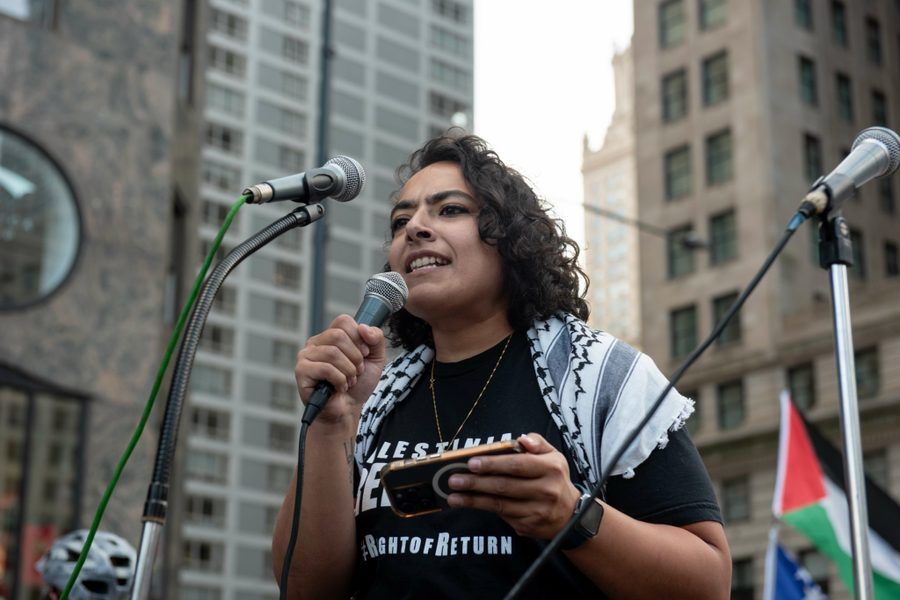
The other is the speech delivered by Eman Abdelhadi (“And now they want our votes”) at the massive demonstration in Chicago yesterday.

Eman Abdelhadi speaks at the Bodies Against Unjust Laws march in Chicago on Sunday, August 18.
Photo by Steel Brooks

If you’re interested in independent coverage of the DNC, I highly recommend signing up for emails from In These Times / The Real News Network. You can do that HERE.

Please leave a comment if you have other reading/sources to recommend!

Gaza, Harris, and an arms embargo

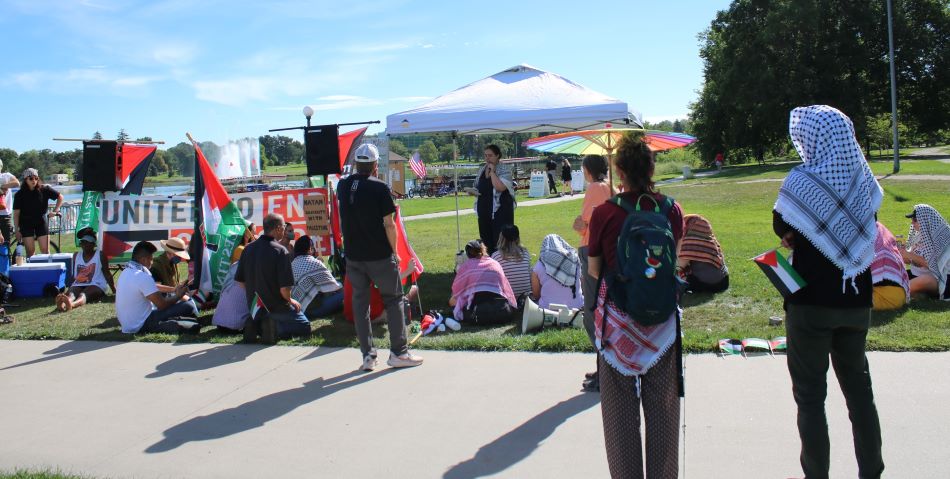
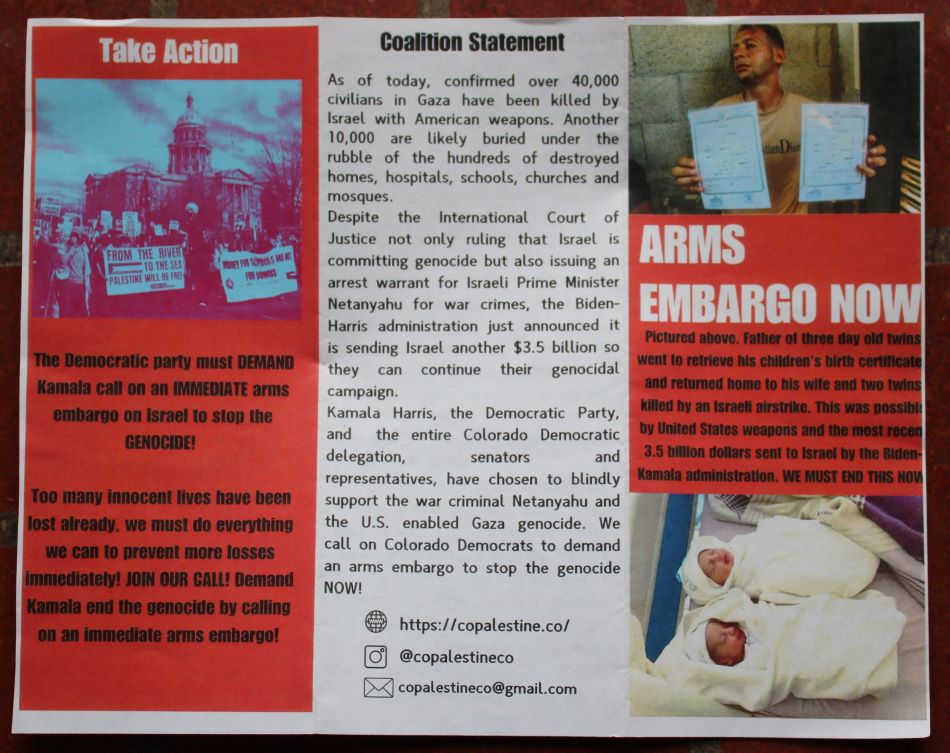
This morning Zippy and I went to City Park in Denver to attend a Colorado Palestine Coalition teach-in at the “dash for democracy” running/walking event sponsored by the Denver Democrats to raise funds for the Kamala Harris campaign. Our intent was to get the Democrats to understand that many of us will not vote for Harris/Walz in November if they do not call for an immediate arms embargo on Israel. It is no longer enough to call for a CEASEFIRE NOW (even though our sign remains in our front yard, faded and battered by nine-plus months of weather). The White House pretends to be negotiating in good faith toward a ceasefire, but it’s all theater. There cannot be a lasting ceasefire when the U.S. keeps supplying Israel with bombs. As was succinctly stated here, “If you say you want a ceasefire while sending the bombs that keep shredding children, you don’t really want a ceasefire. That’s all there is to it.”

The only way to end the carnage is to immediately stop arming Israel with U.S.-made bombs. The good news is that several weeks ago “…seven unions representing six million workers published an open letter to President Biden demanding that he cut off military aid to Israel until it ends its brutal assault on Gaza.” A demand for an arms embargo does not allow wiggle-room for weasel words from the White House and Harris.

Here’s the flier CPC handed out today (click on images to enlarge):


Okay, so what did I learn at the teach-in? Unfortunately, not as much as I’d hoped to learn due to an unhinged person who yelled and shook a cowbell while the speakers spoke. I admit to feeling so much anger I couldn’t focus on what was being said. Several times, I attempted to reason with Cowbell Karen who kept telling us to “educate yourselves” while doing everything in her power to make that impossible. When I finally aimed my camera at her, she gleefully sneered at me.

The masked person in the keffiyeh has been at many pro-Palestine events, often serving as a marshal to keep us safe while we march in the streets. They remained calm throughout Cowbell Karen’s rampage, and I am not only grateful for their presence but also in awe of their composure. Speaking for me, my blood pressure was running pretty high. The situation sidetracked my learning and I only caught snippets here and there, including:

A Palestinian man spoke about those who insist the situation in Palestine is incredibly complex and that the only way forward is a “two-state solution.” He reiterated that the situation is actually quite simple and that two states isn’t tenable, especially now because of the absolute and total destruction of Gaza. He offered a succinct response to those who cynically demand “well, then what’s your solution?” which is One state with equal rights for all. As he pointed out, it’s pretty hard to argue against that.

The speaker beneath the tent in the above photo is Indigenous and she spoke on the history of solidarity between Natives and Palestinians. I learned there was once an official U.S. Army regulation that required army helicopters to be named after Native tribes. Tomahawks, Apaches, Black Hawks. I didn’t catch much of what else she said, but was stunned to realize I’d never thought about the Army using those names.

Another speaker was a Black woman who works as a youth defender. She quoted from Ruha Benjamin’s Spelman Convocation 2024 (emphasis mine):
Remember too, that despite the social media slogan, trust black women, you too have to be trustworthy. Black faces in high places are not going to save us.

Just look at the black proponents of Cop City in Atlanta’s leadership class. Black faces in high places are not going to save us. Just look at the black woman, Tan, ambassador at the UN, voting against a ceasefire in Gaza. That is, our blackness and our womanness are not in themselves trustworthy if we allow ourselves to be conscripted into positions of power that maintain the oppressive status quo.

There’s a huge effort now on social media to drive a wedge between Black people and Gaza/Palestine, to fracture the solidarity, so it was really good to hear her reiterate the importance of the shared struggle against oppression.

Despite the disruptions and the glazed-over expressions from many of the Denver Dems volunteers who made it clear they were not interested in new perspectives or pushing their candidate to do the right thing, I’m still glad we went. It always feels good to be in solidarity with others.

If you are still making calls and sending emails to your representatives in regards to Gaza, please push for an arms embargo. If you don’t want to vote for candidates who enable genocide, please let them know you will withhold your vote unless they push for an arms embargo. Remember, if those in power truly want a ceasefire, they must immediately stop sending bombs that shred children.

It’s really that simple.

Climate Movement Monday: save the Pearl River

Hello, again. I took an unscheduled break from my blog because everything felt like too much. Everything still feels like too much, but I want to continue offering information, perspectives, and ways to take action on behalf of people and planet. Because the WordPress community is spread around the world, these Monday climate posts dedicated to specific issues and communities could be viewed as unrelated to your own life and experience, but because I firmly believe we are ALL connected–everyone and everything–I also believe there’s no such thing as an unrelated issue (climate or otherwise). Anything that negatively affects the climate halfway around the world from where you live will eventually have negative consequences for your community. Okay, so let’s get to today’s issue. 🙂

Pearl River at Rosemary by J.G.W.Blakeney (wikimedia)

In September of 2022, I highlighted the flooding in Jackson, Mississippi, that happened when the Pearl River overflowed its banks due to heavy rains. As a result of that flooding, the water treatment plant failed in Jackson which is 82% Black, leaving 150,000 people without clean drinking water. Nearly two years later, Jackson residents are still dealing with low pressure and brown water.

There are plans to address the flooding issues, but the solution being pushed–One Lake–is environmentally devastating. From Healthy Gulf:

Instead of levee improvements, the Rankin-Hinds Pearl River Flood and Drainage Control District, in charge of levees, is sponsoring an Environmental Impact Statement (EIS) to study dredging and widening 9 miles of the river to create a lake, primarily to please developers and mayors who see an urban waterfront as a money maker for Hinds and Rankin Counties. The cities of Jackson and Flowood will “share” the lake and the Drainage District has taxing power to create bonds to finance it. The plan is to dredge the river wider, remove 1860 acres of riverside wetlands and swamps, set back some levees and construct a new low-head dam below the I-20 Pearl River Bridge. The resulting 1900 acre lake is promised to tame the river’s backwater flooding during large releases. 

The problem is that the wetland and wildlife habitat destruction resulting from this much dredging of banks and riverbed make the “One Lake” project the most environmentally damaging of the three alternatives (lake, levees, and floodplain buyouts) for solving the flooding, according to the U.S. Fish and Wildlife Service.

TAKING ACTION

So what can we do to help support the environment and people of Jackson? Submit comments to the Army Corps of Engineers TODAY! (tomorrow is the deadline for public comments and I apologize for the last-minute notice). As always, personalized letters have the most impact. But you don’t have to put tons of effort into your letter: just make your points and sign off! Here’s the letter template in which I’ve highlighted points to hit:

As someone who cares deeply about our country’s birds, wildlife, and habitats, I ask that you reject all flood relief plans for Jackson, Mississippi, that would dam or dredge the Pearl River. Instead, prioritize and expand on a proposal that can provide effective non-structural and nature-based flood solutions to benefit Pearl River communities and wildlife. Specifically, I urge you to pursue and bolster the Corps’ Draft Environmental Impact Study (DEIS) Alternative A1 and deny Alternatives C, D, and E.

The Pearl River runs from Choctaw Tribal lands in Neshoba County, Mississippi, to Lake Borgne and the Rigolets in coastal Louisiana. It connects nearly 500 miles of ecology, communities, and economies across Mississippi and Louisiana. I urge you to oppose any flood relief plan that would dam or dredge this natural treasure.

The One Lake project and related proposals are all ecologically devastating plans. They would dredge river banks and wetlands, depositing the spoil behind levees to create broad terraces for commercial development. This would destroy thousands of acres of wildlife habitat and worsen Jackson’s flooding and drinking water crisis. It would also expose local and downstream communities to toxic contamination and reduce freshwater flows critical to the region’s seafood and tourism economies.

The DEIS is incomplete and missing sections required by law for adequate public and scientific review. It lacks a full analysis of wildlife habitat impacts, toxic sites, and downstream flows. However, it makes clear that One Lake and all related dam/dredge plans should be rejected. Federally mandated habitat protection areas for two endemic turtle species and the Gulf sturgeon are within the project area and LeFleur’s Bluff State Park would lose 63 acres of hardwood forest, changed to lake bottom. These are just two examples of the damage that the One Lake Project would cause.

Instead, I urge you to pursue effective, environmentally sustainable flood relief proposed in Alternative A1. This includes home elevations and flood-proofing buildings. Expand on this plan to consider restoring floodplains, raising roads, and incorporating levee setbacks and protections for vulnerable Jackson neighborhoods.

Please protect the Pearl River for this and future generations. Reject One Lake and all similar plans. Employ nature-based and non-structural flood solutions that benefit all Pearl River communities and species.

Again, here’s the link for writing a letter. Thank you in advance for reading this far and taking action on behalf of the people and environment in Jackson, Mississippi. Solidarity! ✊🏽

Climate Movement Mondays: public utility commissions (PUCs)

Welcome back to another Movement Monday. I hadn’t planned on posting anything today (kinda low energy as I hunker down inside my home to avoid the bad air from the wildfires in Canada), but then came across a very cool resource on the Earthjustice site.

Here’s the page where you can access all the info about Public Utility Commissions (PUCs), but I’ll highlight a bit of the introduction:

In a conference room somewhere in your state, a small, largely unseen group of people is casting votes that could make or break the clean energy transition.

You’ve probably never heard their names, and you might not even know the name of the agency they’re running: the state public utility commission (PUC). Fossil fuel interests would love to keep it that way.

PUCs regulate utilities. (In some states, they have other names, like public service commissions, or PSCs.) They determine the cost of your gas and electricity bills and where your power comes from, whether it’s fossil fuels, hydroelectricity, or renewables like wind and solar.

Day 295 of genocidal war on Palestinians

At the end of February, I underwent dental surgery with the help of general anesthesia and pain medication. I wrote about my mixed feelings when contrasting my situation with Palestinians who were, unbelievably, still under siege. At that time, I was shocked and sickened  that the United States had not yet shut off the money and weapons to Israel. I was horrified by the knowledge that while I’d be blissfully sedated during a dental procedure, Palestinian children were having limbs amputated without anesthesia.

Two days ago, I had another dental surgery related to the first and, still, the genocide continues. As for me? Again, I had the privilege of having surgery in a clean, safe environment while under general anesthesia. While I experienced my usual dental anxiety, I did not for one moment fear for my life and well-being. Bombs would not rain down on the building and soldiers would not storm in, aiming guns at me while I sought medical treatment. I was not at risk for infection. I would survive.

It is now Day 295 of the genocidal war on Palestinians, and the barbarity has only intensified. Civilians are being slaughtered at an accelerated rate. Mass starvation, malnutrition, dehydration, and illness are spreading. Every hospital and school in Gaza has been destroyed. Netanyahu blocked the defense minister’s order to build a “temporary hospital” in Israel to treat children from Gaza. 

Photo by Alfo Medeiros (pexels.com)


Meanwhile, we in the U.S. are focused on the sham of democracy and free elections as the duopoly forces two monstrous “choices” on the electorate, neither of whom view Palestinians as people worthy of decency and respect. The political theater surrounding November’s election has distracted us from what is actually happening right now, this very minute, as our “leaders” actively enable mass death and destruction.

The Lancet reports the conservative death toll in Gaza is 186,000 people. If you’re able to donate any amount:

  • Donate HERE to the Gaza Health Emergency via the World Health Organization (WHO).
  • Donate HERE to UNRWA, Gaza’s humanitarian aid organization (donations doubled through July 19).
  • Donate HERE to fundraising campaigns in Gaza

If you can make phone calls or send emails to your two senators and one representative, it’s worth letting them know you oppose using our taxes to wreak death and destruction halfway across the world. Feel free to also let them know how you would prefer they spend our taxes. Same for letting Biden know, about his genocide and/or him remaining the presidential candidate.

Thank you for reading this far. Thank you for caring about our shared humanity. Thank you for keeping eyes on Gaza.

Free Palestine!

Climate Movement Monday: mutual aid

Welcome back to Movement Mondays in which we discuss all things climate. And guess what? Climate is connected to every other issue we’re facing for the simple reason that everyone and everything on this planet is connected. No one and nothing exists in isolation.

As I write this, much of the western U.S. is under a heatdome while Hurricane Beryl continues to wreak havoc, this time in Texas. A couple days ago, the medical journal The Lancet published a report saying that a conservative death toll in Gaza is 186,000 dead–which equals 8% of the Palestinian population in the Gaza Strip–when indirect deaths (starvation, illness, disease, etc.) are taken into account. Ten days ago, the Supreme Court ruled that the constitution doesn’t protect unhoused people from cruel and unusual punishment, meaning it’s okay for cities to criminalize people for sleeping outdoors. Extreme weather is difficult even under the best of circumstances (i.e. with housing), and surviving extreme weather is much, much harder for those living on the streets. That’s where mutual aid comes in.

What is mutual aid? Mutual aid is about cooperating to serve community members. Mutual aid creates networks of care and generosity to meet the immediate needs of our neighbors. It also addresses the root causes of challenges we face and demands transformative change. 

Image by Gerd Altmann from Pixabay

As it becomes increasingly clear that the powerful elite has no interest in listening to or working on behalf of we-the-people, mutual aid shines brighter as a powerful way to share our energy. I hoped to find a national database of mutual aid efforts around the country that I could link here, but was unsuccessful (many mutual aid efforts started at the beginning of the pandemic have since folded). However, if you do a search for your city + mutual aid, you will get some hits. For instance, Zippy and I help via Rocky Mountain Mutual Aid Network (RMMAN) which collaborates with Joy’s Kitchen to get “saved” food to needy households. We also carry bottled water, granola bars, and masks in our car to offer people flying signs or washing windshields at stop lights. After that disastrous Supreme Court ruling against the unhoused, I came across this very helpful thread listing specific ways to offer aid to the unhoused.

I’ll close with this beautiful poem by the incredible Joy Hargo.

Once the World Was Perfect
BY JOY HARJO

Once the world was perfect, and we were happy in that world.
Then we took it for granted.
Discontent began a small rumble in the earthly mind.
Then Doubt pushed through with its spiked head.
And once Doubt ruptured the web,
All manner of demon thoughts
Jumped through—
We destroyed the world we had been given
For inspiration, for life—
Each stone of jealousy, each stone
Of fear, greed, envy, and hatred, put out the light.
No one was without a stone in his or her hand.
There we were,
Right back where we had started.
We were bumping into each other
In the dark.
And now we had no place to live, since we didn’t know
How to live with each other.
Then one of the stumbling ones took pity on another
And shared a blanket.
A spark of kindness made a light.
The light made an opening in the darkness.
Everyone worked together to make a ladder.
A Wind Clan person climbed out first into the next world,
And then the other clans, the children of those clans, their children,
And their children, all the way through time—
To now, into this morning light to you.
Joy Harjo, “Once the World Was Perfect” from Conflict Resolution for Holy Beings.  Copyright © 2015 by Joy Harjo.
——-
Thank you for reading this far. I’d love to hear your thoughts on any or all of what’s mentioned here, especially any further tips/ideas for helping out in our communities. Either way, take good care. Solidarity! ✊🏽

On this Independence Day

On this Independence Day, I suggest we in the United States think about liberating ourselves from one of our most harmful and destructive practices:

MONEY AND WEAPONS TO ISRAEL
“Israel has been the largest cumulative recipient of U.S. foreign aid since its founding, receiving about $310 billion (adjusted for inflation) in total economic and military assistance.” (source). Since October 7, 2023, the U.S. has sent at least 14,000 of its 2,000-pound bombs to Israel for a grand total of 28 million pounds of bombs raining down on Palestinians. And that only accounts for the BIG bombs. Who knows how many more pounds of death have dropped on Gaza.

Image by segobou from Pixabay

On this Independence Day, the thought utmost in my mind is declaring independence from genocide.  No one is free when others are oppressed.

From the river to the sea, Palestine will be free.

Climate Movement Monday: whales, tents, & jail support

It’s another Movement Monday and I’ll be extra brief as Zippy and I are headed out for a much-needed dose of nature. I’m grateful to be able to escape to the great outdoors where I can clear my mind and refill my well, and I hope you’re also able to  rejuvenate during these incredibly dark days.

This ask comes from Healthy Gulf and involves personalizing a quick letter:

The critically-endangered Rice’s whale lives only in the Gulf of Mexico and is teetering on the edge of extinction, with only about 50 whales remaining. But rather than protecting them, members of Congress are trying to block desperately needed actions to protect the whales. These whales need your support!

Will you take action today to tell your representatives that you support protections for critically endangered Rice’s whales?

Some members of Congress are attaching anti-whale language to bills that would fund government agencies in 2025. One measure by Rep. Matt Gaetz (R-FL) would force the U.S. Air Force to exempt itself from protections for the Rice’s whale under the Marine Mammal Protection Act, even though the Air Force has not requested it and has a long history of working to protect endangered species in its operations. Another would block the federal government from spending any money on creating restrictions on the speed of ships traveling through designated whale habitat—a proven conservation action used worldwide to protect whales from vessel strikes. 

It’s pathological behavior for Congress to ignore the multiple crises threatening humanity’s very existence and, instead, to use their considerable power to target whales for extinction. Whew.

The second issue I want to put on your radar is a fundraiser to buy tents for people in Gaza (just realized they also have a separate fundraiser to buy diapers). The Sameer Project is a donations based aid Palestinian-led initiative working to supply emergency funding to the displaced families in Gaza. They are doing amazing work under incredibly difficult circumstances. This from their GoFundMe update today: The Sameer Project has so far provided over 525+ tents sheltering more than 5,000 people since the Rafah invasion started in May. That accounts for 1.5% of all the displaced population. Not only that, but our team has also been providing cash, clothing, food, water, and medical in all parts of the Strip. Wheelchairs are extremely expensive and difficult to find yet we successfully secured one for a woman with a severe case of Multiple Sclerosis (MS). Our community kitchens and water trucks are going strong in the North because of your support. We also recently sourced around 300 milk tins and 1250 packs of diapers in both the North and South. 

Donations of any amount are greatly appreciated!

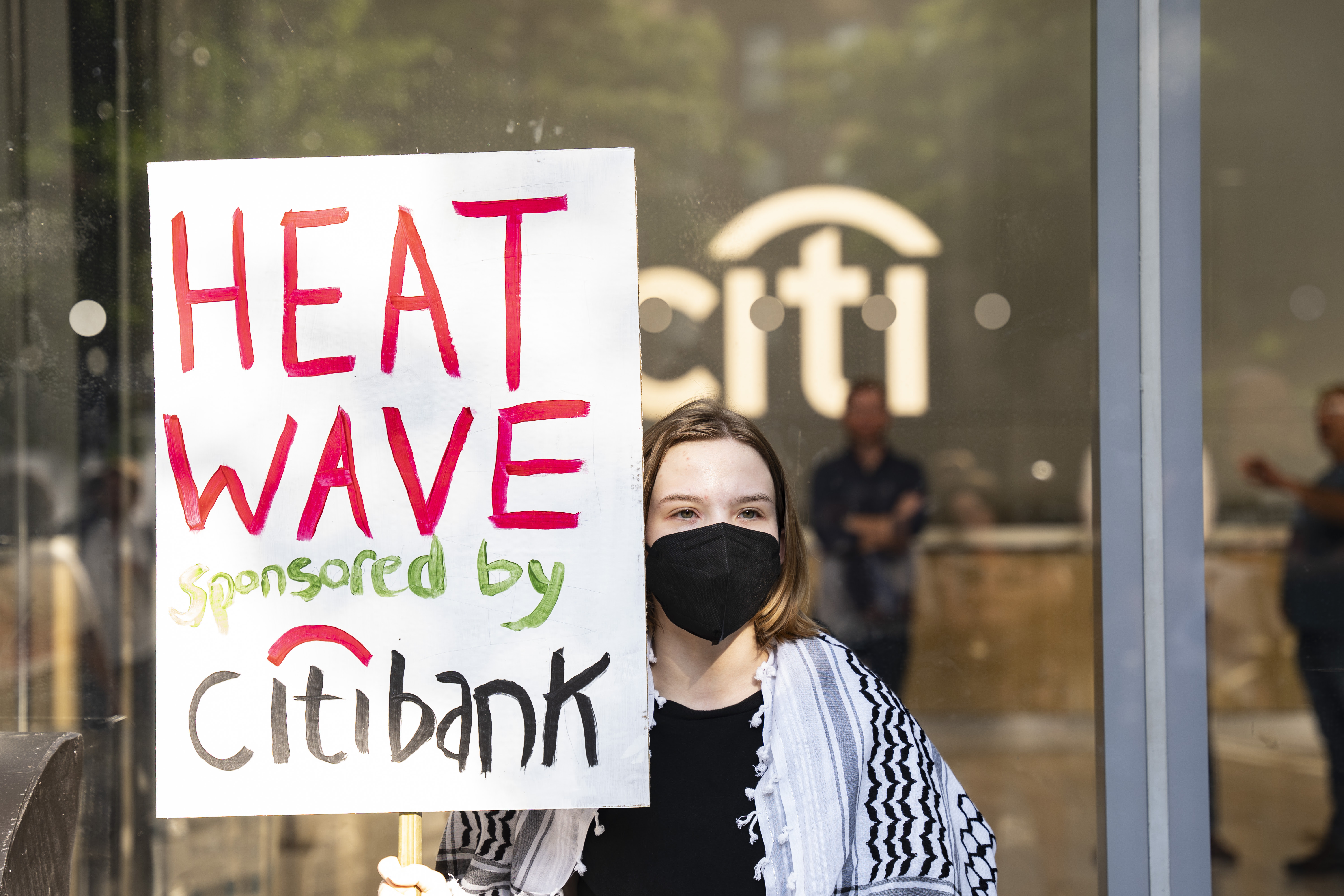
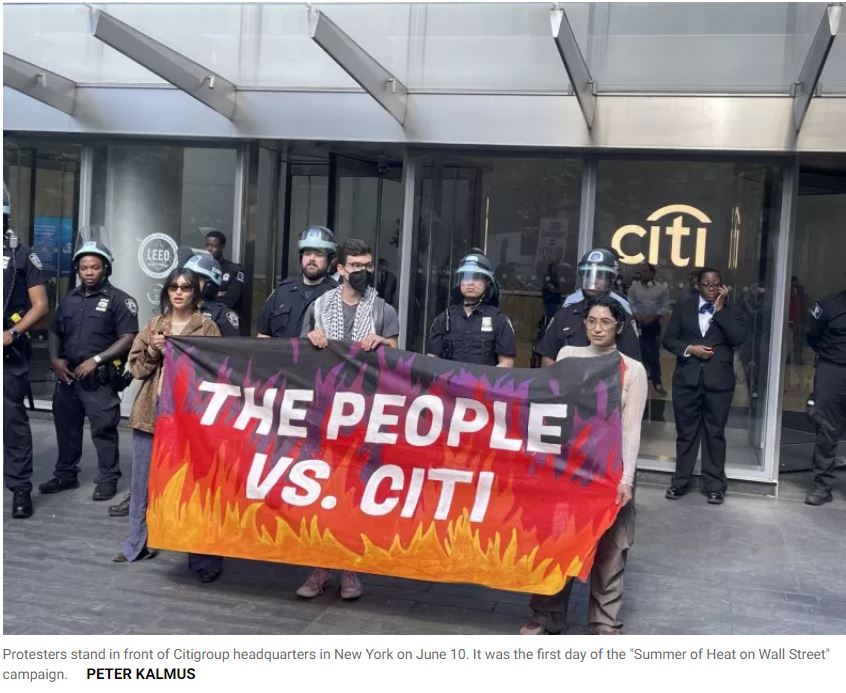
The third issue is monetary support for the courageous people of Stop the Money Pipeline who are putting pressure on CitiBank to stop funding fossil fuel projects and genocide in Israel (you can notify Citi you’re opposed their actions here). I wrote about the Summer of Heat campaign here. This from the latest Stop the Money Pipeline email:

In the last three weeks, we’ve helped organize sixteen actions on Wall Street financiers of fossil fuels, including seven civil disobedience protests at Citi’s HQ that have ended in more than 250 arrests.

As a result of our tireless organizing, our message is getting out.

Yesterday, ABC correctly reported that “fossil fuel projects in [the Gulf South] are devastating Black and Brown communities.” Reuters wrote that “Citi employees were alerted on Thursday to anticipate ‘significant protest’ activity on Friday.” The previous day, Bloomberg reported that our protracted campaign is beginning to wear on employees and executives alike.”

We aren’t deterred by all the arrests. Our resolve is only hardened: we will make our demand to end fossil fuels impossible to ignore by continuing disruptive, nonviolent civil disobedience.

That’s why we’ve been shutting down Citi’s HQ since early June – and why we’ll continue to be back week after week.

To sustain this fight, we need your help. Donate here to our legal and jail support fund. Every cent raised will support the courageous activists risking arrest week after week here in New York.

Again, any amount is helps! Thank you for reading this far and please know how much you’re appreciated. Solidarity! ✊🏽

His poetry and my photo

This morning I went into the backyard with the camera and came away with this image from one of our blooming Apache Plumes.

The image reminded me of dancing fairies, delicate and airy. Later, I received an update and thank-you email from a fundraising campaign, sponsored by the Gaza Poets Society, to evacuate two young children from Gaza. The email update stated that due to the continued closure of the Rafah border, the campaign is shifting from evacuation to sustainability (food and basic supplies), and donations of any amount are gratefully accepted.  The thank-you portion of the email was a PDF of the Gaza Poets Society Anthology.

As I read through the poems, Dance with Me made me think of my blooming Apache Plume, and I wanted to share the pairing here. His poetry and my photo, connected across the miles, in honor of our shared humanity.

Dance with Me – Mohammed Moussa

I’ll dance with you
under the rain
in love and pain;
on the seashore of hope
we will sing for life and joy.
We’ll dance
on behalf of absence
in the streets, and
on the outskirts of our city
we’ll flap our wings
lift joy and love
and sing
         and sing

Climate Movement Monday: declare a national climate emergency

Welcome back to another Movement Monday in which we discuss the climate crisis and take a quick action on behalf of people and planet. I don’t have a formal request for an action today, but suggest making phone calls and/or emailing Biden plus your two Senators and one Representative to report on what June has been like where you live. Is it hotter than usual? Windier than usual? Have there been wildfires, floods, tornados, tropical storms, drought, hail storms, etc.? How’s your air quality? Have you had to curtail physical activity? Have you lost insurance coverage due to climate risks?

A Bloomberg article from April stated “White House officials have renewed discussions about potentially declaring a national climate emergency, an unprecedented step that could unlock federal powers…” I don’t have a subscription so could only read that opening, but it seems like a good idea to let Biden and the Democrats know there’s broad support for the declaration of a climate emergency that would unlock all sorts of powers to take action.

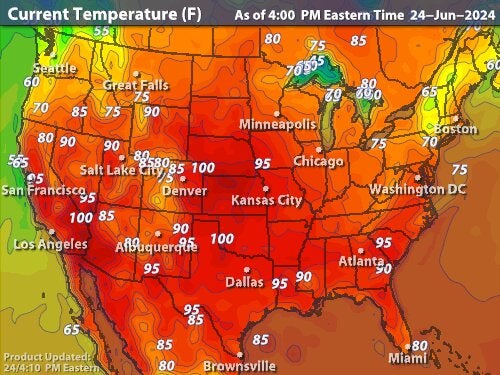
When I made calls today, I reported that despite it still being morning, the temperature in the Denver metro area was already above 90 degrees. I went on to say that while those elected officials possessed considerable power that could be used to mitigate the climate crisis, they were instead using that power to enable and support a genocide in Gaza, and total destruction of infrastructure via 262 days of nonstop bombing that was also accelerating the climate crisis. I pointed out that the majority of people do NOT want their tax dollars used to kill and destroy, and would prefer a climate emergency declaration that would get everyone working together to ensure the planet remains livable.

On a related note, last week organizer Kelly Hayes shared the link to a Truthout article Climate Refugees Are Occupying Abandoned Buildings in Southern Brazil. This not only ties in with Rosaliene Bacchus’s recent blog post, but also gave me a boost. People coming together to care for each other in time of tragedy.

“This is our lifeboat,” says Liziane Pacheco Dutra. She wears a thick black jacket. Her hair is pulled back in a pony tail. “We lost everything to the flood. We have nothing. We have no bed. No food. We were disrespected at the shelter, and here we have found a connection, care and open arms. We’ve made friends. The kids play together and we are looking after each other.”

People were not treated well in the shelters which are mostly run by middle and upper class people who show the working class little respect. Instead, people are forming communities in abandoned buildings.

It’s a profound sentiment and a symbol of what the occupation means for the nearly 60 families that live here.

I recommend reading the entire article which shows what happens when people come together for the common good. Reading it warmed my heart and filled me with hope for the many possibilities available to us. Shared humanity for the win!

Wherever you are, I hope your local temperatures and weather are moderate. I’d love if you shared details of your June in the comments and/or comments made to your elected officials. Either way, please take care and stay safe. Solidarity! ✊🏽

Day 261: it’s all connected, we’re all connected

On this 261st Day of Genocide in Gaza, I admit to being stunned that the carnage has not only not ceased, but has become increasingly depraved. I won’t go into details as the words and images are easily found due to IOF soldiers proudly documenting their depravity/lack of humanity on social media sites. To counteract the sadism, I decided to offer a poem by a Palestinian, and so went in search of something that resonated.

I landed on a poem by Mahmoud Darwish (1941-2008) who is “feted as Palestine’s national poet for his words expressing the longing of Palestinians deprived of their homeland, which was taken by Zionist militias to make way for present-day Israel. His poetry gave voice to the pain of Palestinians living as refugees and those under Israeli occupation for nearly a century.” And because this morning I began reading the Pulitzer Prize-winning Blood in the Water: The Attica Prison Uprising of 1971 and Its Legacy by Heather Ann Thompson, the Darwish poem I chose is “The Prison Cell.” Because just as the United States incarcerates more people than any country on earth (currently about 2 million people), Israel incarcerates thousands upon thousands of Palestinians and holds them without filing charges. It’s all connected. We’re all connected. And just as the incarcerated in the U.S. are treated as less-than and subjected to brutal conditions, so are the Palestinians. It doesn’t matter who we are or where we live on this planet: It’s all connected. We’re all connected.

In this spirit, I offer:

The Prison Cell
by Mahmoud Darwish
(Translated by Ben Bennani)

It is possible . . .
It is possible at least sometimes . . .
It is possible especially now
To ride a horse
Inside a prison cell
And run away . . .

It is possible for prison walls
To disappear,
For the cell to become a distant land
Without frontiers:

What did you do with the walls?
I gave them back to the rocks.
And what did you do with the ceiling?
I turned it into a saddle.
And your chain?
I turned it into a pencil.

The prison guard got angry.
He put an end to the dialogue.
He said he didn’t care for poetry,
And bolted the door of my cell.

He came back to see me
In the morning.
He shouted at me:

Where did all this water come from?
I brought it from the Nile.
And the trees?
From the orchards of Damascus.
And the music?
From my heartbeat.

The prison guard got mad.
He put an end to my dialogue.
He said he didn’t like my poetry,
And bolted the door of my cell.

But he returned in the evening:

Where did this moon come from?
From the nights of Baghdad.
And the wine?
From the vineyards of Algiers.
And this freedom?
From the chain you tied me with last night.

The prison guard grew so sad . . .
He begged me to give him back
His freedom.

—-

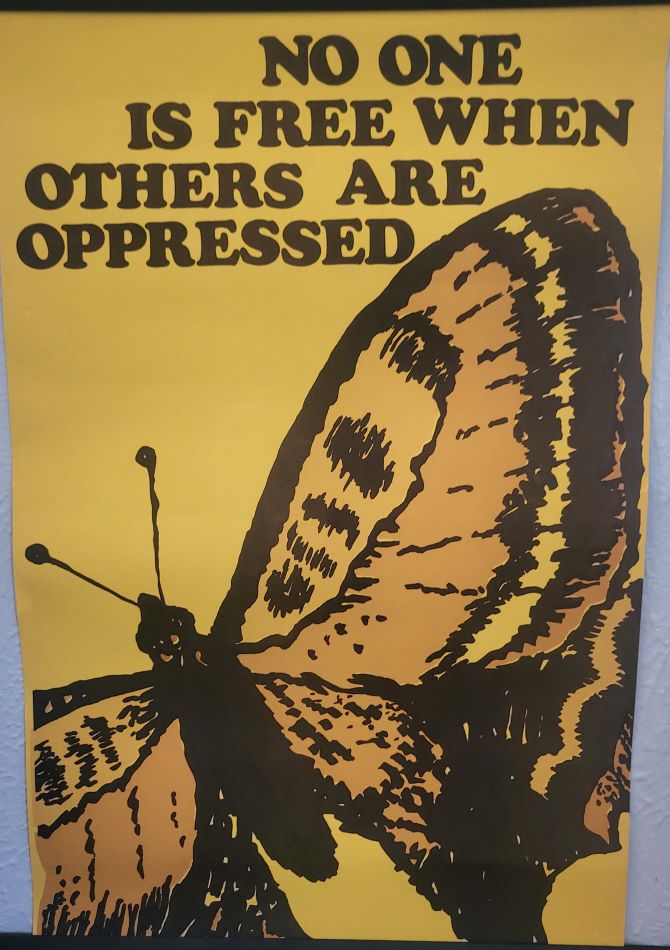
One final connection between Palestinians, the men in Attica in 1971, and me: this poster I unearthed in my basement yesterday, one I’d bought years ago (and possibly hung in my California classroom):


It’s all connected. We’re all connected.

Climate Movement Monday: Summer of Heat campaign

Welcome back to another Movement Mondays in which we discuss all things climate and then typically take a quick action or two (today’s suggestions from Stop the Money Pipeline will be to donate, make a phone call, and send personalized emails) in support of frontline communities, those enduring the worst of the climate crisis.

With record-breaking heat happening around the country, along with a whole lot of wildfires currently burning, it could be said that every single one of us lives in a frontline community. Here’s today’s wildfire map from FIRMS US/CANADA (Fire Information for Resource Management System US/Canada):

Each of those orange flame icons represents a current wildfire. And it’s precisely for this reason that last week, Stop the Money Pipeline launched their Summer of Heat campaign (scroll down at link for details and lots of good info, including this):

The clock is ticking. That’s why during the Summer of Heat, we’re taking joyful, relentless nonviolent direct action to end fossil fuel financing. 

Wall Street is bankrolling the coal, oil and gas companies that are polluting our communities and killing our planet. But we’re going to stop them.

We’re going hard all summer long. Week after week. Month after month. We’re taking the party to the streets and we won’t stop.

The following comes from the Stop the Money Pipeline newsletter sent last night:
It’s been quite the first week here in New York. We organized civil disobedience actions at Citibank’s global headquarters four days in a row: On Monday we blockaded every entrance with 150+ people. On Tuesday, we did it with a giant pod of orcas. On Wednesday, it was the turn of the scientists, including Dr. Sandra Steingraber and Dr. Peter Kalmus. And on Thursday we blockaded the headquarters with 200+ elders and 50+ rocking chairs.

On Friday, we held a block party in the plaza outside the HQ and in the midst of it all, we also found the time to disrupt a speech by Citibank’s Head of Wealth Management, Andy Seig. In total, 144 people were arrested this week, demanding an end to the financing of fossil fuels.

As someone who was arrested and jailed for climate protest, I know the risks these folks are taking on our behalf (especially risky now during an ongoing pandemic in which New York’s governor, Kathy Hochul, is threatening a statewide mask ban). Alec Connon, co-director of Stop the Money Pipeline, said in that newsletter he was jailed twice last week! If you can spare a few dollars, please donate to the legal fund set up for the summer’s planned actions. Twelve weeks of actions will land an awful lot of people in jail because the powerful elites are working overtime to crush dissent as climate collapse worsens. Note: today’s article from independent journalists at The Lever is Big Oil’s Plan to Criminalize Pipeline Protestors.

The following also comes from last night’s Stop the Money Pipeline newsletter:

The stakes of the climate fight cannot be overestimated. Already, at less than 1.5°C of warming, half of the world’s coral reefs have collapsed and millions of children are being displaced by climate-driven extreme weather events every year. If we don’t stop burning fossil fuels in the coming years, it will get so much worse.

Given these stakes, it feels good to be a part of a campaign that at least feels close to being commensurate with the scale of the crisis.

I take heart, too, in knowing that history shows how effective sustained campaigns of civil disobedience can be. Indeed, many of most significant advances in social justice of the past 150 years ― from women’s suffrage to desegregation to the many gains won by organized labor ― owe less to subtle, “respectable” maneuvering than to the disruptive campaigns and groups that first made the issues impossible to ignore, and then forced decision-makers to act.

I believe that will be true of the fight to end fossil fuels, too―and that civil disobedience will play a key role in turning Wall Street against the fossil fuel industry.

As we take a breath and prepare for another week of civil disobedience actions, there are several ways that you can support the Summer of Heat campaign, wherever you are.

You can take a few minutes to call Citi’s CEOemail a dozen of their top executives, or call them out on social media. If you have the means to do so, you can also make a donation to the Summer of Heat campaign here. We’ll put every cent to good use.

And, of course, if you’re really eager to jump in, you can also look up where the closest Citi branch is to you and plan an action; or you could even start to plan your trip to New York. June 28th would be a very good day to be in town…

In Solidarity
– Alec Connon, Stop the Money Pipeline coalition co-director

PS: Interested in checking out the media from the first week of Summer of Heat? The pick of the bunch is here: Newsweek, the HillSalonDemocracy Now – WednesdayDemocracy Now – ThursdayBloombergABC7AM NYNPRCommon Dreams, and the NY Post

As I end here, I want to highlight the TikTok video of the orcas blockading Citibank on Tuesday. (Warning: profanities).

Thank you for being here and please know I appreciate your efforts on behalf of people and planet. Solidarity! ✊🏽

Action needed: prioritize Palestinian refugees in U.S.

As you know, the United States is largely responsible for the genocide happening in Gaza right now. Tens of thousands dead, thousands more buried beneath rubble, and entire families wiped out by the U.S. bombs supplied to Israel. The reality is incredibly bleak. However, there’s an effort underway that could potentially save thousands of Palestinian lives, and that is to allow them to reunite with family members in the U.S.

This action info came to me via an email from MPOWER CHANGE:

Rep. Greg Casar, Sen. Dick Durbin, and Rep. Pramila Jayapal are leading a bicameral letter expressing strong support for a Priority-2 (P-2) designation under the U.S. Refugee Admissions Program (USRAP) for Palestinians in Gaza with family in the United States. The Biden administration is reportedly considering this policy change.1

Urge your U.S. Senators and Representative to sign on to the Casar-Durbin letter NOW:

Palestinians are so rarely granted U.S. refugee status that, of the over 60,000 refugees resettled in the United States in 2023, fewer than 0.1% were Palestinians.2

PLEASE take two minutes to personalize a letter to your representatives, demanding they ease some of the pain and suffering they’ve enabled by signing on to the Casar-Durbin letter.

Thank you in advance for your help. Solidarity! ✊🏽

  1. White House considers welcoming some Palestinians from war-torn Gaza as refugees,” CBS News, Apr. 30, 2024.
  2. Republicans want to ban Palestinian refugees from entering the U.S., but it’s already very hard for them to get in,” NBC News, Oct. 7, 2023

Olive Odyssey: olive oil from Palestine

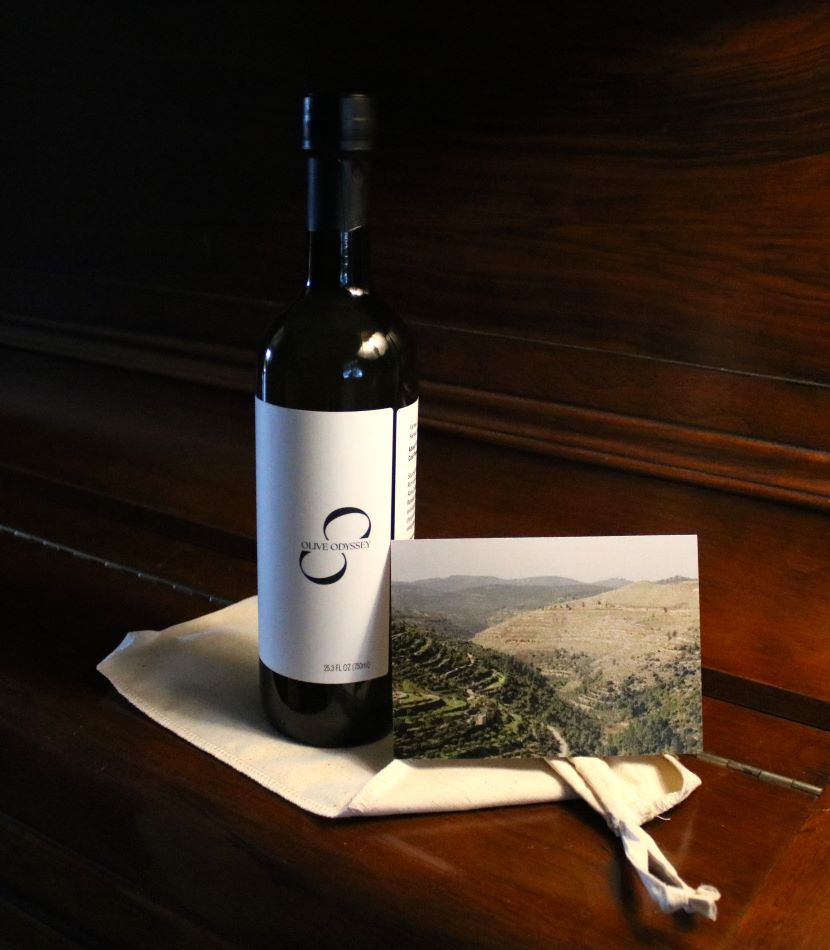
Zippy is the chef of our household (while I fill the role of “grateful eater of all he prepares”), and when he decided his cooking was in need of some olive oil from Palestine, he placed an order with Olive Odyssey. Our olive oil arrived today!

But we didn’t only receive the bottle of olive oil. The package also contained an organic fabric bag and a post card with the above picture on the front and this message on the back:

It feels so good to hold that bottle in our hands and feel the connection with Palestinian farmers who lovingly care for their olive trees, land, and traditions. Shared humanity for the win!

eta: I just realized the bottle has other info, including that this olive oil is from farmer  Abed Al-salam Bargouti and that it was sourced from “Rumi olive trees nestled in the hills of Aboud village at the heart of Palestine’s Ramallah region.”

Poppies for Palestine

As I walked past my neighbor’s poppies today, my thoughts went to Gaza because the poppy is the national flower of Palestine.

June 10, 2024

I’m grateful for these poppies, glorious and resilient in the face of our frequent heavy winds, since mine tend to live very short lives. Every year, they’re here and then gone. But despite my poppy experience, poppies are seen as a symbol of resilience:

The poppy symbolizes the resilience and enduring spirit of the Palestinian people. This designation stems from the flower’s pervasive presence in the region and its poignant representation in various cultural and historical contexts.

The red of the poppy symbolises the blood of the martyrs within this land. The colors of the poppy also mirror the colors of the Palestinian flag with red, black, white and green.

The poppy’s vibrant red petals are often seen as a metaphor for the bloodshed and sacrifices endured in the ongoing struggle for freedom and self-determination. Its ability to thrive in adverse conditions mirrors the steadfastness and hope of the Palestinian people amidst their challenging circumstances. The choice of the poppy as a national symbol is a powerful testament to the collective memory, cultural identity, and the unyielding quest for peace and sovereignty in Palestine.

Today I post these poppies in solidarity with the people of Gaza. From the river to the sea, Palestine will be free.

Friday Haiku: on freedom of the press

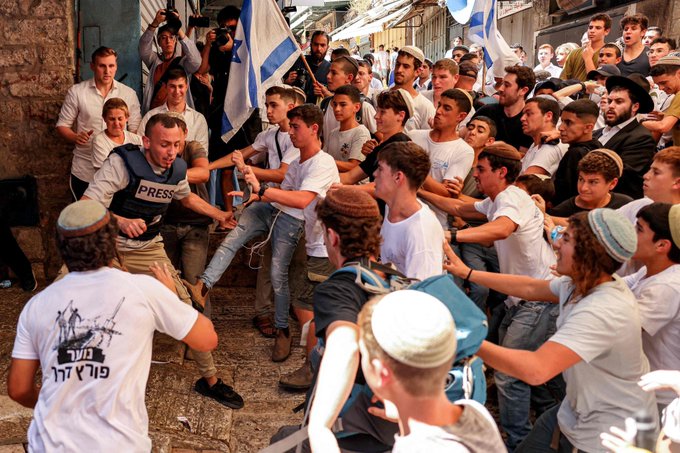
religious school mob
attacks journalist
supremacist frenzy

Note: this happened on June 5 in occupied Jerusalem during the “Flag March.” Palestinian journalist Saif Al-Qawasmi was attacked, first by students of a religious school and then beaten by Israeli police. Journalist Nir Hasson tried to protect Qawasmi and was also beaten. Hasson, who works for the newspaper Haaretz, took this photo. Other images can be seen here.

Climate Movement Monday: deadly heat in Gaza

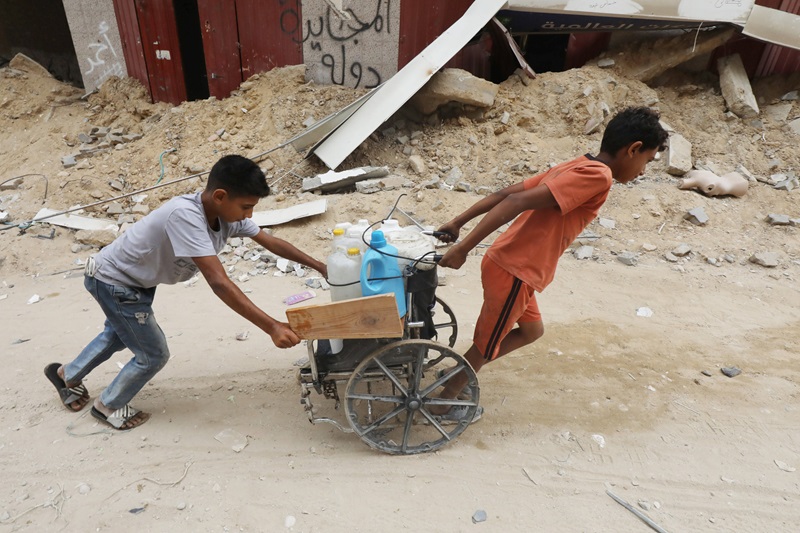
Welcome back to another Movement Monday in which we talk about the climate crisis and the communities already getting hit the hardest. Today’s post focuses on the people of Gaza who have not only been under attack since October–thousands and thousands of bombs raining down on them no matter where they go–but have also been under siege in terms of deprivation of food, water, medical supplies, and humanitarian aid.  On top of all that, displaced Palestinians faced a record-breaking heatwave that pushed temperatures over 100 degrees as they huddled in tents that became deathly hot. This article from Climate Home News points out the disparity between how the Israelis’ in Tel Aviv and Gazans living in refugee camps handle high temperatures. Spoiler alert:  people in Tel Aviv stay in their air-conditioned homes or travel to the sea to sit under beach umbrellas while Gazans forced to live in nylon tents are losing their children to heat stroke. This week, the temperatures will “only” be in the upper 80s and low 90s, but if you’ve ever slept in a tent not shaded by trees, you know how unbearably hot it gets inside.

Boys carry water bottles in Gaza on May 28, 2024. (Photo: Naaman Omar)

Here’s an excerpt from the Climate Home News article:
The predicament of Gazans forced to endure sweltering conditions in ill-equipped tents is not an isolated problem. Across the world, climate change and war are forcing more and more people out of their homes and into makeshift camps. More than 75 million people are currently displaced inside their own countries – 50% more than five years ago.

Read that last line again: More than 75 million people are currently displaced inside their own countries – 50% more than five years ago

If you’re like me, reading something like that can tip you precariously close to despair. But we can also have a different response. We can read something that feels overwhelmingly bad and ask ourselves “what can I do here and now to effect change?” Today I’m going to share some links for ways in which we can help Gazans.

  • MUNICIPALITY OF GAZA is working toward the restoration of sewage treatment, waste management, and access to clean water which will cut down on waterborne illnesses.  You can donate HERE (any amount helps!) If you appreciated Refaat Alareer’s work I shared here (including “If I must die, let it be a tale”), please note that he also ran the social media account for the Municipality of Gaza (@munigaza).
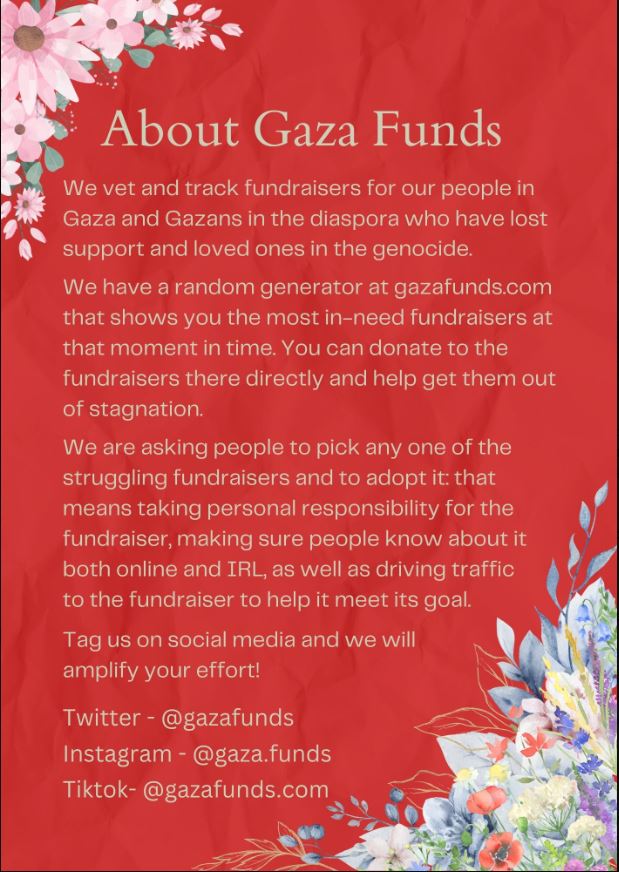
  • GAZA FUNDS is a project that connects people to crowdfunding campaigns for individuals and families from Gaza. Each time the page is reloaded, a different campaign appears. While the rotation is randomized, campaigns for the sick/injured and campaigns close to meeting their goals are prioritized. We never want any of these campaigns to go stagnant, so we make sure to also prioritize fundraisers that haven’t had a donation in a while. As existing fundraisers meet their goals, they will be replaced with other fundraisers that need your help. You can donate HERE. I’ve seen people on Twitter highlighting their $5 donations to several campaigns with the knowledge that those contributions add up as well as give Palestinians the much-needed boost of knowing they haven’t been forgotten by the rest of the world. (more info re the Gaza Funds volunteers here). Also, I’m including the below graphics that offer additional ideas on how to help plus social media account info.

One last note to help make the connection between the United States and what’s happening in Gaza: On May 31, multiple water mains in Atlanta burst and people were/are under a boil water advisory. Many parts of the city are still without water. As I write this, it appears there’s still no clear communication on the water situation and many Atlanta residents are calling out Mayor Andre Dickens for attending a fundraiser on Friday AFTER THE FIRST PIPE BURST. The water infrastructure failure further highlights that the push to build Cop City in Atlanta to the tune of $100 million is the absolute wrong “public safety” initiative needed when the city can’t even provide citizens clean, safe water.

If you’ve read this far, thank you for being here! We’re facing incredibly difficult realities, but we’re much stronger together. Solidarity!✊🏽

“Pocketful of Warding Stones” by Rasha Abdulhadi

The following poem and image were published at Poetry Online (a nonprofit organization dedicated to sharing literature and art accessibly) on October 21, 2023.
Pocketful of Warding Stones by Rasha Abdulhadi
how much of the weight of time we carry
is the burden the murderers gave us,
and whose ends do we serve to hate
ourselves for not dying as easy as they wanted?
what firekeeper can scrape
the char of guilt from this burnt offering,
pull air over embers of grief & longing,
find some flint in the heart left to light?
how can we untie living grief from the longing
to have done more, and find instead what
more could yet by our breath be done?
we can hold ourselves, responsible yes,
refuse a rebellion captive or complicit
confess instead a broader bravery
on which to spend the coin of our lives.
we who untangle loss from creation by blowing it to bits—
why obscure grief, why hoard it or hide its face,
as if a siphon could drain an ocean, no—
let them hear the holes when we sing.
every death in war is a casualty, no matter the speed
or how exhausted, how unscaffolded the rebuilding.
i know a hurricane who reached through years and state lines
into lungs hearts and bowels, and snatched souls back to flood.
when the disaster of war or the war of disaster steals homes it steals lives,
and though it may take time to cash them, we know where the blame lies.
we ward against the guilt of war
the blistered blessing of surviving our kin, and
around the undefused bombs our bodies hide,
we build a larger house to live in.
though the house of sorrow be vast,
give grief her rooms to stalk through
let living longing paint the walls.
can we then deny guilt, that rent-free tenant,
the lease it seeks in the house of grief?
refuse them victory on this field at least:
our breathing belongs to us
and is not some shame we owe or stole,
or failed to lose like they wanted us to—
our bellows blow to break knees bent over any neck.
i won’t devolve the monument of my body
to the keeping of the state, won’t donate
the corpse of my dreaming
to service the desires of murderers
or their gracious paperwork proctors.
i won’t do the blamework for them.
our mothers have been here before, they know
there’s no antidote for the poisons sown in the fields of war
but i will refuse the death machine of the imagination any morsel more
at least in my heart, the war can’t have you, my friend—
and wherever the last domino of my body falls,
let me land as a gear-breaking wedge—
the murder wheel won’t win my shame.
i won’t let them kill me before i die
and i offer you the same.
——————————-
Rasha Abdulhadi is calling on you, dear reader, to join them in refusing and resisting the genocide of the Palestinian people. Wherever you are, whatever sand you can throw on the gears of genocide, do it now. If it’s a handful, throw it. If it’s a fingernail full, scrape it out and throw. Get in the way however you can. The elimination of the Palestinian people is not inevitable. We can refuse with our every breath and action. We must.
On this Memorial Day

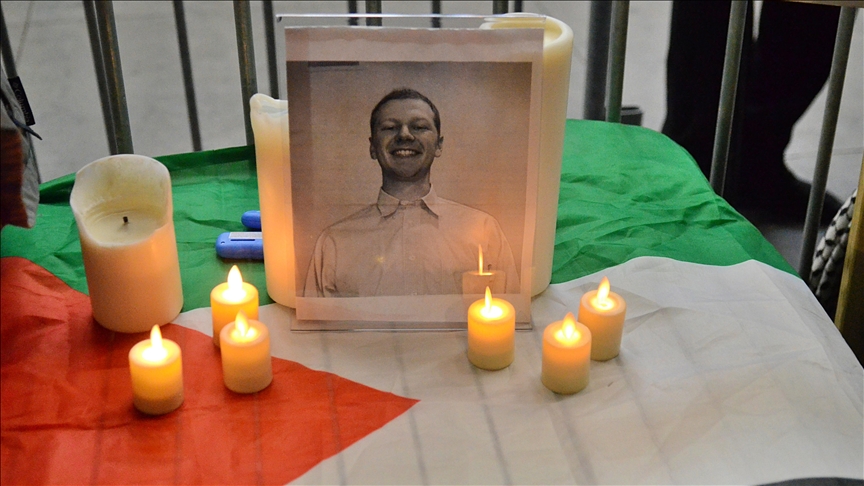
Today, as neighbors fly their red-white-and-blue flags and the U.S. government-sponsored slaughter of Palestinians in Rafah reaches new levels of horror, my thoughts are on Aaron Bushnell who was a 25-year-old active serviceman (U.S. Air Force). On February 25, Bushnell self-immolated in front of the Israeli Embassy in Washington. D.C.

Before setting himself on fire, Bushnell said this“I will no longer be complicit in genocide. I’m about to engage in an extreme act of protest, but compared to what people have been experiencing in Palestine at the hands of their colonizers it’s not extreme at all. This is what our ruling class has decided will be normal.”  His final words were “Free Palestine.”

I wanted to highlight Aaron Bushnell today, in part, because I also want to highlight the reality of the U.S. military that recruits desperate people who see no other way to build a future for themselves. Levi Pierpont went through basic training with Aaron Bushnell and the two became friends. After a year-long process, Pierpont was released from the military as a conscientious objector in 2023. In this opinion piece published after Bushnell’s death, Pierpont wrote of the talks he’d had with fellow service-people about wanting to get out of the military before their contracts expired:

During the process, I had so many conversations with fellow military members, a great many of whom could relate to the way I felt. One member spoke frankly with me, admitting that she had serious concerns with supporting the military. However, faced with the high costs of medical care outside the military, she commented: “If I have to sell my soul to the devil to get my children healthcare, that’s what I have to do.” [emphasis mine].

Think about that: because the elites have decided we in the U.S. can’t have universal healthcare, young people are forced to make the excruciating decision to inflict violence on strangers around the world–literally blowing up men, women, and children–so that their own children will get the medical care they need.

According to Pierpont, there are also those in the military who are unable to carry the burden of their role in violence and destruction. The above paragraph ends with this:  “Others were considering taking their lives as the only way to escape, and had no hope that they could make it to the end of their contract.”

I wonder how many of those flying flags today think about the despair felt by military personnel. How many of those flag-wavers would support service members who’ve served this country and now want out after realizing that what they’re being forced to do is an affront to their consciences and souls? What exactly does it mean to “support our troops”?

Today I honor Aaron Bushnell who made his own excruciating decision to very publicly protest the U.S.’s role in the genocide in Gaza. To be very clear, that’s not a death I wanted for him or for any of us who feel so much anger and despair about the slaughter and destruction being carried out in our names. Instead, I want an end to U.S. imperialism and the military industrial complex so that corporations no longer get rich off death and destruction. I want an end to people being forced to commit violence because their own country treats them violently via not providing for their material needs such as food, housing, healthcare, and clean air/water. In the meanwhile, I made a donation in honor of Bushnell and Pierpont to the non-profit Center on Conscience & War that “advocates for the rights of conscience, opposes military conscription, and serves all conscientious objectors to war.”

Aaron Bushnell’s final Facebook post (since removed) said this:
“Many of us like to ask ourselves, “What would I do if I was alive during slavery? Or the Jim Crow South? Or apartheid? What would I do if my country was committing genocide?”

The answer is, you’re doing it. Right now.”

Rest in power, Aaron Bushnell.

********

Final note: In reading more about Aaron Bushnell, I learned about an earlier act of self-immolation in December 2023 by an unidentified woman holding a Palestinian flag in New York City. At the time of the article’s publication, the woman remained hospitalized in stable condition.

Climate Movement Monday: FEMA, Puerto Rico, and renewable energy

Welcome back to Movement Mondays in which we discuss climate-related issues. Typically, I highlight a frontline community (people/place that’s bearing the worst effects of climate change) and then offer a quick action you can take on their behalf. Today I won’t ask you to take action and am, instead, merely offering info that triggered an aha moment when I read it. I’m all about sharing the aha wealth! 🙂

I considered myself fairly well-versed in the many ways that climate change is connected to various aspects of our lives. For instance, our physical and mental health, infrastructure, insurance premiums, poverty, racism, food, supply chains, etc. There’s really no escaping climate change’s many tentacles . But for all that awareness, I somehow never considered that the Federal Emergency Management Agency (FEMA) might play a major role in the continuation and acceleration of the climate crisis. I mean, FEMA’s job is to help people in the aftermath of disasters, so why would that agency take actions that ensure more climate-related disasters? Well, Center for Biological Diversity and a slew of other groups (energy justice , consumer and environmental) are suing FEMA for doing that very thing. From their May 2 press release:

Energy justice, consumer and environmental groups sued the Federal Emergency Management Agency and the Department of Housing and Urban Development today for withholding public records and failing to outline plans to use resilient renewable energy to rebuild communities ravaged by the climate emergency.

The groups also formally petitioned the agencies to craft new regulations to redirect taxpayer dollars these agencies are spending to prop up fossil fuels — the primary driver of human-caused climate change — toward distributed renewable energy recovery and mitigation projects. FEMA spent more than $14 billion last year in states across the country pummeled by floods, fires, hurricanes and other weather-related disasters made worse by burning oil, gas and coal.

The press release goes on to cite a 2018 congressional requirement that demands a definition of “resiliency” that could determine how much FEMA funding goes to environmental justice communities. When I read that, I realized how often “resilient” is thrown around (including by my own city’s “sustainability plan”) and how that term has become nearly meaningless in climate discourse. Because I’ve never asked my city to definite “resiliency,” I don’t even know if they have parameters or whether it’s just a feel-good word used to lull us into a false sense that something’s being done. My bet is on the latter.

I highly recommend reading the entire press release that also includes this reference to the Department of Housing and Urban Development: HUD also spends billions annually on public and assisted housing, further propping up the fossil-fuel economy, without significant effort to encourage the use of renewable energy.

I’m embarrassed to say I never thought about HUD being a willing accomplice in the climate crisis, either.

The press release ends with this: The proposed rules would redirect these funds, requiring that whenever the agencies provide energy funding, they prioritize efficiency and other demand reductions, zero-carbon technologies like rooftop solar and storage, and electric options for home heating and cooking rather than fossil gas.

After reading the press release, I went in search of more info and came across this excellent analysis of the lawsuit that highlights the disaster response in Puerto Rico: Lawsuit Challenges FEMA Funding to Rebuild Puerto Rico’s Fossil Fuel-Reliant Power Grid. The summary paragraph reads: Conservation and community groups filed a lawsuit today against the Federal Emergency Management Agency (FEMA) and the U.S. Department of Homeland Security over their plans to rebuild Puerto Rico’s centralized power grid from the return to the status quo of fossil fuels instead of investing in the distributed renewable energy that Puerto Ricans need.

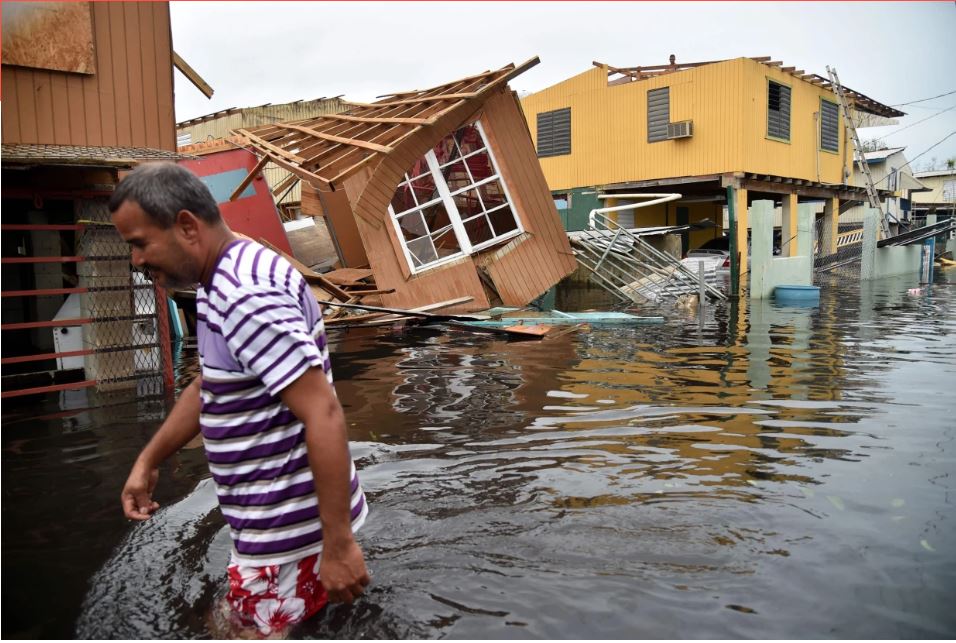
Catano, Puerto Rico, on Sept. 21, 2017.      Hector Retamal / AFP – Getty Images file

The entirety of Puerto Rico is a frontline community in the climate crisis! The United States colonized Puerto Rico in 1898, exploiting the people and land ever since. The analysis includes this: Five years after Hurricane Maria devastated Puerto Rico, causing thousands of deaths and decimating the archipelago’s already fragile electrical grid, FEMA is planning to finally spend funds intended to alleviate the consequences of natural disasters in making permanent repairs to the network. However, the agency plans to invest at least $12 billion in projects that lock Puerto Ricans into dependence on fossil fuels. The FEMA project conflicts with the Puerto Rico Law of 2019 that establishes the goal of basing 100% of energy production on renewable sources by 2050 and Puerto Rico’s energy plan based on the production and storage of solar energy.  

$12 billion is a HUGE investment in fossil fuels and, frankly, it’s grotesque that those billions would be used to prop up the very industry that caused Hurricane Maria. Why would FEMA do that, especially when Puerto Rico could generate enough renewable energy for its own needs? Well, perhaps it has something to do with this (from that same analysis): In 2021, Luma Energy, a private American-Canadian corporation, assumed control of the archipelago’s public distribution system. LUMA will be a major recipient of FEMA disaster recovery and mitigation funds. In January, Genera PR, a subsidiary of US liquefied natural gas company New Fortress Energy, was awarded a contract to take over power generation in Puerto Rico.

I haven’t done the research on this, but it’s fairly easy to surmise that politicians receive money from fossil fuel lobbyists and then pressure these agencies to grant funds to fossil fuel companies. Again, completely grotesque and also another example of how our government’s policies are solely driven by special interests.

My intention in posting all this is not to (further) demoralize anyone, but to shine light on what’s happening. We’re better positioned to call B.S. and fight back when we understand the intricacies of exploitation.

If you’ve read this far, thank you for being here with me. Solidarity with you, Puerto Rico, and frontline communities around the globe! ✊🏽

On this Mother’s Day

Just got home from the Auraria Campus solidarity encampment in Denver. Students have been camping on the Tivoli Quad for, I believe, 18 days now. Despite serious fear-mongering from ace reporter Jim Hooley, Zippy and I saw no signs of weaponry or human waste today.

What we did see was lots of love and admiration for the approximately 20 young people from the encampment who received diplomas during “The People’s Graduation.” We heard from one of those graduates who was introduced as an organizing wizard (in just six hours, they organized three actions that spanned twelve hours) and  also heard from faculty members who are in solidarity with the students. As always, the speeches at these pro-Palestine gatherings brought tears while also filling my heart with love and hope.

It was a wonderful way to spend this Mother’s Day and it felt very fitting that the rainy, overcast skies cleared, allowing the sun to shine down on the events. I’ll leave you with this poem shared by one of the speakers.

Solidarity on behalf of all children!

Hope and grief can coexist

I don’t know about you, but it’s increasingly difficult for me to get out of bed in the morning. So far, I’ve been able to rally my energy rather than remain curled in the fetal position with the covers pulled over my head, but today I feel the need to return to one of my favorite resources, LET THIS RADICALIZE YOU (mentioned earlier here).

Sandhill Cranes from March 11, 2024, here representing Hope and Grief

The wise Kelly Hayes and Mariame Kaba wrote a chapter titled “Hope and Grief Can Coexist” which is filled with wisdom from their decades of organizing. The following was written in conjunction with paragraphs about climate collapse, but also applies to our broader experience (emphasis mine):

We feel deeply for those who are suffering and for the young people who have inherited this era of catastrophe. We share in their heartbreak and fury.

We also know this: hope and grief can coexist, and if we wish to transform the world, we must learn to hold and to process both simultaneously. That process will, as ever, involve reaching for community.

In a society where fellowship and connection are so lacking, where isolation and loneliness abound, we are often ill equipped to process grief. [   ]  Grief can also lead us to retreat and recoil and, too often, to abandon people to suffer in ways that we cannot bear to process and behold. 

. . . we, as people, do have power. Depending on our choices, we can turn away from injustice and let it continue, or we can confront our grief and move forward to shift the course of societal action in the face of a massive failure of leadership and institutional abandonment. Grief, after all, is a manifestation of love, and our capacity to grieve is in some ways proportional to our capacity to care. Grief is painful, but when we process our grief in community, we are less likely to slip into despair.

Personally, it helps to view my grief as a manifestation of love, maybe because it’s a reminder of my sense of humanity and connection to others, which makes the pain feel almost welcome. Maybe this perspective does the same for you. Later in the chapter, Hayes and Kaba write:

When we talk about hope in these times, we are not prescribing optimism. Rather, we are talking about a practice and a discipline–what Joanna Macy and Chris Johnstone have termed “Active Hope.” As Macy and Johnstone write,

Active Hope is a practice. Like tai chi or gardening, it is something we do rather than have. It is a process we can apply to any situation, and it involves three key steps. First, we take a clear view of reality; second, we identify what we hope for in terms of the direction we’d like to see expressed; and third, we take steps to move ourselves or our situation in that direction. Since Active Hope doesn’t require our optimism, we can apply it even in areas where we feel hopeless. The guiding impetus is intention; we choose what we aim to bring about, act for, or express. Rather than weighing our chances and proceeding only when we feel hopeful, we focus on our intention and let it be our guide.

Hayes and Kaba continue: This practice of hope allows us to remain creative and strategic. It does not require us to deny the severity of our situation or detract from our practice of grief. To practice active hope, we do not need to believe that everything will work out in the end. We need only decide who we are choosing to be and how we are choosing to function in relation to the outcome we desire and abide by what those decisions demand of us.

This practice of hope does not guarantee any victories against long odds, but it does make those victories more possible. Hope, therefore, is not only a source of comfort to the afflicted but also a strategic imperative.

Whew. Just typing out those words helped center me in my grief and to feel those stirrings of hope all over again. My wish is that they do the same for you. Solidarity, friends!

Climate Movement Mondays: on crushing dissent

It’s another Movement Monday post in which we discuss climate-related issues. Typically, I highlight a frontline community–those facing the worst effects of the climate crisis–and then offer a quick action you can take on behalf of people and planet. Today’s post is a bit different and is intended to educate regarding the considerable efforts being made to crush dissent, whether it’s climate protest, pro-Palestine protest, or protest aimed at police brutality. Long story short: the powers that be want us to remain docile and accepting of the many injustices inflicted on people and the environment, and they do not take well to organized protest.

Image by StockSnap from Pixabay

Last week, I wrote about student protest and authoritarianism. We’ve all seen the images of heavily militarized police coming onto campuses to attack and arrest students for daring to, among other things, demand their tuition money not be invested in the manufacture of weapons used in the ongoing genocide of Palestinians. Here’s a video of Virginia State Police threatening UVA students on May 4th, the anniversary of the four students murdered by the National Guard on the Kent State campus in 1970. Over and over again, students are being threatened and brutalized by the police. (edited to add: Oddly enough, the police didn’t intervene at UCLA when pro-Palestinian students were literally being attacked and beaten by Zionists.)

It hasn’t escaped these young people’s attention that the same police who stood outside as children were being slaughtered in a classroom are all too willing to don riot gear to wade into crowds of unarmed people who’ve gathered on behalf of an oppressed people. In Texas, students chanted “You failed Uvalde.” Also? A week ago yesterday, white supremacists were allowed to march in Charleston, West Virginia. Where were the police and their riot gear?

The willingness to send heavily armed police onto campuses is just one facet of what’s happening in this country in anticipation of rising unrest due to climate collapse, income inequality, nonstop wars, broken supply chains, etc. There are many other signs pointing to how any one of us will be treated in the near future if we dare voice opposition to the status quo.

On May 3 (as police continued to brutalize students and faculty), Biden put out a statement renewing his pleas for Congressional support for his “Safer America Plan.” Biden wants “Congress to invest $37 billion to support law enforcement and crime prevention, including by funding 100,000 additional police officers…” We don’t have universal healthcare and are not at all prepared for the ravages of climate collapse, but there’s always money/support for more cops! But this is who Biden’s always been; in the 90s he joined forces with segregationist Strom Thurmond to sponsor and pass the “Violent Crime Control Act” and in  2022, Biden used his state of the union speech to encourage the use of $350 billion in COVID recovery funds to hire more police.

I’ve written about Cop City in Atlanta multiple times and highly recommend also reading my post that connects the dots between civic actions, protest, militarized police response, and trumped up charges of terrorism that result in RICO charges. You might wonder why we should care about Atlanta. Well, guess what? The proposed urban warfare training center in Atlanta is just one of 69 proposed cop training centers in the country. Go here for an interactive map showing the status of proposed sites around the U.S.

There’s more oppression on the horizon. From Truthout: In April, the House of Representatives passed HR 6408 by a vote of 382-11. This legislation would grant the secretary of the treasury broad power to designate any charity as a “terrorist supporting organization” and remove its tax-exempt status within 90 days. The Senate introduced its companion measure, S 4136, shortly after. While that article primarily focuses on pro-Palestinian organizations, climate journalists and activists have pointed out this legislation would also make it very easy to target climate nonprofits (and any other organization that threatens the status quo). This legislation is even more alarming with the knowledge there’s a very real chance Trump will get another four years in the White House. Somehow, the Dems and Republicans always find a way to come together in order to oppress the people.

For no particular reason, ahem, I want to link to this earlier post about the U.S. government’s decade-long campaign against the anti-pipeline movement.

And one last note on our current reality: the United States incarcerates more people than any other country in the world. Two million people are in jail or prison. Prison Policy Initiative breaks it down here with easy to read graphs and info.

Finally, I have a book to recommend: NO MORE POLICE: A CASE FOR ABOLITION by Mariame Kaba and Andrea J. Ritchie.

If you’ve read this far, give yourself a cookie! I appreciate you taking the time to wade into all this information. It’s a lot, but it’s important we know what’s happening. I’d love to hear your thoughts on this so please talk to me in the comments. Solidarity! ✊🏽