Deprogramming ourselves

Today I’m deviating from my usual Climate Movement Monday post to offer some info regarding what’s happening now between Palestine and Israel. We in the United States, whose government gives Israel’s military $3.8 billion per year, have been fed a narrative about the conflict between Israel and Palestine. We have been programmed to believe it’s a complex situation rather than clear-cut apartheid akin to South Africa. It can be intimidating to speak out on behalf of Palestinians because of the knee-jerk charges of anti-semitism, but the morality of the situation demands we do just that.

A boy waves a Palestinian flag, at the Israel-Gaza border, during clashes with Israeli troops, at a protest where Palestinians demand the right to return to their homeland, east of Gaza City, April 1, 2018.
(Reuters /Mohammed Salem)

I encourage you to read this October 7 piece from Haggai Matar “Gaza’s shock attack has terrified Israelis. It should also unveil the context. The dread Israelis are feeling after today’s assault, myself included, has been the daily experience of millions of Palestinians for far too long.”

Here’s an excerpt: “In Gaza, meanwhile, the ongoing siege is continuously destroying the lives of over two million Palestinians, many of whom are living in extreme poverty, with little access to clean water and about four hours of electricity a day. This siege has no official endgame; even an Israeli State Comptroller report found that the government has never discussed long-term solutions to ending the blockade, nor seriously considered any alternatives to recurring rounds of war and death. It is literally the only option this government, and its predecessors, have on the table.”

And for more background on the situation, Indigenous organizer, Kelly Hayes of Truthout, had an in-depth conversation with Palestinian American  organizer, Lea Kayali, on Kelly’s “Movement Memos” podcast (transcript provided) in May 2021. The title of this episode is “What the Mainstream Media Never Told You About Palestine.”

Here’s an excerpt, a quote from Lea Kayli: “Our resistance will actually always be called violence, even if no physical human beings are actually being harmed and I think the characterizations of, for example, the Boycott, Divestment and Sanction movement, sort of clarifies how that can happen, but that really, forces us to ask this question about what is violence? In the Palestinian context, Israel has one of the world’s largest and most well-financed military, bankrolled by of course, that 3.8 billion dollars of U.S. tax money a year. When we ask ourselves, what is violence, I’d highlight that life expectancy in Israel is 10 years higher than it is the West Bank and Gaza. The infant mortality rate in Gaza is more than five times higher than it is in Israel and several times higher than it is in the U.S.. Palestinians … and obviously, within the U.S. there’s massive disparities in those numbers as well, when we look at racial breakdown. And to me, this characterization is essential, because all of these things are forms of violence and Palestinians in every corner of historic Palestine are facing violent dispossession. So the reality is that the State of Israel does not want Palestinians to live. That is the core violence. Population control and demographic supremacy is literally baked into the idea of Zionism, as with any ethnostate, and it’s written into the laws of the country, as we talked about earlier.”
All of us who attended public schools in the United States are in need of deprogramming (on this and many other issues), and I hope you’ll take the time to read and think about how you might react if you and your ancestors had “endured 73 years of brutal colonization, brutal racial oppression and ongoing ethnic cleansing.”
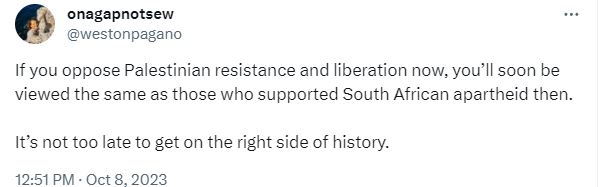
One way to show solidarity with Palestinian people’s fight for freedom, justice, and equality is to check out the BDS Movement (Boycott, Divest, Sanctions). Another is to have conversations with friends and families, especially those who believe the situation is too complex for them to hold an opinion. This tweet from a couple days ago really resonated with me:
Wishing you all a good week! We’re headed out for a camping trip and will be without internet connection, but I’d love to engage with you on this upon my return. Until then, solidarity! ✊🏽

Climate Movement Monday: Lahaina/Maui + good news

Welcome back to Movement Mondays in which I highlight a frontline community that’s bearing the brunt of climate change. Today I’m focusing on Maui and the town of Lahaina. The current death toll is 96, but officials believe that number will increase as the search continues for the estimated 1,000 missing persons.

Maui Fire Relief + Off-Grid Shelter Setup donations here
Maui Community Power Recover Fund donations here

The hall of historic Waiola Church in Lahaina and nearby Lahaina Hongwanji Mission are engulfed in flames along Wainee Street in Lahaina, Hawaii, Aug. 8, 2023. // Matthew Thayer/ | The Maui News | AP

Wildfires are not a natural force in Hawaii’s islands and used to be a rare occurrence. “Hawaii’s ecosystem is not adapted to fire. It is destroyed by fire,” says Elizabeth Pickett, co-executive director of the Hawaii Wildfire Management Organization. “So we don’t have good fire and bad  fire. We have bad fire, period.” That quote comes from the WIRED article “The Scary Science of Maui’s Wildfires” that also includes background on the invasive grass species introduced by European settlers, grasses that have spread across the island and are intensely fire-prone.

Emily Atkin wrote in her HEATED newsletter (Lahaina used to be a wetland: Nature didn’t turn the historic Hawaiian community into a tinderbox. People did.”) how the fire that decimated Lahaina wasn’t entirely due to climate change. Colonialism played a huge role in what happened there, specifically European colonizers who illegally diverted the water for their sugar crops, turning a former wetlands into a tinderbox susceptible to the deadly combination of fire and high winds.

Maui Fire Relief + Off-Grid Shelter Setup donations here
Maui Community Power Recover Fund donations here

There’s huge concern that disaster capitalists will use this tragedy to further enrich themselves while driving Indigenous people from their lands. Realtors and investors are already calling families that have lost their homes to the fire, offering to buy the land. Oprah Winfrey owns 2,000 acres on Maui where she lives part-time, and there are calls for her to donate that acreage back to the Indigenous community. The Landback Movement to get Indigenous lands back in Indigenous hands is gaining exposure and momentum in the wake of the fire.

The people of Maui are going to need much more than thoughts and prayers as they rebuild their communities. Thank you in advance for helping out as you can. I send wishes for a good and safe week, wherever you are! Solidarity! ✊🏽

P.S. — here’s a bit of GOOD NEWS: “Judge rules in favor of Montana youths in landmark climate decision”