Climate change: we’re the cause but we can also be the solution

It’s a Wednesday, but I’m offering what would usually be a Climate Movement Monday post because the synchronicity of the two elements contained here was just too perfect to pass up. Below, I offer information on hurricanes and then a quick action.

As Hurricane Milton bears down on Florida while millions struggle to recover from Helene (mutual aid links here), I received two connected emails. The first, from HEATED which is billed as “a newsletter for people who are pissed off about the climate crisis,” was their latest article titled “How fossil fuels mutated Milton: Climate scientists tell HEATED the historic storm represents “the profound irresponsibility and culpability” of polluters.”

I highly recommend reading the entire piece which begins: For scientists who study the effects of climate change, the scariest thing about Hurricane Milton is not simply its historic strength. It’s the fact that Milton grew so strong so quickly—mutating from a pipsqueak into a monster. 
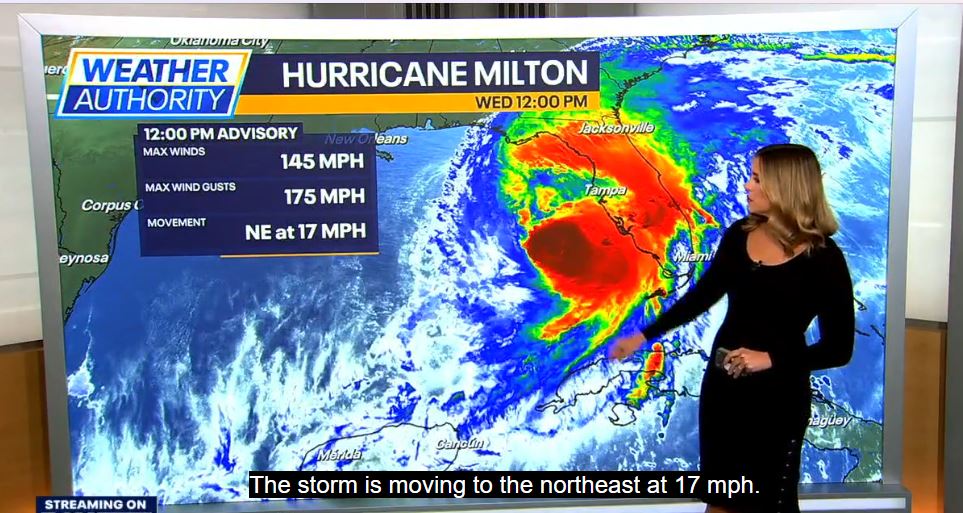
screen grab from a news broadcast

Milton’s rapid intensification from a tropical storm to a Category 5 hurricane left meteorologists speechless, with one veteran NBC6 Miami scientist tearing up on air. On X, hurricane scientists described Milton’s sudden explosion as “unprecedented,” “terrifying,” and “jaw-dropping,” as the storm’s wind speeds grew from 60 mph to over 180 mph in only 36 hours—one of the fastest intensifications on record.

A similarly rapid hurricane intensification happened just weeks earlier with Hurricane Helene, which transformed from a relatively weak tropical storm into a historic Category 4 hurricane within two days.

The article goes on to quote climate scientist Michael Mann who points the finger at the fossil fuel industry which is responsible for 76 percent of greenhouse gas emissions. “ExxonMobil’s own scientists warned that continued fossil fuel burning would lead to “potentially catastrophic events,” Mann said. That those catastrophes are playing out today represents “the profound irresponsibility and culpability of a fossil fuel industry that knowingly hid evidence of the tremendous danger of their product—not just danger to individuals … but danger to humanity and the planet. A whole higher category of crime.”

The article continues, including an explanation of how warmer sea temperatures contribute to the strength and size of tropical storms. Then the article ends with this quote from hurricane scientist Andra Garner (emphasis mine):

“The bad news here is that we know that human-caused climate change is driving these kinds of extremes to be more deadly,” said Garner. “But the good news is that we are the cause, and so we can also be the solution.

That bears repeating: We are the cause of climate change which means we can also be the solution.

Right after reading that HEATED article, I returned to my inbox to find an email from Stand.earth. That email opened with: “Exciting news! Late last month, Philadelphia, PA, became the latest city to join the growing chorus of municipal and sub-national governments to officially call for a Fossil Fuel Non-Proliferation Treaty. Not only is Philadelphia one of the largest cities in North America, it’s also located in Pennsylvania, a state dominated by fracking. It’s proof that our movement is even reaching areas where the fossil fuel industry is most powerful.”

The email then offers a link to send a message to your local city council, asking for them to call for a Fossil Fuel Non-Proliferation Treaty. What are the principles of such a treaty?

  1. Non-proliferation: Stop building out the problem by ending the expansion of coal, oil and gas production
  2. A fair phase-out: An equitable plan for the wind down of existing fossil fuel production, where nations with the capacity and historical responsibility for emissions transition fastest, providing support to others around the world
  3. Just transition: Fast-track the adoption of renewable energy and economic diversification away from fossil fuels so that no worker, community or country is left behind

Please take a minute to urge your city to join the call for a Fossil Fuel Non-Proliferation Treaty and start working on the just transition in your community.

It was SO easy to send a message to all my city council members and mayor. I personalized (and shortened) the letter to make my point which I must say felt extra personal since one of those council members lives right down the street from me. We’ve seen horrific climate policy on the federal level and the Democrat’s presidential nominee, Kamala Harris, now contradicts her earlier campaign vow to ban fracking, but local communities offer a greater chance for citizens to make an impact. Please take a moment to reach out to your city council to let them know how you feel about the role of fossil fuels in these catastrophic hurricanes which are destroying lives and property.

Thank you for reading this far! I appreciate you being here. Solidarity! ✊🏾
Climate Movement Monday: turning the fossil fuel narrative on its head

Welcome back to Movement Mondays in which we discuss all things climate. Today I’m returning to Not Too Late: Changing the Climate Story from Despair to Possibility (edited by Rebecca Solnit & Thelma Young Lutunatabua) in order to offer my readers another lens to look at our climate reality while also imagining a better world.

At the start of the chapter “Different Ways of Measuring: On Renunciation and Abundance” (a conversation between Solnit and Lutunatabua), there’s this quote from Dr. Elizabeth Sawin:

“It is some very effective marketing that has convinced so many of us that getting off of fossil fuels is a sacrifice as opposed to a money-saving, peace-promoting, water-protecting, health-improving, technological leap forward.”

This jumped out at me because whenever I (foolishly) read comments about various climate actions (and it doesn’t matter if it’s folks politely demanding better of their government or Climate Defiance interrupting fossil fuel executives as they’re being celebrated), there are always people who ridicule the activists for imagining a world without fossil fuels. Those naysayers insist the many negative consequences  we’re experiencing in real-time are a given and that there’s no way forward that doesn’t include fossil fuels. A frequent commenter “gotcha” is “Did you drive your car to that action?” which reveals a complete lack of imagination in regards to our woefully inadequate public transportation, connected biking routes, etc.

Directly following Sawin’s quote, Solnit eloquently presents a different perspective that I’d love to copy and paste in reply to those cynical comments.

What if the climate crisis requires us to give up the things we don’t love and the things that makes us poorer, not richer? What if we have to give up the foul contamination around fossil-fuel extraction, the heavy metals people inhale when coal is burned around them, the oil refineries that contaminate the communities of color around them from the Gulf of Mexico to California? What if the people of Richmond in my own home region, the Bay Area, didn’t have emergency alerts where they were supposed to seal their homes because of a refinery leak? What if the incidence of asthma in kids went way down, and we stopped losing almost nine million people a year to pollution worldwide? What if that moment when the pandemic shut down so much fossil-fuel burning that people in parts of northern India saw the Himalayas for the first time in decades became permanent?   

I don’t know about you, but reading those words expanded my mind and heart, while reaffirming my belief in a better world. Kicking our fossil fuel addiction won’t set us back, but will instead liberate us to live healthier, happier lives.

If you’re interested, here’s an article about the visible Himalayas, including grateful social media posts:  Peaks of Himalayas visible from parts of India for first time in decades as pollution drops amid lockdown. And if these quotations resonated with you and you’re interested in reading more, Not Too Late is available through Haymarket Books and is currently offered at a discount.

Thank you for reading this far and please know I welcome all thoughts and comments below (spoiler: no, I did not drive my car to this post). Until next time, solidarity! ✊🏽

Climate Movement Monday: FEMA, Puerto Rico, and renewable energy

Welcome back to Movement Mondays in which we discuss climate-related issues. Typically, I highlight a frontline community (people/place that’s bearing the worst effects of climate change) and then offer a quick action you can take on their behalf. Today I won’t ask you to take action and am, instead, merely offering info that triggered an aha moment when I read it. I’m all about sharing the aha wealth! 🙂

I considered myself fairly well-versed in the many ways that climate change is connected to various aspects of our lives. For instance, our physical and mental health, infrastructure, insurance premiums, poverty, racism, food, supply chains, etc. There’s really no escaping climate change’s many tentacles . But for all that awareness, I somehow never considered that the Federal Emergency Management Agency (FEMA) might play a major role in the continuation and acceleration of the climate crisis. I mean, FEMA’s job is to help people in the aftermath of disasters, so why would that agency take actions that ensure more climate-related disasters? Well, Center for Biological Diversity and a slew of other groups (energy justice , consumer and environmental) are suing FEMA for doing that very thing. From their May 2 press release:

Energy justice, consumer and environmental groups sued the Federal Emergency Management Agency and the Department of Housing and Urban Development today for withholding public records and failing to outline plans to use resilient renewable energy to rebuild communities ravaged by the climate emergency.

The groups also formally petitioned the agencies to craft new regulations to redirect taxpayer dollars these agencies are spending to prop up fossil fuels — the primary driver of human-caused climate change — toward distributed renewable energy recovery and mitigation projects. FEMA spent more than $14 billion last year in states across the country pummeled by floods, fires, hurricanes and other weather-related disasters made worse by burning oil, gas and coal.

The press release goes on to cite a 2018 congressional requirement that demands a definition of “resiliency” that could determine how much FEMA funding goes to environmental justice communities. When I read that, I realized how often “resilient” is thrown around (including by my own city’s “sustainability plan”) and how that term has become nearly meaningless in climate discourse. Because I’ve never asked my city to definite “resiliency,” I don’t even know if they have parameters or whether it’s just a feel-good word used to lull us into a false sense that something’s being done. My bet is on the latter.

I highly recommend reading the entire press release that also includes this reference to the Department of Housing and Urban Development: HUD also spends billions annually on public and assisted housing, further propping up the fossil-fuel economy, without significant effort to encourage the use of renewable energy.

I’m embarrassed to say I never thought about HUD being a willing accomplice in the climate crisis, either.

The press release ends with this: The proposed rules would redirect these funds, requiring that whenever the agencies provide energy funding, they prioritize efficiency and other demand reductions, zero-carbon technologies like rooftop solar and storage, and electric options for home heating and cooking rather than fossil gas.

After reading the press release, I went in search of more info and came across this excellent analysis of the lawsuit that highlights the disaster response in Puerto Rico: Lawsuit Challenges FEMA Funding to Rebuild Puerto Rico’s Fossil Fuel-Reliant Power Grid. The summary paragraph reads: Conservation and community groups filed a lawsuit today against the Federal Emergency Management Agency (FEMA) and the U.S. Department of Homeland Security over their plans to rebuild Puerto Rico’s centralized power grid from the return to the status quo of fossil fuels instead of investing in the distributed renewable energy that Puerto Ricans need.

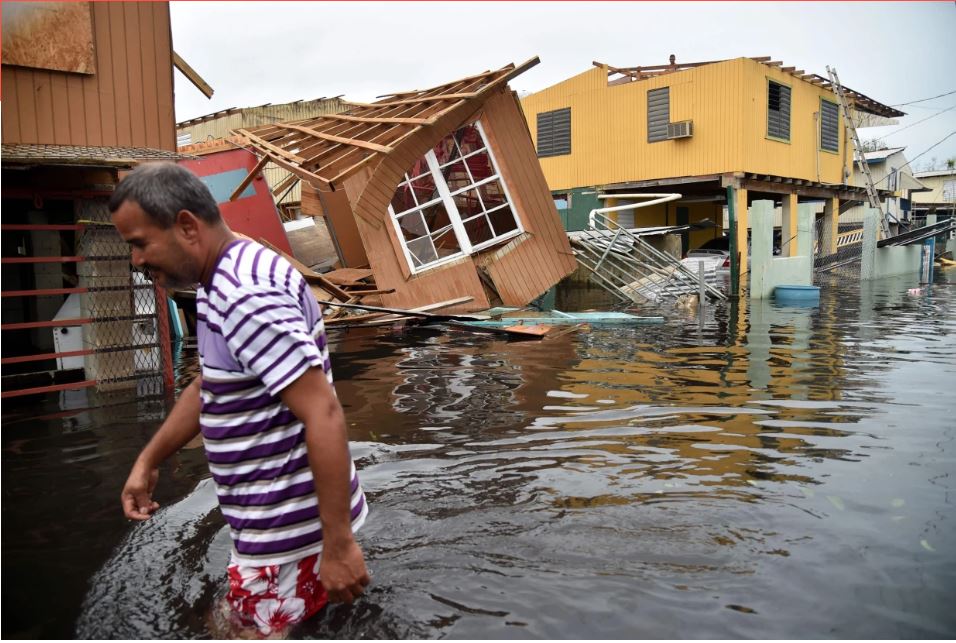
Catano, Puerto Rico, on Sept. 21, 2017.      Hector Retamal / AFP – Getty Images file

The entirety of Puerto Rico is a frontline community in the climate crisis! The United States colonized Puerto Rico in 1898, exploiting the people and land ever since. The analysis includes this: Five years after Hurricane Maria devastated Puerto Rico, causing thousands of deaths and decimating the archipelago’s already fragile electrical grid, FEMA is planning to finally spend funds intended to alleviate the consequences of natural disasters in making permanent repairs to the network. However, the agency plans to invest at least $12 billion in projects that lock Puerto Ricans into dependence on fossil fuels. The FEMA project conflicts with the Puerto Rico Law of 2019 that establishes the goal of basing 100% of energy production on renewable sources by 2050 and Puerto Rico’s energy plan based on the production and storage of solar energy.  

$12 billion is a HUGE investment in fossil fuels and, frankly, it’s grotesque that those billions would be used to prop up the very industry that caused Hurricane Maria. Why would FEMA do that, especially when Puerto Rico could generate enough renewable energy for its own needs? Well, perhaps it has something to do with this (from that same analysis): In 2021, Luma Energy, a private American-Canadian corporation, assumed control of the archipelago’s public distribution system. LUMA will be a major recipient of FEMA disaster recovery and mitigation funds. In January, Genera PR, a subsidiary of US liquefied natural gas company New Fortress Energy, was awarded a contract to take over power generation in Puerto Rico.

I haven’t done the research on this, but it’s fairly easy to surmise that politicians receive money from fossil fuel lobbyists and then pressure these agencies to grant funds to fossil fuel companies. Again, completely grotesque and also another example of how our government’s policies are solely driven by special interests.

My intention in posting all this is not to (further) demoralize anyone, but to shine light on what’s happening. We’re better positioned to call B.S. and fight back when we understand the intricacies of exploitation.

If you’ve read this far, thank you for being here with me. Solidarity with you, Puerto Rico, and frontline communities around the globe! ✊🏽