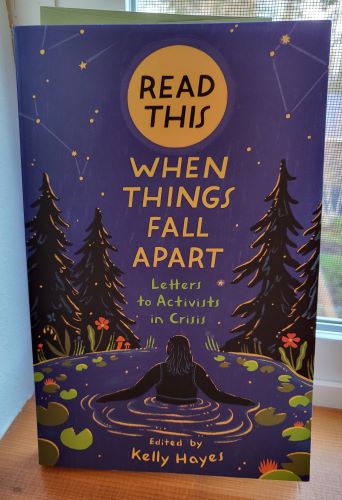
From Kelly Hayes: Mahmoud Khalil and the Repression That Was, Is, and Will Be

I’m not only grateful for my move to Washington, but also the distraction from the horrors being inflicted upon us by the authoritarians. However, I can’t keep my head down forever and today want to share an important read from Kelly Hayes: Mahmoud Khalil and the Repression That Was, Is, and Will Be.

Mahmoud Khalil is a Columbia University student, Palestinian activist, and permanent resident of the U.S. with a Green card who was abducted by ICE a week ago in retaliation for pro-Palestinian activities. The government agents removed Khalil from his housing against the protestations of Khalil’s wife who is eight months pregnant with their first child.

This is incredibly dangerous and ominous territory. And what makes it even worse is that there’s not an opposition party in this moment. The Democrats have made it clear via their support for genocide and the brutalization of students who speak out against that genocide that they will not magically become better people who will fight for civil liberties for all.

As Palestinian activist and University of Chicago professor Eman Abdelhadi recently told me, “The abduction of Mahmoud Khalil represents a major escalation in the wars against political freedom, higher education and Palestine activism that this administration is waging.” Abdelhadi noted that these wars are intertwined. “Palestine solidarity activists have faced repression and criminalization for decades, and these escalated to unprecedented levels with the assault on Gaza that began in October 2023.” Abdelhadi noted that participants in the Palestine solidarity movement have long warned that the repression being waged against them was setting the stage for greater escalations. “We warned, over and over, that the repression we were facing was setting a dangerous precedent,” she said. “Democrats and college administrators didn’t listen.” 

Abdelhadi says that by treating Palestinians and their allies as “fair game for repression,” Democratic officials and college administrators “opened the door for the far right to strip away constitutional protections from everyone.” 

“Trump is waltzing through the door that liberals opened for him, and we are all suffering for it,” Abdelhadi said. “It is clear this administration is testing what we are willing to tolerate, what we are willing to sit through. If Mahmoud Khalil has no rights, none of us do.”

We cannot afford to look the other way, to tell ourselves this is an isolated case. They are coming for all of us.

They came for Mahmoud Khalil in the night, and they will come for us, too. They will come with immigration raids. They will come for us with AI searches, scraping our data, and compiling massive lists of political targets. They will come with RICO charges, as they have for Cop City protesters in Atlanta. They will come with bizarre allegations of “fraud.” They will accuse us of supporting and abetting terrorism. They will terrorize us, criminalize us, and attempt to silence us. Now is the time to speak out and to “flood the zone,” as Scot Nakagawa writes. 

As protests and support efforts for Khalil continue, we should all uplift demands for his freedom.

Do what you can, where you can.

Please read and share Mahmoud Khalil and the Repression That Was, Is, and Will Be.


You should have joy and pleasure

When reading this week’s newsletter “Organizing My Thoughts” from Kelly Hayes this morning, a quote jumped out at me. It came via the linked piece from Lewis Raven Wallace “The Right Wants Us to Submit to Nihilism. Here Is Where I’m Searching for Hope.”

“You should have joy and pleasure from being on the right side of history,” [ . . ], “not anguish and despair. Let the other people have that.”

My first yellow leaves of the season. Golden Gate Canyon State Park. August 30, 2024

Wallace continues with this:
Joy is not just icing on the cake or the purview of the privileged. It is an exercise in hope that has always been rigorously practiced by people facing impossible situations of oppression. Laughter, pleasure and small acts of connection are precisely where we find our power — and the soul fuel that makes it possible to go on.

Anyway, that sentiment helped me a lot today–helped me remember who and what I am–and I wanted to share in case it could help someone here. Let’s hold onto our shared humanity and refuse to let the horrors and ugliness turn us into shells of ourselves. Let’s rejoice in nature and each other, and laugh as much as possible.

The fear-based, mean-spirited people can keep all that ugly for themselves.

Hope and grief can coexist

I don’t know about you, but it’s increasingly difficult for me to get out of bed in the morning. So far, I’ve been able to rally my energy rather than remain curled in the fetal position with the covers pulled over my head, but today I feel the need to return to one of my favorite resources, LET THIS RADICALIZE YOU (mentioned earlier here).

Sandhill Cranes from March 11, 2024, here representing Hope and Grief

The wise Kelly Hayes and Mariame Kaba wrote a chapter titled “Hope and Grief Can Coexist” which is filled with wisdom from their decades of organizing. The following was written in conjunction with paragraphs about climate collapse, but also applies to our broader experience (emphasis mine):

We feel deeply for those who are suffering and for the young people who have inherited this era of catastrophe. We share in their heartbreak and fury.

We also know this: hope and grief can coexist, and if we wish to transform the world, we must learn to hold and to process both simultaneously. That process will, as ever, involve reaching for community.

In a society where fellowship and connection are so lacking, where isolation and loneliness abound, we are often ill equipped to process grief. [   ]  Grief can also lead us to retreat and recoil and, too often, to abandon people to suffer in ways that we cannot bear to process and behold. 

. . . we, as people, do have power. Depending on our choices, we can turn away from injustice and let it continue, or we can confront our grief and move forward to shift the course of societal action in the face of a massive failure of leadership and institutional abandonment. Grief, after all, is a manifestation of love, and our capacity to grieve is in some ways proportional to our capacity to care. Grief is painful, but when we process our grief in community, we are less likely to slip into despair.

Personally, it helps to view my grief as a manifestation of love, maybe because it’s a reminder of my sense of humanity and connection to others, which makes the pain feel almost welcome. Maybe this perspective does the same for you. Later in the chapter, Hayes and Kaba write:

When we talk about hope in these times, we are not prescribing optimism. Rather, we are talking about a practice and a discipline–what Joanna Macy and Chris Johnstone have termed “Active Hope.” As Macy and Johnstone write,

Active Hope is a practice. Like tai chi or gardening, it is something we do rather than have. It is a process we can apply to any situation, and it involves three key steps. First, we take a clear view of reality; second, we identify what we hope for in terms of the direction we’d like to see expressed; and third, we take steps to move ourselves or our situation in that direction. Since Active Hope doesn’t require our optimism, we can apply it even in areas where we feel hopeless. The guiding impetus is intention; we choose what we aim to bring about, act for, or express. Rather than weighing our chances and proceeding only when we feel hopeful, we focus on our intention and let it be our guide.

Hayes and Kaba continue: This practice of hope allows us to remain creative and strategic. It does not require us to deny the severity of our situation or detract from our practice of grief. To practice active hope, we do not need to believe that everything will work out in the end. We need only decide who we are choosing to be and how we are choosing to function in relation to the outcome we desire and abide by what those decisions demand of us.

This practice of hope does not guarantee any victories against long odds, but it does make those victories more possible. Hope, therefore, is not only a source of comfort to the afflicted but also a strategic imperative.

Whew. Just typing out those words helped center me in my grief and to feel those stirrings of hope all over again. My wish is that they do the same for you. Solidarity, friends!