“On Why We Still Hold Onto Our Phones and Keep Recording” by Asmaa Abu Mezied

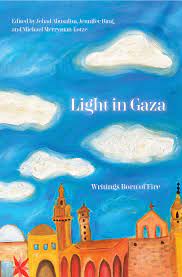
This essay is from Light in Gaza: Writings Born of Fire (August 2022) which is available as a free ebook from Haymarket Books. As the U.S. continues to fund and supply bombs for Israel’s genocidal campaign and as the corporate media continues to portray Palestinians as non-persons (even as Israel targets Palestinian journalists for assassination), the images captured by Palestinian civilians often provide the only window into their horrific reality.

Here, though, from Asmaa Abu Mezied, is a powerful explanation for the intent behind those photos and videos.

On Why We Still Hold Onto Our Phones and Keep Recording by Asmaa Abu Mezied

Why would someone running from falling Israeli missiles or huddled together with their family next to the rubble of a neighbor’s destroyed home, surrounded by artillerty shelling, be holding their phones to record the horror around them? (I have often seen these questions on social media, which displays an utter disregard for Palestinian suffering.)

I am writing this for us, not for them.

We hold onto our phones for dear life because we have learned the hard way that documenting what we are going through is very important to ensure that our narrative remains alive and remains ours. Our stories, our struggle and pain, and the atrocities committed against us for more than seven decades are being erased. The Israeli journalist Hagar Shezaf explained how Israeli Defense Ministry teams systematically removed historic documents from Israeli archives, which describe the killing of Palestinians, the demolition of their villages and the expulsion of entire Palestinian communities. (1) This is part of Israel’s attempt to constantly rewrite history in its favor. So, we hold tight to our phones and record.

We record to resist the labeling of our people as unworthy, if not inhuman, by the so-called “objective” Western media, which can barely say our names and tell our stories. We are always portrayed as terrorists, violent people–or as numbers, abstract and formless. We are repeatedly asked to prove our humanity so media channels can give us a few seconds of airtime.

So, we record to document not for their sake but for ours. We have been systematically brainwashed by the media to apologize for demanding justice. There is no gray area in calls for freedom or equality.

We hold onto our phones and leave the camera rolling, recording our tears, our screams at losing our fathers, mothers, sisters, brothers, and children, our anguish, our attempts to run for our lives, our crippling fears, our powerlessness to calm our children when our houses shake with the deafening sound of death delivered by F-35 missiles sent with love by the US government.

We hold onto that phone and leave the camera rolling to preserve our tormented calls to our mothers to stay alive under the rubble of our destroyed homes, our voices crying goodbye to our loved ones at their graves, trying to sound strong but failing, betrayed by our trembling lips and tear-filled eyes.

We must record our prayers to survive, our children’s joy when they find their toys intact and their pets alive. We record our strength and our vulnerability, our disappointment in our leadership, and our rage at the silence of the world. We record the smoke, the blood, the lost homes, the olive trees targeted, and livelihoods stolen. We record how much we aged and how much we continue to love life even though life doesn’t love us back.

We record for future generations, to tell them this is what truly happened. That we stood here, demanded our rights, fought for them, and were annihilated. We record not to humanize ourselves for others, but so that future generations will remember who we were and what we did . . . to warn them against all attempts at erasing our existence.

We record our plea for humanity’s help to end this horror, which is more than our cameras can bear.

————————————————–

(1) Hagar Shezaf, “Burying the Nakba: How Israel Systematically Hides Evidence of 1948 Expulsion of Arabs,” Haaretz, July 5, 2019.

Refaat Alareer: rest in power and peace

Today I learned that Dr. Refaat Alareer, along with his brother, sister, and her four children, were targeted and murdered in an Israeli airstrike. Refaat was a translator, academic, and writer who also reported on life in Gaza. These last two months I got to “know” him on Twitter/X as he shared specific details of the violence and horrors inflicted upon Gazans. Despite the death and destruction, he was funny and hopeful. He struck me as a human being comfortable in his own skin.

At the end of October, I posted a glimpse into LIGHT IN GAZA, an anthology of Palestinian writers and artists sharing their lived experiences under military occupation. But it wasn’t until today that I made the connection that the Refaat from social media was the same man with an essay in LIGHT IN GAZA. Refaat wrote “Gaza Asks: When Shall This Pass?” (Note: You may download the anthology for free from Haymarket Books). I highly recommend reading the entire piece yourself in order to better understand the gift that Refaat was to this world.

In “Gaza Asks,” he shared memories of the random violence he experienced over the years, along with that of friends and family members, and how in each instance they comforted themselves with “It shall pass.” When Refaat was older, teaching world literature and creative writing at the Islamic University in Gaza (IUG), he told stories to his three children to distract them from the twenty-three-day onslaught by Israel’s military (Operation Cast Lead). He told stories as bombs and missiles exploded in the background. Refaat wrote “As a Palestinian, I have been brought up on stories and storytelling. It’s both selfish and treacherous to keep a story to yourself–stories are meant to be told and retold. If I kept a story to myself, I would be betraying my legacy, my mother, my grandmother, and my homeland.”  He went on to say “Telling stories was my way of resisting. It was all I could do. And it was then I decided that if I lived, I would dedicate much of my life to telling the stories of Palestine, empowering Palestinian narratives, and nurturing younger voices.” 

When that particular onslaught ended, Refaat returned to the classroom where he told his students “Writing is a testimony, a memory that outlives any human experience, and an obligation to communicate with ourselves and the world. We lived for a reason, to tell the tales of loss, of survival, and of hope.” He began assigning and training his students to write short stories based on their realities. Those stories were collected and edited by Refaat and published as GAZA WRITES BACK.

But that wasn’t all Refaat did in the classroom. As so succinctly expressed by his friend Dan Cohen, Refaat “used English-language literature and poetry to teach his students the difference between Judaism and Zionism, equipping them with the mental tools to resist Zionist propaganda that seeks to conflate the two.” You can read more about those classroom experiences in “Gaza Asks.”

Later in the essay, in regards to Israel later destroying the administration building at IUG, Refaat wrote “. . . to me, IUG’s only danger to the Israeli occupation and its apartheid regime is that it is the most important place in Gaza to develop students’ minds as indestructible weapons. Knowledge is Israel’s worst enemy. Awareness is Israel’s most hated and feared foe. That’s why Israel bombs a university: it wants to kill openness and determination to refuse living under injustice and racism.”

I’ll stop there because I can’t do justice to the eloquence of Refaat’s essay, and I hope you’ll forgive me for already revealing so much. It’s just that this entire essay touched my heart and I felt compelled to share.

I do want to highlight this poem that follows his essay in LIGHT IN GAZA. Refaat also posted the poem on his Instagram account one week ago:

I’ll end with this poem he’d pinned at the top of his Twitter/X account on November 1: “If I must die, let it be a tale.”

Rest in power and peace, Dr. Refaat Alareer.

Finding our shared humanity: LIGHT IN GAZA

I’m taking advantage of the many resources on offer right now to help people such as myself become more educated on the Palestinian experience and the history of Palestine. As mentioned earlier, Haymarket Books has made three Palestine-related ebooks free to download.

One of those books, Light In Gaza: Writings Born of Fire is an anthology of Palestinian writers and artists sharing their lived experiences. Reading about daily life in Gaza helps me better understand their lives while also broadening my perspective.

“Let Me Dream” by Israa Mohammed Jamal begins with an exchange with her third-grade daughter as they worked on a school lesson together about tourist sites in northern Palestine. The daughter exclaims, “What beautiful places we have in our country. Let’s go there, Mama! Please!” The mother/author had never been to any of those places, either, and has to explain to her daughter that because Israel occupies the West Bank and blockades Gaza, they cannot go to those tourist attractions.

As someone who heavily relies on nature to maintain my emotional and mental health, I can barely imagine a life in which I was prevented from not only traveling freely, but seeking out the calming influence of the natural world. My body literally constricts at the thought.  The author’s essay moves from that exchange with her young daughter to some of her childhood and adult experiences, such as various family members leaving Gaza and the ensuing loneliness that enveloped her. She also writes of the party plans for her firstborn daughter’s first birthday in 2009 made in defiance of the fact that Israel was bombing Gaza then, plans that had to be abandoned when the bombs targeted their neighborhood, forcing them to flee to a relative’s house where they watched the news on their mobile phones because the electricity had been cut.

The essay ends with the author’s dreams for her children, including this excerpt:
I wish to witness the miracle of the liberation of all our occupied lands. Then, I can go to our home villages with our children so they can feel where they originate and belong and feel ownership of their homeland. I hope to erase “refugee” from their vocabulary, because this word is full of disappointment and weakness. They will go to every place in our country. They will see the beautiful places on the West Bank, without fear from armed soldiers, and will have peace of mind without being restricted in their movements inside and outside our ancestral land. They will discover those places by themselves and will live the adventure of traveling to new places such as cities and forests. Gaza doesn’t have mountains or forests, so we have never gone on safari and enjoyed the glory of nature.

Everyone on this glorious planet should have access to nature. Everyone deserves freedom of movement and, after reading “Let Me Dream,” I’m more grateful than ever for the ability to come and go as I please.

But the truth is, none of us are truly free while others are oppressed.