An ICE-capped mountain of horribleness and the people who refuse to give in

Last week’s passage and signing of the they want us dead bill is horrifying on every level so it’s hard to point to one “worst” element, but there’s a case to be made that giving Immigration and Custom Enforcements (ICE) $170 billion is at the top of the list. As a PIC abolitionist (prison industrial complex), I’m horrified by the $45 billion to nearly double the current immigrant detention capacity. Also horrifying is the fact we already have masked people (many of whom, I’m quite certain, railed against masking for public health but are quite happy to don a mask in order to inflict terror) showing up in neighborhoods with their guns, eager to fulfill their white supremacist dreams.

Here’s a video thread from independent L.A. journalist Mel Buer in Los Angeles today: UPDATED INFO BELOW**

from Mel Buer on Bluesky

From Mel Buer thread on Bluesky

These highly militarized and faceless people descended upon a community to inflict terror. Apparently, after Mayor Bass spoke to someone at Department of Homeland Security (DHS), the terror goons packed up and left as people from the community chased them out, shouting their disdain. One participant in the video thread said the goons released mace on their way out. Again, the thread can be found here.

** UPDATE from Ken Klippenstein: Operation Excalibur in Los Angeles Is “Show of Presence” (I don’t know whether to laugh or cry)

This morning I also happened upon Garrett M. Graff’s article Four Fears About ICE, Trump’s New Masked Monster. Reading Graff’s take opened my eyes to issues I hadn’t considered. For instance, he draws parallels with what happened when war criminal G.W. Bush played on post 9/11 fears to double the size of Border Patrol. Spoiler alert: an escalation in violence and corruption. Graff raises four major issues:

1) THE HOW — ICE can’t grow that fast.
2) THE WHO — We should fear specifically who the next 10,000 ICE officers will be.
3) THE WHAT — Funding ICE and CBP at this level marks a fundamental and dangerous shift in the balance of the rule of law and federal law enforcement.
4) THE WHY — Trump’s vast spending increase will coincide with an increasingly lawless administration.

I recommend reading the entire article, not a fun or uplifting read, but vital to our understanding of where we’re at in this country.

If you’ve read this far, you’re probably thinking “Thanks for the doom and gloom, Tracy. What can we possibly do about all this?” Well, it’s true that we don’t have representation that listens to the will of the people (say, for instance, those sounding the alarm that “people will die if kicked off Medicaid so PLEASE DO NOT CUT MEDICAID!”), but we do have each other! And, as Mariame Kaba says, “People are in motion, everywhere.” All around this country, people are organizing for their communities and pushing back against the authoritarians. We are not helpless and the situation is not hopeless. This horrific moment provides room for people to come together to effect change. I guarantee there’s a mutual aid group in your community. (Note: our local group wasn’t on that map so we had to ask around and check bulletin boards.) Yesterday, Zippy and I met with a group here, and I not only left with joy in my heart to have connected with those folks but also a renewed commitment to building community.

I’ve shared this document from Mariame Kaba before–Some Actions That Are Not Protesting or Votingand encourage you again to check it out for ideas on how you can take action in a way that works for you. I will also reshare this from Garrett Bucks: Thirty lonely but beautiful actions you can take right now.

The authoritarians are trying their hardest to inflict the most damage they can in the shortest amount of time, and they’re counting on us being overwhelmed and demoralized and passive. Instead, let’s keep our hearts soft and squishy, filled with compassion and empathy, and fight together for people and planet.

Please don’t hesitate to send a private message if you have questions, ideas, thoughts, or experiences you’d rather not share publicly. I’m here for you. Solidarity.

Today’s project: a GOP ransom note

Mariame Kaba is soliciting submissions for a zine she’s creating (deadline extended to July 15!) which will be a collection of ransom notes from the GOP, and I highly recommend you check it out. I just finished creating my ransom note and had so much fun!

That last line is a tribute to stone-hearted Senator Joni Ernst (R-Iowa) who, during a town hall meeting with constituents at the end of May, didn’t even pretend to care.

Appearing at a town hall on Friday, Ernst was pressed on cuts to Medicaid – the health care program for low-income Americans – in House Republicans’ budget plan. One audience member shouted that “people will die.”

The usual politician thing would have been to take issue with that premise – or to, as other Republicans have strained to do, cast the Medicaid cuts as merely cutting waste and abuse. (That’s not the full story, of course; the Congressional Budget Office recently projected that House Republicans’ changes to Medicaid, including work requirements for some recipients, would leave 7.6 million Americans uninsured by 2034.)

But Ernst decided to go in a different direction.

Well, we all are going to die,” said Ernst, who’s facing reelection in 2026.

When hostile portions of the crowd balked at the response, she said: “For heaven’s sakes, folks.”

In researching this to provide links, I just found out that Ernst doubled down on her lack of compassion in that town hall by making a follow-up “apology” video in a cemetery and saying this [emphasis mine]:

“… I made an incorrect assumption that everyone in the auditorium understood that yes, we are all going to perish from this earth,” Ernst said. “So I apologize. And I’m really, really glad that I did not have to bring up the subject of the tooth fairy as well.

The condescension is grotesque. I don’t know how much money Ernst has, but I do know she’s paid a whopping $174,000 per year to represent her constituents in the Senate and is much more likely to weather a medical emergency than the typical U.S. citizen. Many of her constituents are rightfully worried about the proposed massive cuts to the social safety net, including Medicaid, that would hit them hard. The good news is that Ernst is up for reelection and is now more vulnerable as a result of that open contempt for her constituents. NOTE: If you’re in Iowa or have friends or family in Iowa, please know it’s very worth time and effort to push Ernst on the massive bill the Republicans are trying to ram through. Vulnerable Republicans like Ernst are more likely to peel off and cause further discord in the negotiations. Let Ernst know what you think of those proposed cuts and how they’d affect you.

Again, I hope you’ll check out Kaba’s call for submissions and have some fun cutting up old magazines! I found it to be cathartic and the perfect use of my time on a rainy Saturday. If you do make a ransom note, please share yours here!

Hope and grief can coexist

I don’t know about you, but it’s increasingly difficult for me to get out of bed in the morning. So far, I’ve been able to rally my energy rather than remain curled in the fetal position with the covers pulled over my head, but today I feel the need to return to one of my favorite resources, LET THIS RADICALIZE YOU (mentioned earlier here).

Sandhill Cranes from March 11, 2024, here representing Hope and Grief

The wise Kelly Hayes and Mariame Kaba wrote a chapter titled “Hope and Grief Can Coexist” which is filled with wisdom from their decades of organizing. The following was written in conjunction with paragraphs about climate collapse, but also applies to our broader experience (emphasis mine):

We feel deeply for those who are suffering and for the young people who have inherited this era of catastrophe. We share in their heartbreak and fury.

We also know this: hope and grief can coexist, and if we wish to transform the world, we must learn to hold and to process both simultaneously. That process will, as ever, involve reaching for community.

In a society where fellowship and connection are so lacking, where isolation and loneliness abound, we are often ill equipped to process grief. [   ]  Grief can also lead us to retreat and recoil and, too often, to abandon people to suffer in ways that we cannot bear to process and behold. 

. . . we, as people, do have power. Depending on our choices, we can turn away from injustice and let it continue, or we can confront our grief and move forward to shift the course of societal action in the face of a massive failure of leadership and institutional abandonment. Grief, after all, is a manifestation of love, and our capacity to grieve is in some ways proportional to our capacity to care. Grief is painful, but when we process our grief in community, we are less likely to slip into despair.

Personally, it helps to view my grief as a manifestation of love, maybe because it’s a reminder of my sense of humanity and connection to others, which makes the pain feel almost welcome. Maybe this perspective does the same for you. Later in the chapter, Hayes and Kaba write:

When we talk about hope in these times, we are not prescribing optimism. Rather, we are talking about a practice and a discipline–what Joanna Macy and Chris Johnstone have termed “Active Hope.” As Macy and Johnstone write,

Active Hope is a practice. Like tai chi or gardening, it is something we do rather than have. It is a process we can apply to any situation, and it involves three key steps. First, we take a clear view of reality; second, we identify what we hope for in terms of the direction we’d like to see expressed; and third, we take steps to move ourselves or our situation in that direction. Since Active Hope doesn’t require our optimism, we can apply it even in areas where we feel hopeless. The guiding impetus is intention; we choose what we aim to bring about, act for, or express. Rather than weighing our chances and proceeding only when we feel hopeful, we focus on our intention and let it be our guide.

Hayes and Kaba continue: This practice of hope allows us to remain creative and strategic. It does not require us to deny the severity of our situation or detract from our practice of grief. To practice active hope, we do not need to believe that everything will work out in the end. We need only decide who we are choosing to be and how we are choosing to function in relation to the outcome we desire and abide by what those decisions demand of us.

This practice of hope does not guarantee any victories against long odds, but it does make those victories more possible. Hope, therefore, is not only a source of comfort to the afflicted but also a strategic imperative.

Whew. Just typing out those words helped center me in my grief and to feel those stirrings of hope all over again. My wish is that they do the same for you. Solidarity, friends!
Please remain in the struggle

I’m writing this post for myself as much as anyone else. These are incredibly dark days on the planet and on some mornings, the grief of all we’re facing weighs so heavily it’s hard to get out of bed. But once I’m up, I always feel, if not better, then at least a shift in my emotions. And despite the fact that Biden and my three so-called representatives in the federal government refuse to heed our call for a permanent ceasefire in Gaza and, instead, continue to unconditionally support sending more money and bombs to Israel, I do feel a tiny bit better after calling their offices to voice my horror at the blood on their hands because my call equals me adding my voice to the chorus. How much worse would I feel if I remained silent and complicit as my tax dollars enable genocide and the displacement of millions?

So, from where I sit, it’s well worth it to make phone calls. Even better? Attending a rally in which I always, always learn something from the speakers (and always, always weep, which is also cathartic). Zippy and I did this yesterday. It was cold and the wind was biting, but we bundled up to join a whole lot of folks at the capitol for a rally before marching to the convention center in protest of the Jewish National Fund Conference. Here’s a good article explaining JNF and the protest.

It feels good to stand in solidarity with others. It feels good to remember there are MANY people working so very hard on behalf of the Palestinians. It feels good to be in company with people who recognize the connection between struggles, here and around the world. It feels good to share space with people who acknowledge the heartbreak of other ongoing genocides in Congo, Sudan, India, Armenia. All of that feels good, even in the biting cold.

Basically, it feels better to take action on behalf of the oppressed than to remain in bed, curled up in the fetal position. Again, I’m writing this reminder as much for myself as anyone else. And in case your energies and attention are flagging, PLEASE remain in the struggle. Please keep calling and sending emails. Go to ceasefiretoday.com for ALL help in taking action, whether it’s making calls and writing emails, learning how to arrange a visit to your rep’s office, or finding a rally or action where you live.

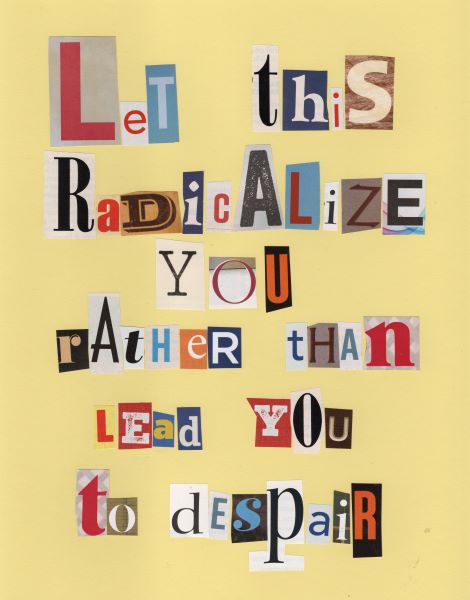
The powerful elites are counting on us getting tired, distracted, or overcome by despair. (But as Mariame Kaba says: “Let this radicalize you rather than lead you to despair.”) They want us to look away from the ugly truth. PLEASE do not avert your gaze. If you haven’t yet taken action on behalf of the Palestinian people, please know it’s never too late to add your voice to the chorus. Hello and welcome to the struggle!

Okay, this is me publicly vowing to remain in  the struggle. I hope you’ll do the same. Solidarity! ✊🏽

Timely book recommendations

I’m joining a book discussion tomorrow that will be facilitated by activist, organizer, and educator Mariame Kaba as part of Project NIA. We’re reading The Fearless Benjamin Lay: The Quaker Dwarf Who Became the First Revolutionary Abolitionist. As I tweeted earlier today, “Lay didn’t try to “reform” slavery, but treated it as the absolute horror it was, calling out ALL who participated in the system. Inspiring! Solidified my stance on PIC abolition.”

I highly recommend reading this book about an extraordinary man who fought against slavery for 40 years (during the 1700s), “suffering endless persecution, ridicule, and repression, without a movement to support and sustain him.”

This book feels especially timely as we mourn Tortuguita (forest defender/climate justice warrior, and abolitionist) who was murdered by the police for defending against Cop City in Atlanta AND the murder of Tyre Nichols by Memphis police (not going to link because don’t want to inadvertently include video). Also? This book is timely because in 2022, the police killed more people than ever (1,176) which is nearly 100 people killed every single month.

We cannot reform state sanctioned violence. We must defund the police. We must abolish the police. Then, all those billions of dollars must go to communities so that people are housed, fed, and receiving health care. Police do not keep us safe. We keep us safe.

Benjamin Lay pushed back against a system that many considered inevitable and here-to-stay. Back then, people thought it was futile to oppose slavery and we’re currently facing that same mindset regarding the police. Do you know how/why we have police in the United States? They started as slave patrols, men hired to hunt down enslaved people who ran away. Policing has nothing to do with public safety and everything to do with protecting capital.

I’m tired and upset, and possibly not writing very eloquently, so if you’re interested in learning more about prison industrial complex (PIC) abolition, I highly recommend Mariame Kaba’s We Do This ‘Til We Free Us. She and the other contributors do a stellar job getting across their information and perspectives.

I’m currently working to find an agent to represent my middle grade novel about two kids in a small town divided over the presence of a for-profit prison, and was able to write the ending I wanted for that story. In the meanwhile, a whole lot of people are fighting for the creation of a safer reality in the here and now. Benjamin Lay would be proud.