Climate Movement Monday: on behalf of Alaska

It’s been quite some time, but welcome back to another edition of Movement Monday in which we discuss all things climate and take a quick action or two on behalf of frontline communities bearing the brunt of the climate crisis. Today’s post focuses on Alaska. First, if you’re able please consider making a much-needed donation to the Western Alaska Disaster Relief Fund in the aftermath of Typhoon Halong that devastated western Alaska in October.

The remnants of Typhoon Halong brought record-breaking winds and flooding to the Yukon-Kuskokwim Delta overnight on Oct. 12, hitting the Kuskokwim Delta coast especially hard. High water, immense damage, and other storm impacts prompted hundreds of people to evacuate from their homes to other villages, Bethel, and Anchorage. In the wake of the storm, one woman was found dead. Two of her family members remain missing.

Evacuating people from storm-damaged communities represented the largest airlift in state history, according to state officials. The storm’s impact prompted both state and federal disaster declarations. Many from the hardest-hit communities don’t know when or if they will be able to return home.
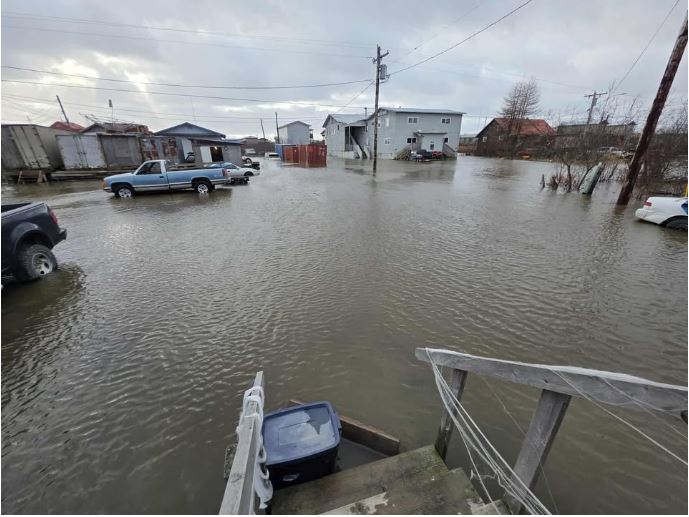
A residential neighborhood of Bethel flooded by the remnant storm of Typhoon Halong on Oct. 12, 2025. (Photo courtesy of Selena Allgiq James via KYUK Public Media)

You’d think we as a species would be more thoughtful about our actions in the face of climate-induced death, destruction, and displacement. You’d be wrong. Because what does this (and every other administration) want to do? Give more handouts to the oil and gas industry. Which brings us to Ask #2 of this post.

Via Earthjustice: please take two minutes to personalize your comment letting this administration know why you DO NOT want them to drill in Alaska’s Arctic. There are SO many reasons this is a bad idea including the fact the federal government is already paying out MILLIONS of dollars in disaster recovery and drilling for oil will only accelerate/deepen the crisis and disasters. COMMENTS DUE BY NOVEMBER 21.

I get that you might be hesitant to write a letter which can feel like screaming into the void. And yet, if we don’t make any noise, what’s the point? Two minutes of time to register your thoughts and opinions. If you need further convincing, scroll through some images of communities in western Alaska that were decimated by that typhoon. Do we really want anyone else to suffer that way? Again, donations gratefully accepted here.

Either way, thank you for reading and your consideration. I’m trying to post here more frequently despite feelings of overwhelm, exhaustion, and grief.

As always, solidarity!
Climate Movement Monday: Bill McKibben on “How We Make Progress Now”

Hello! As mentioned, I’ll be scarce around here as I prepare to move out of state (scroll to the bottom of this post for a quick action on behalf of the United States Postal Service), but wanted to share Bill McKibben’s “How We Make Progress Now” today because I think it contains important info, including a list of Trump’s actions in his first days back in office:

The attacks on sensible energy policy have been swift and savage. We exited the Paris climate accords, paused IRA spending, halted wind and solar projects, gutted the effort to help us transition to electric vehicles, lifted the pause on new LNG export projects, canceled the Climate Corps just as it was getting off the ground, and closed the various government agencies dedicated to environmental justice. Oh, and we declared an “energy emergency” to make it easier to do all of the above.

Image by Nino Souza Nino from Pixabay

McKibben continues on to lay out different strategies for the coming years and ends with this [emphasis mine]:

” . . .in the climate movement we have something else going for us. All those years of pipeline fights and divestment battles occurred in a period when fossil fuel was the cheapest way to power a society. That’s no longer true; now it’s Trump and his friends fighting uphill against economic gravity. And they know it—Trump moved so fast to ban new wind and solar—indeed to literally define ‘energy’ to exclude them—because every poll shows they are far more popular than hydrocarbons.

We need to figure out how to leverage those facts in the years ahead—creatively, in ways that make use of our advantage in truth and beauty and minimize our current lack of political power.”

You can read the piece in its entirety here. It’s clear that over the coming years, the climate movement will need to apply different strategies and creativity in our efforts. We need to be fierce, agile, and show up for each other as needed.

On another front, go here to take a quick action on behalf of the United States Postal Service which is also under attack, which would be especially catastrophic for rural communities.

Thank you for reading this far. Solidarity! ✊🏾

Climate Movement Monday: good news

Welcome back to another Movement Monday in which we discuss all things climate. I typically offer a quick action you can take on behalf of a frontline community experiencing the worst effects of the climate crisis, but today am content to share two pieces of good news.

On December 26, New York Gov. Kathy Hochul signed the Climate Change Superfund Act. From the press release from Senator Liz Krueger who sponsored the bill in the Senate, this legislation “…will use the polluter-pays model exemplified by existing federal and state superfund laws to collect $75 billion over twenty-five years for climate change adaptation from the parties most responsible for causing the climate crisis – big oil and gas companies.”

This is very good news because, as is stated in the press release, New York is the 10th largest economy in the world. The final paragraph reads:

The Climate Change Superfund Act isn’t just necessary—it’s popular. According to a poll from Data for Progress, a whopping 89% of New Yorkers support fossil fuel companies covering at least some of the cost for climate damages. Another poll found that 70% of New York voters support the Climate Change Superfund Act, including majorities across party lines. Nationally, 89% of Democratic voters support the Climate Superfund approach, and 53% of New York voters are more likely to vote for candidates who support passing a Climate Superfund bill. 

Go here to read the press release in its entirety.

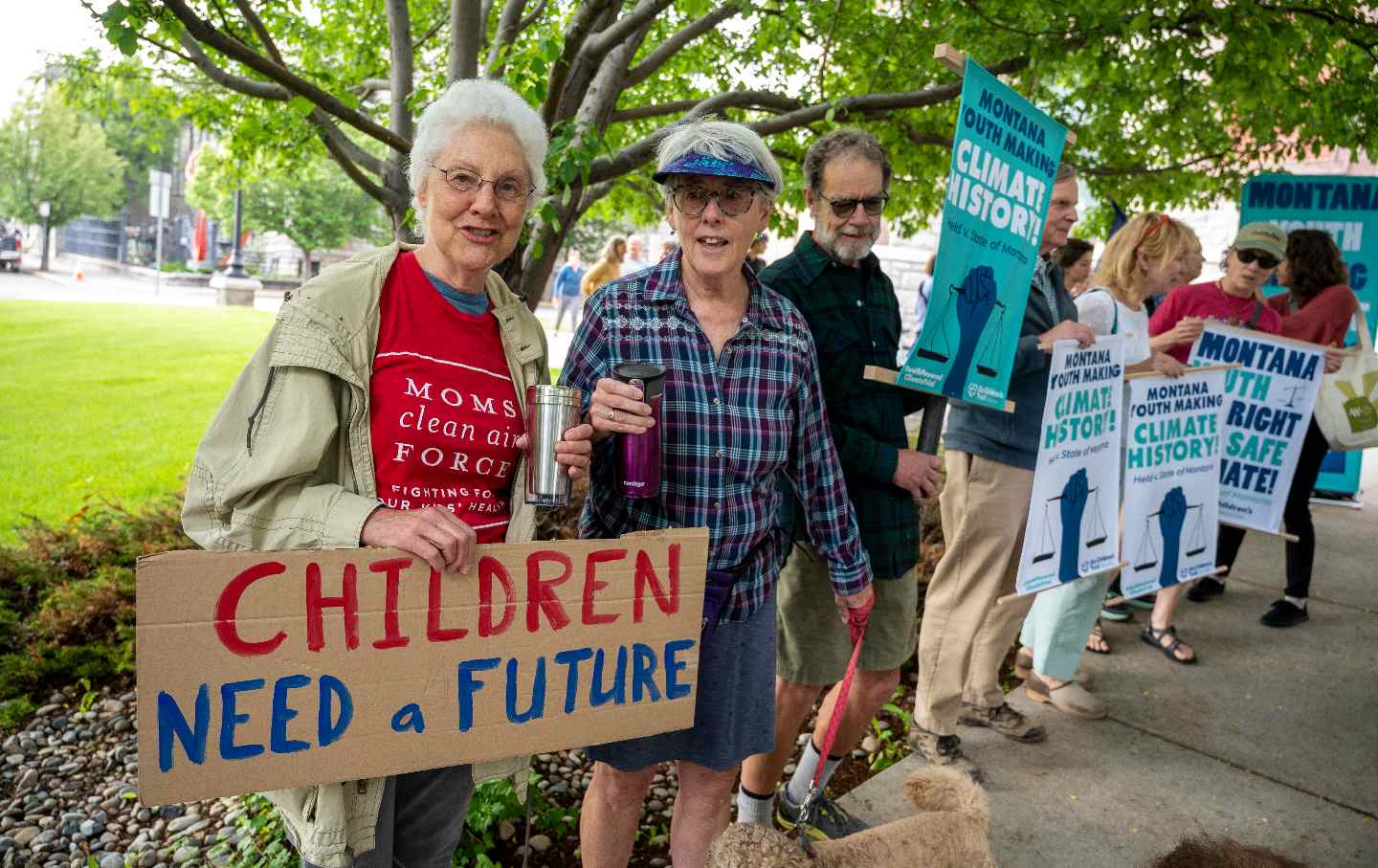
The second piece of good news is that on December 18, the Montana Supreme Court ruled in favor of the 16 young people who in 2020 filed a lawsuit (Held v. Montana), charging the state with violating their constitutional rights by favoring fossil fuel development over the health and well-being of the citizenry. The Supreme Court decision upheld an earlier lower court decision, 6-1. It was the first state supreme court decision of this kind.

Supporters gather to greet plaintiffs as they arrive for the nation’s first youth climate change trial at Montana’s First Judicial District Court on June 12, 2023 in Helena, Montana
(William Campbell / Getty Images)

Per an EcoWatch article, Alaska, Hawaii, and Utah are set to hear similar cases (as are Pakistan, Uganda, Colombia, Australia and New Zealand).

Hatch Magazine also wrote about Montana’s Supreme Court decision, and I want to highlight this paragraph [emphasis mine]:

In its 6-1 majority ruling upholding the plaintiffs’ case, the court used sometimes strikingly affirmative language. Regarding whether Montana’s constitutional responsibility to guarantee its residents a “clean and healthful environment” includes the state including climate-related impacts in its decision making, the court was unequivocal, stating that the “plaintiffs showed at trial—without dispute—that climate change is harming Montana’s environmental life support system now and with increasing severity for the foreseeable future. The State and its agencies have previously acknowledged such current and future impacts to the Montana environment stemming from climate change, many of which can already be increasingly seen today.3 Plaintiffs showed that climate change does impact the clear, unpolluted air of the Bob Marshall wilderness; it does impact the availability of clear water and clear air in the Bull Mountains; and it does exacerbate the wildfire stench in Missoula, along with the rest of the State.”

We’ve seen how difficult it is to force climate action at the federal level**, so these wins on the state level are very encouraging. It’s possible to use our local might to push for meaningful action!

Thank you for reading this far. Solidarity! ✊🏾

**I’ve written before about Juliana v. United States, the constitutional lawsuit brought by young people, here and here. Go here for an updated  timeline from Our Children’s Trust, one of the legal teams representing the 21 young people in that case.

Climate Movement Monday: in support of Native Village of Hooper Bay

Welcome back to Movement Mondays in which we discuss all things climate and then typically take action on behalf of a frontline community facing immediate effects of the climate crisis. Today’s information and TAKE ACTION come from Earthjustice, the nonprofit environmental law organization representing Native Village of Hooper Bay in southwest Alaska.

The federal government is proposing a land swap and road through the Izembek National Wildlife Refuge despite the fact that, as the name says, it’s supposed to be a refuge. Per the U.S. Fish & Wildlife Service website, this refuge located between the Bering Sea and the Gulf of Alaska,  is [emphasis mine] “home to one of the world’s largest eelgrass (Zostera marina) beds. Hundreds of thousands of waterfowl, including virtually the entire population of Pacific black brant, visit the lagoon to feed on eelgrass and rest during migration. From brown bears to Pacific salmon, more than 200 species call this refuge home.” Call me alarmist, but it seems really stupid to negatively interfere with the feeding ground and resting place for an entire species.

Aerial view of black brant in flight over Izembek National Wildlife Refuge.  Photo by Kristine Sowl/USFWS

What does all this have to do with Native Village of Hooper Bay?  The proposed road would cut through the refuge which provides, you know, refuge for migratory bird species that Native Village of Hooper Bay tribal members rely on for food and cultural practices.

“Any loss of these species in the Yukon-Kuskokwim Delta could have devastating impacts on communities already stressed by climate change, the salmon crisis, and by significant socio-economic and health challenges, including high rates of poverty and the highest suicide rates in the nation. Western science and Indigenous knowledge agree that preserving subsistence and traditional practices is key to combating these impacts in Alaska Native communities.”

A 45-day comment period is now open that allows the public to weigh in on the draft supplemental environmental impact statement (SEIS). The federal government needs your input. PLEASE request the federal government withdraw the project OR at least choose the “no action alternative” which is the compromise proposed by Native Village of Hooper Bay and other tribes.

As always, a personalized message carries more weight. However, I realize this issue can seem complicated as you read about it (due, in part, to the use of “alternative” in its many permutations), so it’s completely fine to briefly express your support for the tribal people and the migratory birds, and then request that the federal government withdraw the project entirely OR choose the “no action alternative.” Your message doesn’t need to be long.  All the background information is included here where you also take action via your brief personalized message.

Thank you for reading this far. Thank you for speaking up on behalf of Native Village of Hooper Bay and other tribes in that frontline community, along with the 200 species that call the Izembek National Wildlife Refuge home. Solidarity! ✊🏾

Climate Movement Monday: mutual aid after Hurricane Helene

EDITED WITH UPDATE: Please see my 10.1.24 post with easy-to-navigate lists of mutual aid groups!

Welcome back to another Movement Monday in which we discuss all things climate with a focus on frontline communities. In order to protect my health, I’ve been on a  self-imposed media break from the many horrors of our current reality (and I acknowledge my privilege in being able to avoid those horrors!), so don’t have any new insights into the aftermath of Hurricane Helene. I will, however, share this from Bill McKibben’s newsletter which I did read:

Were it happening just in one place, a compassionate world could figure out how to offer effective relief. But it’s happening in so many places. The same day that Helene slammed into the Gulf, Hurricane John crashed into the Mexican state of Guerrero, dropping nearly 40 inches of rain and causing deadly and devastating floods in many places including Acapulco, which is still a shambles from Hurricane Otis last year. In Nepal this afternoon at least 148 people are dead and many still missing in the Kathmandu Valley. Just this month, as one comprehensive twitter thread documented, we’ve seen massive flooding in Turkey, the Philippines, Saudi Arabia, Spain, Marseilles, Milan, India, Wales, Guatemala, Morocco, Algeria, Vietnam, Croatia, Nigeria, Thailand, Greece, Romania, Poland, the Czech Republic, Austria, with the Danube hitting new heights across Central Europe. 

Make no mistake, we are in climate collapse. And yet, the powers-that-be still pretend it’s not happening. Last week, Zippy received an email survey from one of Colorado’s senators (Michael Bennet), asking Zippy to name his priority issues. That survey did NOT even include climate (or Gaza or Lebanon and the corresponding billions of dollars and weapons to Israel). Clearly, the electeds are completely happy to drive humanity to extinction.

Which is why today’s post is devoted to mutual aid groups working on the ground to help those impacted by Hurricane Helene.  Also, with some overlap, here’s another mutual aid list. What is mutual aid? Per Global Giving: Mutual aid is about cooperating to serve community members. Mutual aid creates networks of care and generosity to meet the immediate needs of our neighbors. It also addresses the root causes of challenges we face and demands transformative change.  

Mutual aid is a powerful way to give because it helps build community and create people power. People trust those who’ve helped them in hard times and are more likely to join later efforts to push for beneficial change in their communities. Mutual aid builds on the present and for the future.

Helene impacted Florida, North Carolina, South Carolina, Kentucky, Tennessee, and Virginia. There are many needs right now and so I again offer this list of mutual aid groups and this list.

I hope you’ll join me in helping the people of Florida, North Carolina, South Carolina, Kentucky, Tennessee, and Virginia. Any amount is appreciated! Thank you in advance for your humanity.

Please take care of yourselves. Solidarity! ✊🏽

Climate Movement Monday: turning the fossil fuel narrative on its head

Welcome back to Movement Mondays in which we discuss all things climate. Today I’m returning to Not Too Late: Changing the Climate Story from Despair to Possibility (edited by Rebecca Solnit & Thelma Young Lutunatabua) in order to offer my readers another lens to look at our climate reality while also imagining a better world.

At the start of the chapter “Different Ways of Measuring: On Renunciation and Abundance” (a conversation between Solnit and Lutunatabua), there’s this quote from Dr. Elizabeth Sawin:

“It is some very effective marketing that has convinced so many of us that getting off of fossil fuels is a sacrifice as opposed to a money-saving, peace-promoting, water-protecting, health-improving, technological leap forward.”

This jumped out at me because whenever I (foolishly) read comments about various climate actions (and it doesn’t matter if it’s folks politely demanding better of their government or Climate Defiance interrupting fossil fuel executives as they’re being celebrated), there are always people who ridicule the activists for imagining a world without fossil fuels. Those naysayers insist the many negative consequences  we’re experiencing in real-time are a given and that there’s no way forward that doesn’t include fossil fuels. A frequent commenter “gotcha” is “Did you drive your car to that action?” which reveals a complete lack of imagination in regards to our woefully inadequate public transportation, connected biking routes, etc.

Directly following Sawin’s quote, Solnit eloquently presents a different perspective that I’d love to copy and paste in reply to those cynical comments.

What if the climate crisis requires us to give up the things we don’t love and the things that makes us poorer, not richer? What if we have to give up the foul contamination around fossil-fuel extraction, the heavy metals people inhale when coal is burned around them, the oil refineries that contaminate the communities of color around them from the Gulf of Mexico to California? What if the people of Richmond in my own home region, the Bay Area, didn’t have emergency alerts where they were supposed to seal their homes because of a refinery leak? What if the incidence of asthma in kids went way down, and we stopped losing almost nine million people a year to pollution worldwide? What if that moment when the pandemic shut down so much fossil-fuel burning that people in parts of northern India saw the Himalayas for the first time in decades became permanent?   

I don’t know about you, but reading those words expanded my mind and heart, while reaffirming my belief in a better world. Kicking our fossil fuel addiction won’t set us back, but will instead liberate us to live healthier, happier lives.

If you’re interested, here’s an article about the visible Himalayas, including grateful social media posts:  Peaks of Himalayas visible from parts of India for first time in decades as pollution drops amid lockdown. And if these quotations resonated with you and you’re interested in reading more, Not Too Late is available through Haymarket Books and is currently offered at a discount.

Thank you for reading this far and please know I welcome all thoughts and comments below (spoiler: no, I did not drive my car to this post). Until next time, solidarity! ✊🏽
Climate Movement Monday: the war on Gaza

Welcome back to Movement Mondays in which I highlight a climate-related issue and offer suggestions for taking action. It’s been a while since I posted one of these and that’s due to a sense of overwhelm and futility. But I’m rousing myself today because the U.S. military is one of the major (if not the major) driver of climate change and because today is Day 346 of the war on Gaza. I’m hoping that people who might have remained silent thus far regarding the ongoing genocide of Palestinian people might be motivated to take action if they realize what the many tons of bombs supplied by the U.S. are doing to the environment, effects that will impact everyone on this planet.

Per “The Gaza war is an environmental catastrophe,” an article published September 5, 2024, in +972 Magazine, Gaza’s future was already precarious with the specter of “Ever-worsening shortages of water and electricity. Catastrophic flooding in dense urban areas. Food insecurity exacerbated by drastic temperature increases, reduction in overall rainfall, and the long-term impact of toxic chemicals.” Those predictions were made two years ago and now, after nearly one year of the U.S. enabling and providing cover for Israel’s campaign of death and destruction, that threat has radically accelerated.

“…environmental degradation in Gaza has worsened exponentially: as Israel’s bombardment destroys infrastructure, an inordinate amount of toxic dust has been released into the air, and wastewater management has entirely collapsed due to the shortage of fuel. 

By April, the destruction of buildings throughout the Gaza Strip had produced an estimated 37 million tons of debris. As buildings are damaged or collapse, they release clouds of noxious smoke, toxic dust, and fumes into the environment.”

As someone who recently lost a beloved family member to cancer as a result of him working several blocks away from the World Trade Center, the thought of this ongoing assault sickens me. Can you imagine 346 days of this where you live?

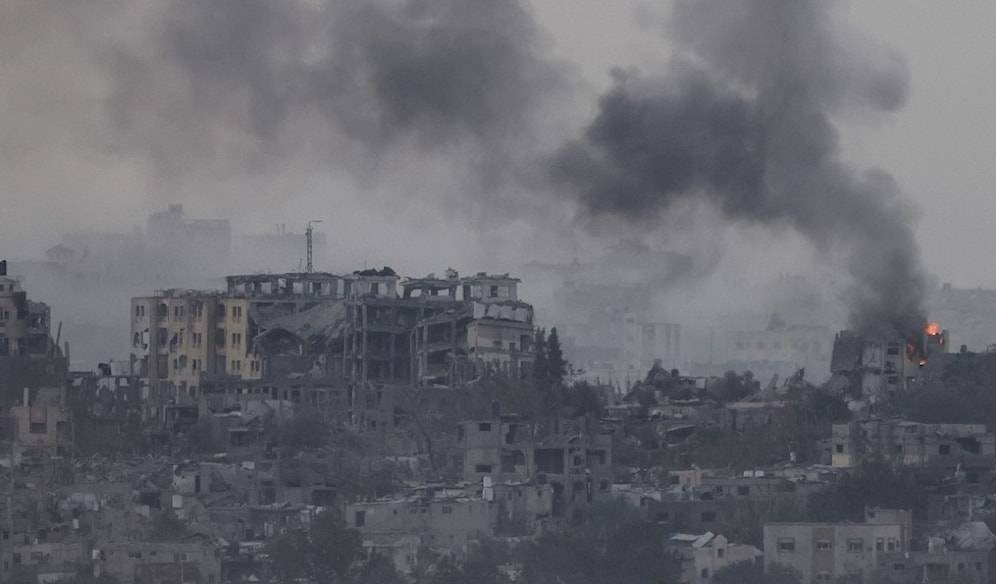
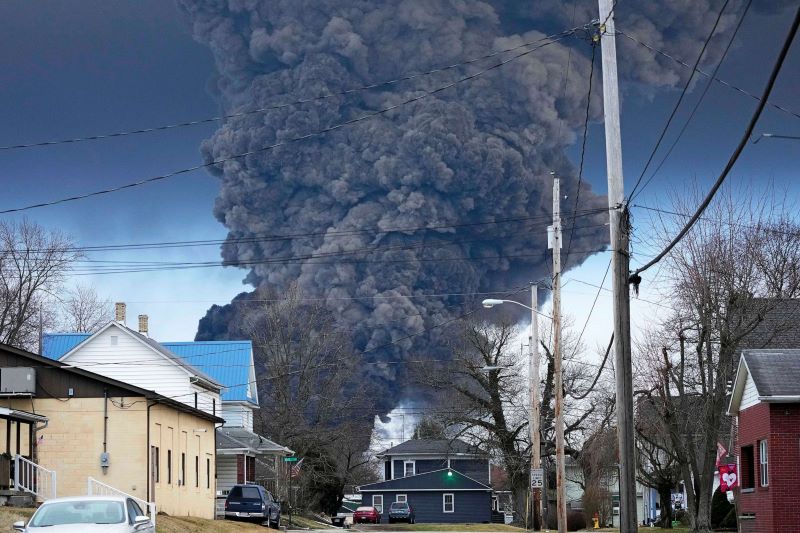
Smoke rises after an Israeli airstrike in Gaza, seen from the Israeli side of the fence encaging the Strip, January 7, 2024. (Chaim Goldberg/Flash90)

Beside the genocidal depravity of all these bombs, “It is projected that the current war already yielded a minimum of 900,000 tons of toxic waste. These pollutants — which include radioactive and carcinogenic materials, heavy metals, pesticides, and other chemicals, emitted both through the use of military munitions and in the destruction of buildings — persist in the environment, posing a threat to all forms of life, including animals and vegetation. They contaminate soil, air, and water sources, endangering ecosystems.” [emphasis mine]

I encourage you to read the article in its entirety as Dr. Mariam Abd El Hay, a researcher in social dynamics and the environmental impacts of conflicts and a Palestinian citizen of Israel from the city of Tira, answers questions posed by +972 Magazine.

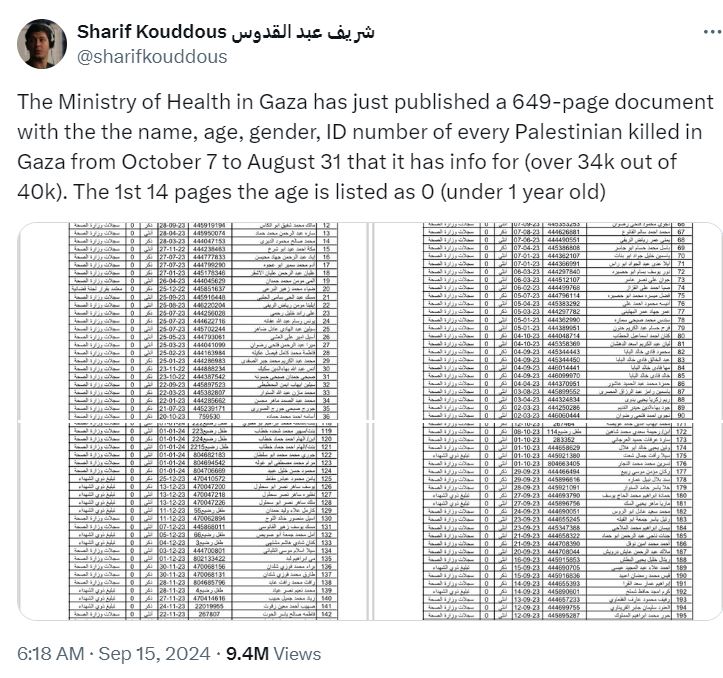
So what can we do? I fully admit that what the global pro-Palestinian coalition has been doing for the past 11+ months hasn’t brought about a ceasefire and aid for Palestinians, but that doesn’t mean we should stop agitating. I continue to contact my electeds to voice my outrage for their continued support for genocide. Today I focused on this document from the Ministry of Health in Gaza.

I used that Tweet as a script which helped me focus my rage at their complicity. Fourteen pages of dead children younger than one year of age! 

To contact your electeds, go HERE for your Representative and HERE for your two Senators. HERE for Biden and HERE for Harris.

In addition to referencing the 649-page document of (documented) dead Palestinians and/or the climate impacts of this U.S.-sponsored genocide, what else might you say to your electeds (particularly if they’re Democrats)?

  • Don’t threaten me with the end of democracy when poll after poll shows the vast majority of voters DO NOT want billions in aid and weapons sent to Israel to commit genocide. What you’re doing is NOT democracy.
  • The poliovirus, which we eradicated, is now present in Gaza’s wastewater. Worse, Israeli soldiers are hindering the delivery of polio vaccine to Palestinians.
  • Humanitarian aid workers are being murdered. As of September 12, 220 UNRWA aid workers have been killed. 
  • Know how to get an immediate ceasefire? Halt all weapons and aid to Israel!
  • There are anti-genocide candidates on the November ballot and I won’t be voting for anyone who doesn’t fully support an arms embargo, immediate ceasefire, and aid to Palestinians.
  • Edited to add: You’re no better than a climate denier if you continue to support this war on Gaza. And that goes for if you support fracking and brag about how much oil production is happening under the Biden administration. You can’t call climate change an existential threat and then push policies that accelerate the climate crisis.

And if you’re unwilling to bang your head against the entrenched political duopoly, you could donate to Municipality of Gaza (water and sewage treatment), UNRWA, esims for Gaza, or vetted fundraising campaigns for families in Gaza via Gaza funds.

Okay, I’ll stop here. It feels gross to frame this genocide in terms of what it’s doing to the climate, but because climate change is a global issue that affects every single one of us, I’m hoping more people will speak out on behalf of Palestinians. And to anyone who continues to scroll on past any mention of what’s happening in Gaza and the West Bank, shame. We need to regain our sense of shared humanity.

Thank you for reading this far. Solidarity! ✊🏽
EDITED TO ADD: Drop Site News is hosting a live screening of the documentary “The Night Won’t End” tomorrow (Tuesday) at 8 p.m. ET. The film tells the story of three Palestinian families in Gaza fighting to survive the genocidal onslaught. Go HERE to subscribe for free and gain access to the screening.

Climate Movement Monday: save the Pearl River

Hello, again. I took an unscheduled break from my blog because everything felt like too much. Everything still feels like too much, but I want to continue offering information, perspectives, and ways to take action on behalf of people and planet. Because the WordPress community is spread around the world, these Monday climate posts dedicated to specific issues and communities could be viewed as unrelated to your own life and experience, but because I firmly believe we are ALL connected–everyone and everything–I also believe there’s no such thing as an unrelated issue (climate or otherwise). Anything that negatively affects the climate halfway around the world from where you live will eventually have negative consequences for your community. Okay, so let’s get to today’s issue. 🙂

Pearl River at Rosemary by J.G.W.Blakeney (wikimedia)

In September of 2022, I highlighted the flooding in Jackson, Mississippi, that happened when the Pearl River overflowed its banks due to heavy rains. As a result of that flooding, the water treatment plant failed in Jackson which is 82% Black, leaving 150,000 people without clean drinking water. Nearly two years later, Jackson residents are still dealing with low pressure and brown water.

There are plans to address the flooding issues, but the solution being pushed–One Lake–is environmentally devastating. From Healthy Gulf:

Instead of levee improvements, the Rankin-Hinds Pearl River Flood and Drainage Control District, in charge of levees, is sponsoring an Environmental Impact Statement (EIS) to study dredging and widening 9 miles of the river to create a lake, primarily to please developers and mayors who see an urban waterfront as a money maker for Hinds and Rankin Counties. The cities of Jackson and Flowood will “share” the lake and the Drainage District has taxing power to create bonds to finance it. The plan is to dredge the river wider, remove 1860 acres of riverside wetlands and swamps, set back some levees and construct a new low-head dam below the I-20 Pearl River Bridge. The resulting 1900 acre lake is promised to tame the river’s backwater flooding during large releases. 

The problem is that the wetland and wildlife habitat destruction resulting from this much dredging of banks and riverbed make the “One Lake” project the most environmentally damaging of the three alternatives (lake, levees, and floodplain buyouts) for solving the flooding, according to the U.S. Fish and Wildlife Service.

TAKING ACTION

So what can we do to help support the environment and people of Jackson? Submit comments to the Army Corps of Engineers TODAY! (tomorrow is the deadline for public comments and I apologize for the last-minute notice). As always, personalized letters have the most impact. But you don’t have to put tons of effort into your letter: just make your points and sign off! Here’s the letter template in which I’ve highlighted points to hit:

As someone who cares deeply about our country’s birds, wildlife, and habitats, I ask that you reject all flood relief plans for Jackson, Mississippi, that would dam or dredge the Pearl River. Instead, prioritize and expand on a proposal that can provide effective non-structural and nature-based flood solutions to benefit Pearl River communities and wildlife. Specifically, I urge you to pursue and bolster the Corps’ Draft Environmental Impact Study (DEIS) Alternative A1 and deny Alternatives C, D, and E.

The Pearl River runs from Choctaw Tribal lands in Neshoba County, Mississippi, to Lake Borgne and the Rigolets in coastal Louisiana. It connects nearly 500 miles of ecology, communities, and economies across Mississippi and Louisiana. I urge you to oppose any flood relief plan that would dam or dredge this natural treasure.

The One Lake project and related proposals are all ecologically devastating plans. They would dredge river banks and wetlands, depositing the spoil behind levees to create broad terraces for commercial development. This would destroy thousands of acres of wildlife habitat and worsen Jackson’s flooding and drinking water crisis. It would also expose local and downstream communities to toxic contamination and reduce freshwater flows critical to the region’s seafood and tourism economies.

The DEIS is incomplete and missing sections required by law for adequate public and scientific review. It lacks a full analysis of wildlife habitat impacts, toxic sites, and downstream flows. However, it makes clear that One Lake and all related dam/dredge plans should be rejected. Federally mandated habitat protection areas for two endemic turtle species and the Gulf sturgeon are within the project area and LeFleur’s Bluff State Park would lose 63 acres of hardwood forest, changed to lake bottom. These are just two examples of the damage that the One Lake Project would cause.

Instead, I urge you to pursue effective, environmentally sustainable flood relief proposed in Alternative A1. This includes home elevations and flood-proofing buildings. Expand on this plan to consider restoring floodplains, raising roads, and incorporating levee setbacks and protections for vulnerable Jackson neighborhoods.

Please protect the Pearl River for this and future generations. Reject One Lake and all similar plans. Employ nature-based and non-structural flood solutions that benefit all Pearl River communities and species.

Again, here’s the link for writing a letter. Thank you in advance for reading this far and taking action on behalf of the people and environment in Jackson, Mississippi. Solidarity! ✊🏽

Climate Movement Mondays: public utility commissions (PUCs)

Welcome back to another Movement Monday. I hadn’t planned on posting anything today (kinda low energy as I hunker down inside my home to avoid the bad air from the wildfires in Canada), but then came across a very cool resource on the Earthjustice site.

Here’s the page where you can access all the info about Public Utility Commissions (PUCs), but I’ll highlight a bit of the introduction:

In a conference room somewhere in your state, a small, largely unseen group of people is casting votes that could make or break the clean energy transition.

You’ve probably never heard their names, and you might not even know the name of the agency they’re running: the state public utility commission (PUC). Fossil fuel interests would love to keep it that way.

PUCs regulate utilities. (In some states, they have other names, like public service commissions, or PSCs.) They determine the cost of your gas and electricity bills and where your power comes from, whether it’s fossil fuels, hydroelectricity, or renewables like wind and solar.

Climate Movement Monday: mutual aid

Welcome back to Movement Mondays in which we discuss all things climate. And guess what? Climate is connected to every other issue we’re facing for the simple reason that everyone and everything on this planet is connected. No one and nothing exists in isolation.

As I write this, much of the western U.S. is under a heatdome while Hurricane Beryl continues to wreak havoc, this time in Texas. A couple days ago, the medical journal The Lancet published a report saying that a conservative death toll in Gaza is 186,000 dead–which equals 8% of the Palestinian population in the Gaza Strip–when indirect deaths (starvation, illness, disease, etc.) are taken into account. Ten days ago, the Supreme Court ruled that the constitution doesn’t protect unhoused people from cruel and unusual punishment, meaning it’s okay for cities to criminalize people for sleeping outdoors. Extreme weather is difficult even under the best of circumstances (i.e. with housing), and surviving extreme weather is much, much harder for those living on the streets. That’s where mutual aid comes in.

What is mutual aid? Mutual aid is about cooperating to serve community members. Mutual aid creates networks of care and generosity to meet the immediate needs of our neighbors. It also addresses the root causes of challenges we face and demands transformative change. 

Image by Gerd Altmann from Pixabay

As it becomes increasingly clear that the powerful elite has no interest in listening to or working on behalf of we-the-people, mutual aid shines brighter as a powerful way to share our energy. I hoped to find a national database of mutual aid efforts around the country that I could link here, but was unsuccessful (many mutual aid efforts started at the beginning of the pandemic have since folded). However, if you do a search for your city + mutual aid, you will get some hits. For instance, Zippy and I help via Rocky Mountain Mutual Aid Network (RMMAN) which collaborates with Joy’s Kitchen to get “saved” food to needy households. We also carry bottled water, granola bars, and masks in our car to offer people flying signs or washing windshields at stop lights. After that disastrous Supreme Court ruling against the unhoused, I came across this very helpful thread listing specific ways to offer aid to the unhoused.

I’ll close with this beautiful poem by the incredible Joy Hargo.

Once the World Was Perfect
BY JOY HARJO

Once the world was perfect, and we were happy in that world.
Then we took it for granted.
Discontent began a small rumble in the earthly mind.
Then Doubt pushed through with its spiked head.
And once Doubt ruptured the web,
All manner of demon thoughts
Jumped through—
We destroyed the world we had been given
For inspiration, for life—
Each stone of jealousy, each stone
Of fear, greed, envy, and hatred, put out the light.
No one was without a stone in his or her hand.
There we were,
Right back where we had started.
We were bumping into each other
In the dark.
And now we had no place to live, since we didn’t know
How to live with each other.
Then one of the stumbling ones took pity on another
And shared a blanket.
A spark of kindness made a light.
The light made an opening in the darkness.
Everyone worked together to make a ladder.
A Wind Clan person climbed out first into the next world,
And then the other clans, the children of those clans, their children,
And their children, all the way through time—
To now, into this morning light to you.
Joy Harjo, “Once the World Was Perfect” from Conflict Resolution for Holy Beings.  Copyright © 2015 by Joy Harjo.
——-
Thank you for reading this far. I’d love to hear your thoughts on any or all of what’s mentioned here, especially any further tips/ideas for helping out in our communities. Either way, take good care. Solidarity! ✊🏽

Climate Movement Monday: whales, tents, & jail support

It’s another Movement Monday and I’ll be extra brief as Zippy and I are headed out for a much-needed dose of nature. I’m grateful to be able to escape to the great outdoors where I can clear my mind and refill my well, and I hope you’re also able to  rejuvenate during these incredibly dark days.

This ask comes from Healthy Gulf and involves personalizing a quick letter:

The critically-endangered Rice’s whale lives only in the Gulf of Mexico and is teetering on the edge of extinction, with only about 50 whales remaining. But rather than protecting them, members of Congress are trying to block desperately needed actions to protect the whales. These whales need your support!

Will you take action today to tell your representatives that you support protections for critically endangered Rice’s whales?

Some members of Congress are attaching anti-whale language to bills that would fund government agencies in 2025. One measure by Rep. Matt Gaetz (R-FL) would force the U.S. Air Force to exempt itself from protections for the Rice’s whale under the Marine Mammal Protection Act, even though the Air Force has not requested it and has a long history of working to protect endangered species in its operations. Another would block the federal government from spending any money on creating restrictions on the speed of ships traveling through designated whale habitat—a proven conservation action used worldwide to protect whales from vessel strikes. 

It’s pathological behavior for Congress to ignore the multiple crises threatening humanity’s very existence and, instead, to use their considerable power to target whales for extinction. Whew.

The second issue I want to put on your radar is a fundraiser to buy tents for people in Gaza (just realized they also have a separate fundraiser to buy diapers). The Sameer Project is a donations based aid Palestinian-led initiative working to supply emergency funding to the displaced families in Gaza. They are doing amazing work under incredibly difficult circumstances. This from their GoFundMe update today: The Sameer Project has so far provided over 525+ tents sheltering more than 5,000 people since the Rafah invasion started in May. That accounts for 1.5% of all the displaced population. Not only that, but our team has also been providing cash, clothing, food, water, and medical in all parts of the Strip. Wheelchairs are extremely expensive and difficult to find yet we successfully secured one for a woman with a severe case of Multiple Sclerosis (MS). Our community kitchens and water trucks are going strong in the North because of your support. We also recently sourced around 300 milk tins and 1250 packs of diapers in both the North and South. 

Donations of any amount are greatly appreciated!

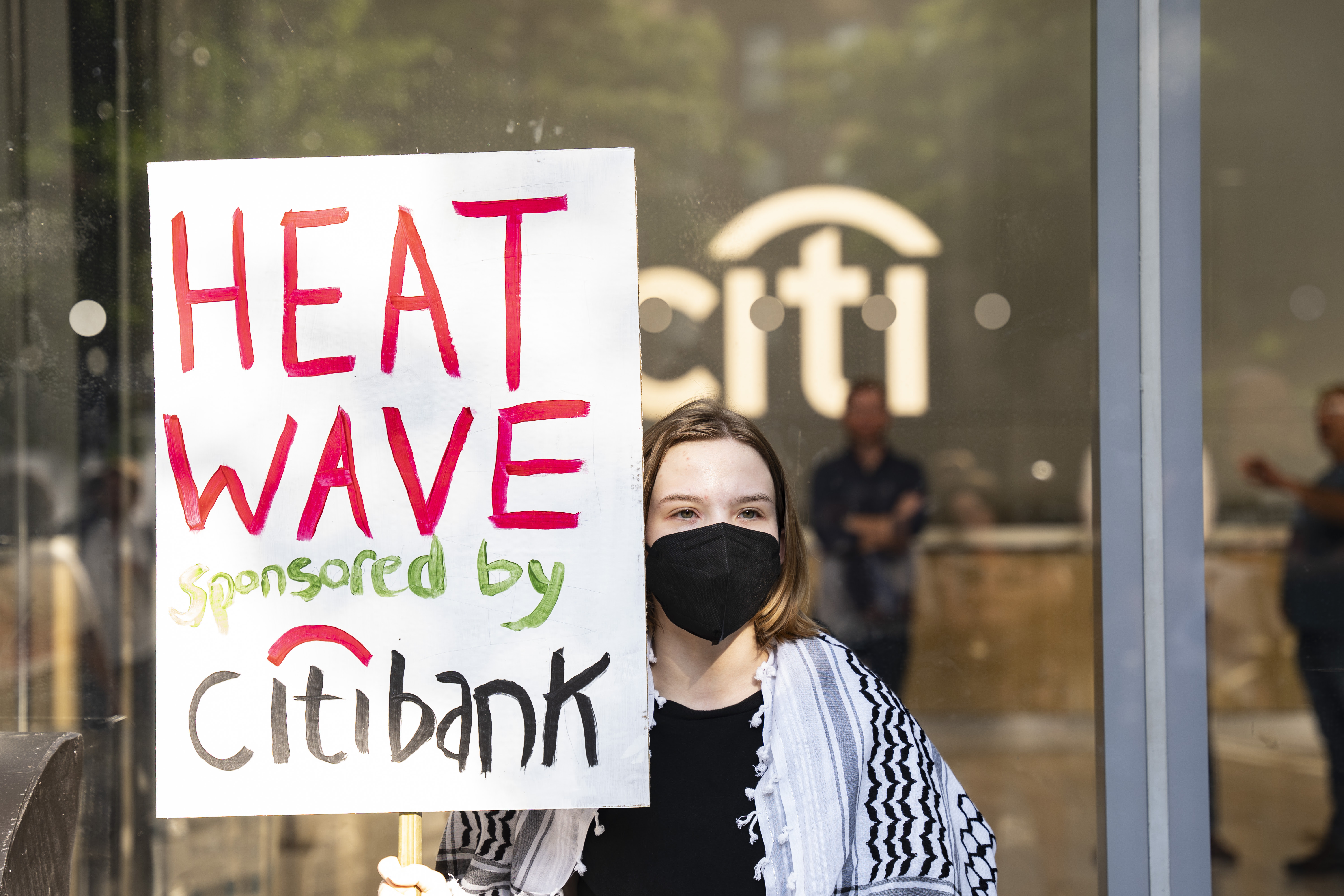
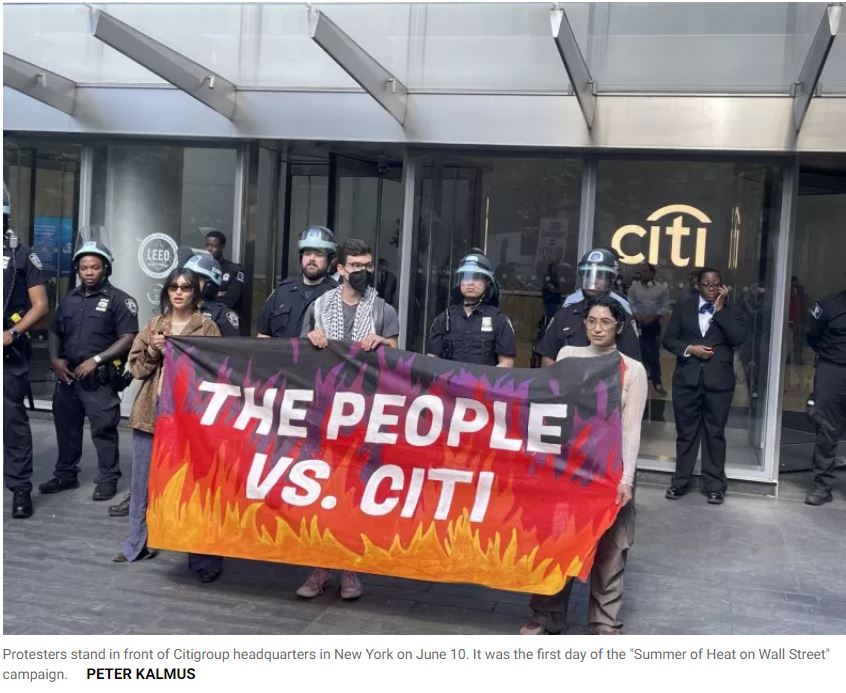
The third issue is monetary support for the courageous people of Stop the Money Pipeline who are putting pressure on CitiBank to stop funding fossil fuel projects and genocide in Israel (you can notify Citi you’re opposed their actions here). I wrote about the Summer of Heat campaign here. This from the latest Stop the Money Pipeline email:

In the last three weeks, we’ve helped organize sixteen actions on Wall Street financiers of fossil fuels, including seven civil disobedience protests at Citi’s HQ that have ended in more than 250 arrests.

As a result of our tireless organizing, our message is getting out.

Yesterday, ABC correctly reported that “fossil fuel projects in [the Gulf South] are devastating Black and Brown communities.” Reuters wrote that “Citi employees were alerted on Thursday to anticipate ‘significant protest’ activity on Friday.” The previous day, Bloomberg reported that our protracted campaign is beginning to wear on employees and executives alike.”

We aren’t deterred by all the arrests. Our resolve is only hardened: we will make our demand to end fossil fuels impossible to ignore by continuing disruptive, nonviolent civil disobedience.

That’s why we’ve been shutting down Citi’s HQ since early June – and why we’ll continue to be back week after week.

To sustain this fight, we need your help. Donate here to our legal and jail support fund. Every cent raised will support the courageous activists risking arrest week after week here in New York.

Again, any amount is helps! Thank you for reading this far and please know how much you’re appreciated. Solidarity! ✊🏽

Climate Movement Monday: declare a national climate emergency

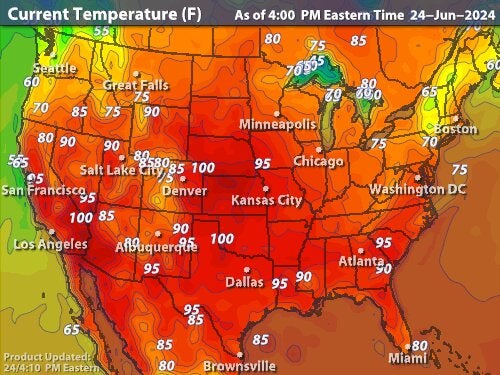
Welcome back to another Movement Monday in which we discuss the climate crisis and take a quick action on behalf of people and planet. I don’t have a formal request for an action today, but suggest making phone calls and/or emailing Biden plus your two Senators and one Representative to report on what June has been like where you live. Is it hotter than usual? Windier than usual? Have there been wildfires, floods, tornados, tropical storms, drought, hail storms, etc.? How’s your air quality? Have you had to curtail physical activity? Have you lost insurance coverage due to climate risks?

A Bloomberg article from April stated “White House officials have renewed discussions about potentially declaring a national climate emergency, an unprecedented step that could unlock federal powers…” I don’t have a subscription so could only read that opening, but it seems like a good idea to let Biden and the Democrats know there’s broad support for the declaration of a climate emergency that would unlock all sorts of powers to take action.

When I made calls today, I reported that despite it still being morning, the temperature in the Denver metro area was already above 90 degrees. I went on to say that while those elected officials possessed considerable power that could be used to mitigate the climate crisis, they were instead using that power to enable and support a genocide in Gaza, and total destruction of infrastructure via 262 days of nonstop bombing that was also accelerating the climate crisis. I pointed out that the majority of people do NOT want their tax dollars used to kill and destroy, and would prefer a climate emergency declaration that would get everyone working together to ensure the planet remains livable.

On a related note, last week organizer Kelly Hayes shared the link to a Truthout article Climate Refugees Are Occupying Abandoned Buildings in Southern Brazil. This not only ties in with Rosaliene Bacchus’s recent blog post, but also gave me a boost. People coming together to care for each other in time of tragedy.

“This is our lifeboat,” says Liziane Pacheco Dutra. She wears a thick black jacket. Her hair is pulled back in a pony tail. “We lost everything to the flood. We have nothing. We have no bed. No food. We were disrespected at the shelter, and here we have found a connection, care and open arms. We’ve made friends. The kids play together and we are looking after each other.”

People were not treated well in the shelters which are mostly run by middle and upper class people who show the working class little respect. Instead, people are forming communities in abandoned buildings.

It’s a profound sentiment and a symbol of what the occupation means for the nearly 60 families that live here.

I recommend reading the entire article which shows what happens when people come together for the common good. Reading it warmed my heart and filled me with hope for the many possibilities available to us. Shared humanity for the win!

Wherever you are, I hope your local temperatures and weather are moderate. I’d love if you shared details of your June in the comments and/or comments made to your elected officials. Either way, please take care and stay safe. Solidarity! ✊🏽

Climate Movement Monday: Summer of Heat campaign

Welcome back to another Movement Mondays in which we discuss all things climate and then typically take a quick action or two (today’s suggestions from Stop the Money Pipeline will be to donate, make a phone call, and send personalized emails) in support of frontline communities, those enduring the worst of the climate crisis.

With record-breaking heat happening around the country, along with a whole lot of wildfires currently burning, it could be said that every single one of us lives in a frontline community. Here’s today’s wildfire map from FIRMS US/CANADA (Fire Information for Resource Management System US/Canada):

Each of those orange flame icons represents a current wildfire. And it’s precisely for this reason that last week, Stop the Money Pipeline launched their Summer of Heat campaign (scroll down at link for details and lots of good info, including this):

The clock is ticking. That’s why during the Summer of Heat, we’re taking joyful, relentless nonviolent direct action to end fossil fuel financing. 

Wall Street is bankrolling the coal, oil and gas companies that are polluting our communities and killing our planet. But we’re going to stop them.

We’re going hard all summer long. Week after week. Month after month. We’re taking the party to the streets and we won’t stop.

The following comes from the Stop the Money Pipeline newsletter sent last night:
It’s been quite the first week here in New York. We organized civil disobedience actions at Citibank’s global headquarters four days in a row: On Monday we blockaded every entrance with 150+ people. On Tuesday, we did it with a giant pod of orcas. On Wednesday, it was the turn of the scientists, including Dr. Sandra Steingraber and Dr. Peter Kalmus. And on Thursday we blockaded the headquarters with 200+ elders and 50+ rocking chairs.

On Friday, we held a block party in the plaza outside the HQ and in the midst of it all, we also found the time to disrupt a speech by Citibank’s Head of Wealth Management, Andy Seig. In total, 144 people were arrested this week, demanding an end to the financing of fossil fuels.

As someone who was arrested and jailed for climate protest, I know the risks these folks are taking on our behalf (especially risky now during an ongoing pandemic in which New York’s governor, Kathy Hochul, is threatening a statewide mask ban). Alec Connon, co-director of Stop the Money Pipeline, said in that newsletter he was jailed twice last week! If you can spare a few dollars, please donate to the legal fund set up for the summer’s planned actions. Twelve weeks of actions will land an awful lot of people in jail because the powerful elites are working overtime to crush dissent as climate collapse worsens. Note: today’s article from independent journalists at The Lever is Big Oil’s Plan to Criminalize Pipeline Protestors.

The following also comes from last night’s Stop the Money Pipeline newsletter:

The stakes of the climate fight cannot be overestimated. Already, at less than 1.5°C of warming, half of the world’s coral reefs have collapsed and millions of children are being displaced by climate-driven extreme weather events every year. If we don’t stop burning fossil fuels in the coming years, it will get so much worse.

Given these stakes, it feels good to be a part of a campaign that at least feels close to being commensurate with the scale of the crisis.

I take heart, too, in knowing that history shows how effective sustained campaigns of civil disobedience can be. Indeed, many of most significant advances in social justice of the past 150 years ― from women’s suffrage to desegregation to the many gains won by organized labor ― owe less to subtle, “respectable” maneuvering than to the disruptive campaigns and groups that first made the issues impossible to ignore, and then forced decision-makers to act.

I believe that will be true of the fight to end fossil fuels, too―and that civil disobedience will play a key role in turning Wall Street against the fossil fuel industry.

As we take a breath and prepare for another week of civil disobedience actions, there are several ways that you can support the Summer of Heat campaign, wherever you are.

You can take a few minutes to call Citi’s CEOemail a dozen of their top executives, or call them out on social media. If you have the means to do so, you can also make a donation to the Summer of Heat campaign here. We’ll put every cent to good use.

And, of course, if you’re really eager to jump in, you can also look up where the closest Citi branch is to you and plan an action; or you could even start to plan your trip to New York. June 28th would be a very good day to be in town…

In Solidarity
– Alec Connon, Stop the Money Pipeline coalition co-director

PS: Interested in checking out the media from the first week of Summer of Heat? The pick of the bunch is here: Newsweek, the HillSalonDemocracy Now – WednesdayDemocracy Now – ThursdayBloombergABC7AM NYNPRCommon Dreams, and the NY Post

As I end here, I want to highlight the TikTok video of the orcas blockading Citibank on Tuesday. (Warning: profanities).

Thank you for being here and please know I appreciate your efforts on behalf of people and planet. Solidarity! ✊🏽

Climate Movement Monday: deadly heat in Gaza

Welcome back to another Movement Monday in which we talk about the climate crisis and the communities already getting hit the hardest. Today’s post focuses on the people of Gaza who have not only been under attack since October–thousands and thousands of bombs raining down on them no matter where they go–but have also been under siege in terms of deprivation of food, water, medical supplies, and humanitarian aid.  On top of all that, displaced Palestinians faced a record-breaking heatwave that pushed temperatures over 100 degrees as they huddled in tents that became deathly hot. This article from Climate Home News points out the disparity between how the Israelis’ in Tel Aviv and Gazans living in refugee camps handle high temperatures. Spoiler alert:  people in Tel Aviv stay in their air-conditioned homes or travel to the sea to sit under beach umbrellas while Gazans forced to live in nylon tents are losing their children to heat stroke. This week, the temperatures will “only” be in the upper 80s and low 90s, but if you’ve ever slept in a tent not shaded by trees, you know how unbearably hot it gets inside.

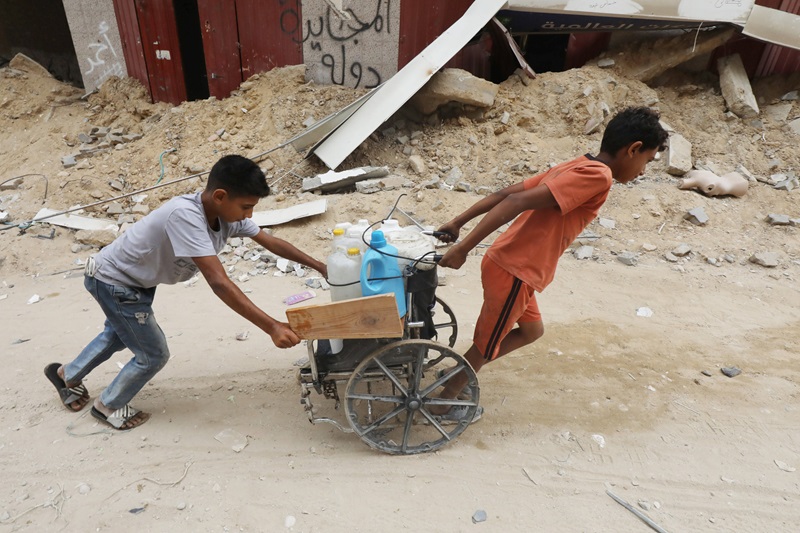
Boys carry water bottles in Gaza on May 28, 2024. (Photo: Naaman Omar)

Here’s an excerpt from the Climate Home News article:
The predicament of Gazans forced to endure sweltering conditions in ill-equipped tents is not an isolated problem. Across the world, climate change and war are forcing more and more people out of their homes and into makeshift camps. More than 75 million people are currently displaced inside their own countries – 50% more than five years ago.

Read that last line again: More than 75 million people are currently displaced inside their own countries – 50% more than five years ago

If you’re like me, reading something like that can tip you precariously close to despair. But we can also have a different response. We can read something that feels overwhelmingly bad and ask ourselves “what can I do here and now to effect change?” Today I’m going to share some links for ways in which we can help Gazans.

  • MUNICIPALITY OF GAZA is working toward the restoration of sewage treatment, waste management, and access to clean water which will cut down on waterborne illnesses.  You can donate HERE (any amount helps!) If you appreciated Refaat Alareer’s work I shared here (including “If I must die, let it be a tale”), please note that he also ran the social media account for the Municipality of Gaza (@munigaza).
  • GAZA FUNDS is a project that connects people to crowdfunding campaigns for individuals and families from Gaza. Each time the page is reloaded, a different campaign appears. While the rotation is randomized, campaigns for the sick/injured and campaigns close to meeting their goals are prioritized. We never want any of these campaigns to go stagnant, so we make sure to also prioritize fundraisers that haven’t had a donation in a while. As existing fundraisers meet their goals, they will be replaced with other fundraisers that need your help. You can donate HERE. I’ve seen people on Twitter highlighting their $5 donations to several campaigns with the knowledge that those contributions add up as well as give Palestinians the much-needed boost of knowing they haven’t been forgotten by the rest of the world. (more info re the Gaza Funds volunteers here). Also, I’m including the below graphics that offer additional ideas on how to help plus social media account info.

One last note to help make the connection between the United States and what’s happening in Gaza: On May 31, multiple water mains in Atlanta burst and people were/are under a boil water advisory. Many parts of the city are still without water. As I write this, it appears there’s still no clear communication on the water situation and many Atlanta residents are calling out Mayor Andre Dickens for attending a fundraiser on Friday AFTER THE FIRST PIPE BURST. The water infrastructure failure further highlights that the push to build Cop City in Atlanta to the tune of $100 million is the absolute wrong “public safety” initiative needed when the city can’t even provide citizens clean, safe water.

If you’ve read this far, thank you for being here! We’re facing incredibly difficult realities, but we’re much stronger together. Solidarity!✊🏽

Climate Movement Monday: FEMA, Puerto Rico, and renewable energy

Welcome back to Movement Mondays in which we discuss climate-related issues. Typically, I highlight a frontline community (people/place that’s bearing the worst effects of climate change) and then offer a quick action you can take on their behalf. Today I won’t ask you to take action and am, instead, merely offering info that triggered an aha moment when I read it. I’m all about sharing the aha wealth! 🙂

I considered myself fairly well-versed in the many ways that climate change is connected to various aspects of our lives. For instance, our physical and mental health, infrastructure, insurance premiums, poverty, racism, food, supply chains, etc. There’s really no escaping climate change’s many tentacles . But for all that awareness, I somehow never considered that the Federal Emergency Management Agency (FEMA) might play a major role in the continuation and acceleration of the climate crisis. I mean, FEMA’s job is to help people in the aftermath of disasters, so why would that agency take actions that ensure more climate-related disasters? Well, Center for Biological Diversity and a slew of other groups (energy justice , consumer and environmental) are suing FEMA for doing that very thing. From their May 2 press release:

Energy justice, consumer and environmental groups sued the Federal Emergency Management Agency and the Department of Housing and Urban Development today for withholding public records and failing to outline plans to use resilient renewable energy to rebuild communities ravaged by the climate emergency.

The groups also formally petitioned the agencies to craft new regulations to redirect taxpayer dollars these agencies are spending to prop up fossil fuels — the primary driver of human-caused climate change — toward distributed renewable energy recovery and mitigation projects. FEMA spent more than $14 billion last year in states across the country pummeled by floods, fires, hurricanes and other weather-related disasters made worse by burning oil, gas and coal.

The press release goes on to cite a 2018 congressional requirement that demands a definition of “resiliency” that could determine how much FEMA funding goes to environmental justice communities. When I read that, I realized how often “resilient” is thrown around (including by my own city’s “sustainability plan”) and how that term has become nearly meaningless in climate discourse. Because I’ve never asked my city to definite “resiliency,” I don’t even know if they have parameters or whether it’s just a feel-good word used to lull us into a false sense that something’s being done. My bet is on the latter.

I highly recommend reading the entire press release that also includes this reference to the Department of Housing and Urban Development: HUD also spends billions annually on public and assisted housing, further propping up the fossil-fuel economy, without significant effort to encourage the use of renewable energy.

I’m embarrassed to say I never thought about HUD being a willing accomplice in the climate crisis, either.

The press release ends with this: The proposed rules would redirect these funds, requiring that whenever the agencies provide energy funding, they prioritize efficiency and other demand reductions, zero-carbon technologies like rooftop solar and storage, and electric options for home heating and cooking rather than fossil gas.

After reading the press release, I went in search of more info and came across this excellent analysis of the lawsuit that highlights the disaster response in Puerto Rico: Lawsuit Challenges FEMA Funding to Rebuild Puerto Rico’s Fossil Fuel-Reliant Power Grid. The summary paragraph reads: Conservation and community groups filed a lawsuit today against the Federal Emergency Management Agency (FEMA) and the U.S. Department of Homeland Security over their plans to rebuild Puerto Rico’s centralized power grid from the return to the status quo of fossil fuels instead of investing in the distributed renewable energy that Puerto Ricans need.

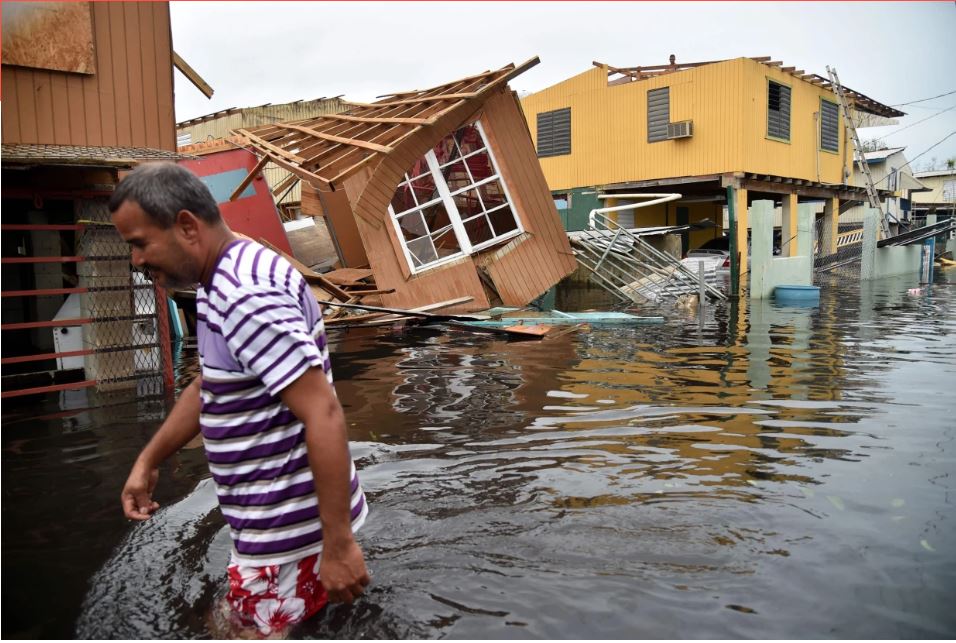
Catano, Puerto Rico, on Sept. 21, 2017.      Hector Retamal / AFP – Getty Images file

The entirety of Puerto Rico is a frontline community in the climate crisis! The United States colonized Puerto Rico in 1898, exploiting the people and land ever since. The analysis includes this: Five years after Hurricane Maria devastated Puerto Rico, causing thousands of deaths and decimating the archipelago’s already fragile electrical grid, FEMA is planning to finally spend funds intended to alleviate the consequences of natural disasters in making permanent repairs to the network. However, the agency plans to invest at least $12 billion in projects that lock Puerto Ricans into dependence on fossil fuels. The FEMA project conflicts with the Puerto Rico Law of 2019 that establishes the goal of basing 100% of energy production on renewable sources by 2050 and Puerto Rico’s energy plan based on the production and storage of solar energy.  

$12 billion is a HUGE investment in fossil fuels and, frankly, it’s grotesque that those billions would be used to prop up the very industry that caused Hurricane Maria. Why would FEMA do that, especially when Puerto Rico could generate enough renewable energy for its own needs? Well, perhaps it has something to do with this (from that same analysis): In 2021, Luma Energy, a private American-Canadian corporation, assumed control of the archipelago’s public distribution system. LUMA will be a major recipient of FEMA disaster recovery and mitigation funds. In January, Genera PR, a subsidiary of US liquefied natural gas company New Fortress Energy, was awarded a contract to take over power generation in Puerto Rico.

I haven’t done the research on this, but it’s fairly easy to surmise that politicians receive money from fossil fuel lobbyists and then pressure these agencies to grant funds to fossil fuel companies. Again, completely grotesque and also another example of how our government’s policies are solely driven by special interests.

My intention in posting all this is not to (further) demoralize anyone, but to shine light on what’s happening. We’re better positioned to call B.S. and fight back when we understand the intricacies of exploitation.

If you’ve read this far, thank you for being here with me. Solidarity with you, Puerto Rico, and frontline communities around the globe! ✊🏽

Climate Movement Mondays: on crushing dissent

It’s another Movement Monday post in which we discuss climate-related issues. Typically, I highlight a frontline community–those facing the worst effects of the climate crisis–and then offer a quick action you can take on behalf of people and planet. Today’s post is a bit different and is intended to educate regarding the considerable efforts being made to crush dissent, whether it’s climate protest, pro-Palestine protest, or protest aimed at police brutality. Long story short: the powers that be want us to remain docile and accepting of the many injustices inflicted on people and the environment, and they do not take well to organized protest.

Image by StockSnap from Pixabay

Last week, I wrote about student protest and authoritarianism. We’ve all seen the images of heavily militarized police coming onto campuses to attack and arrest students for daring to, among other things, demand their tuition money not be invested in the manufacture of weapons used in the ongoing genocide of Palestinians. Here’s a video of Virginia State Police threatening UVA students on May 4th, the anniversary of the four students murdered by the National Guard on the Kent State campus in 1970. Over and over again, students are being threatened and brutalized by the police. (edited to add: Oddly enough, the police didn’t intervene at UCLA when pro-Palestinian students were literally being attacked and beaten by Zionists.)

It hasn’t escaped these young people’s attention that the same police who stood outside as children were being slaughtered in a classroom are all too willing to don riot gear to wade into crowds of unarmed people who’ve gathered on behalf of an oppressed people. In Texas, students chanted “You failed Uvalde.” Also? A week ago yesterday, white supremacists were allowed to march in Charleston, West Virginia. Where were the police and their riot gear?

The willingness to send heavily armed police onto campuses is just one facet of what’s happening in this country in anticipation of rising unrest due to climate collapse, income inequality, nonstop wars, broken supply chains, etc. There are many other signs pointing to how any one of us will be treated in the near future if we dare voice opposition to the status quo.

On May 3 (as police continued to brutalize students and faculty), Biden put out a statement renewing his pleas for Congressional support for his “Safer America Plan.” Biden wants “Congress to invest $37 billion to support law enforcement and crime prevention, including by funding 100,000 additional police officers…” We don’t have universal healthcare and are not at all prepared for the ravages of climate collapse, but there’s always money/support for more cops! But this is who Biden’s always been; in the 90s he joined forces with segregationist Strom Thurmond to sponsor and pass the “Violent Crime Control Act” and in  2022, Biden used his state of the union speech to encourage the use of $350 billion in COVID recovery funds to hire more police.

I’ve written about Cop City in Atlanta multiple times and highly recommend also reading my post that connects the dots between civic actions, protest, militarized police response, and trumped up charges of terrorism that result in RICO charges. You might wonder why we should care about Atlanta. Well, guess what? The proposed urban warfare training center in Atlanta is just one of 69 proposed cop training centers in the country. Go here for an interactive map showing the status of proposed sites around the U.S.

There’s more oppression on the horizon. From Truthout: In April, the House of Representatives passed HR 6408 by a vote of 382-11. This legislation would grant the secretary of the treasury broad power to designate any charity as a “terrorist supporting organization” and remove its tax-exempt status within 90 days. The Senate introduced its companion measure, S 4136, shortly after. While that article primarily focuses on pro-Palestinian organizations, climate journalists and activists have pointed out this legislation would also make it very easy to target climate nonprofits (and any other organization that threatens the status quo). This legislation is even more alarming with the knowledge there’s a very real chance Trump will get another four years in the White House. Somehow, the Dems and Republicans always find a way to come together in order to oppress the people.

For no particular reason, ahem, I want to link to this earlier post about the U.S. government’s decade-long campaign against the anti-pipeline movement.

And one last note on our current reality: the United States incarcerates more people than any other country in the world. Two million people are in jail or prison. Prison Policy Initiative breaks it down here with easy to read graphs and info.

Finally, I have a book to recommend: NO MORE POLICE: A CASE FOR ABOLITION by Mariame Kaba and Andrea J. Ritchie.

If you’ve read this far, give yourself a cookie! I appreciate you taking the time to wade into all this information. It’s a lot, but it’s important we know what’s happening. I’d love to hear your thoughts on this so please talk to me in the comments. Solidarity! ✊🏽

Climate Movement Monday: Lake Charles Methanol plant

Welcome back to Movement Mondays in which we discuss all things climate and then take a quick action on behalf of a frontline community. This week, we’re focusing on the people of Lake Charles, Louisiana, who are facing yet another proposed plant in an area that, according to the EPA, already has some of the worst air pollution in the country. But before I get into that I wanted to quickly update you on a previous action on behalf of people in Louisiana. I’m happy to report that The Vessel Project reached its $25,000 fundraising goal after their office was damaged by a tornado two+ weeks ago, and they are now back at work providing mutual aid, disaster relief, and environmental justice in their community. Yay!

Today’s post info comes from Healthy Gulf (highlighted here before) and this is the info I received via email:

In October 2023, Lake Charles Methanol (LCM) submitted a new application for an air operating permit to the Louisiana Department of Environmental Quality (LDEQ). This plant was previously given authorization in 2016, but despite the fact that they have yet to break ground, this polluting project is still being pushed on Lake Charles communities.

If given approval for this permit, LCM would be able to produce up to 10,000 metric tons of methanol per day, resulting in over 350 tons of toxic emissions per year.

This project is proposed for the heart of Southwest Louisiana, where many community members have been experiencing the effects of toxic industry buildout in their backyards. Many disenfranchised communities, as well as communities of color continue to be targeted and impacted by this buildout.

The deadline to submit comments has been extended to Wednesday, May 1. Please take action today and tell LDEQ to reject Lake Charles Methanol II’s request for an air operating permit.

For a healthy Gulf, 
Breon Robinson
——————————————–

I debated whether to make writing a comment today’s ask since we’re not living in that community, but then thought about how I’d appreciate people from other parts of the country speaking out in solidarity for my community’s health and well-being.  And to be clear, the people in those communities are being sacrificed on the altar of capitalism and consumerism. That’s where industries concentrate their toxic and hazardous plants and factories, and the people there are the first to suffer the effects of those pollutants AND the extreme weather caused by climate change. It’s not acceptable.

I personalized my letter to acknowledge that I don’t live in the community, but would not want those toxic chemicals in my community. Also? When I went to the Louisiana Tourism site and saw this quote at the top of the page: We have the best food, music, and culture in the world, but it’s our people that make Louisiana such a special place to visit!, I had another talking point: if Louisiana really considers their people the most important asset, then they should be protecting ALL citizens from toxic chemicals and poor health. It’s not necessary to personalize your letter, but it will carry more weight if you do.

Thank you for reading this far and taking action on behalf of people who are already dealing with a toxic environment that degrades public health and the environment. Solidarity! ✊🏽

Climate Movement Monday: human composting

Welcome back to Movement Mondays in which we discuss all things climate. Today also happens to be Earth Day which, to be honest, I’d like to ignore rather than get caught up in overly-optimistic and/or downright dishonest rhetoric (I’m looking at you, Biden, as you supply tens of thousands of tons of explosives so that Israel may continue blowing up Palestinians, their residences, infrastructure, and farmland). Those in power are not honoring the earth and its inhabitants, and they should all keep “Earth Day” out of their mouths. Okay, Tracy. *deep breaths*

Instead, let’s talk about human composting, otherwise known as Natural Organic Reduction! I’m interested in this topic for two reasons: (1) I plan to be composted upon my death and (2) because my work-in-progress is a middle grade novel about a girl and her family’s funeral home that pivots from conventional death care (embalming, burial in ornate coffins, flame cremation) to green burial and natural organic reduction. Fortunately for me, in March of 2023, I was able to (virtually) attend the very first human composting conference ever (organized by Seth Viddal of The Natural Funeral)! I learned so much and could talk your ear off about all this, but today will only provide a brief overview along with some resources.

Recompose vessel

In early 2021, Recompose became the first human-composting funeral home in the U.S. Katrina Spade is the founder of Recompose, and the person most responsible for spearheading the human composting  movement. Thanks to her efforts and those of advocates around the country, human composting is now legal not only in Washington, but also Colorado, Oregon, Vermont, California, New York, Nevada, and Arizona. Legislation has been introduced in another sixteen states (scroll down for list/links).

Why is human composting a climate matter? For every person who chooses Recompose over conventional burial or cremation, one metric ton of carbon dioxide is prevented from entering the atmosphere. In addition, our approach to human composting requires 1/8 the energy of conventional burial or cremation. Recompose allows you to choose an end-of-life option that strengthens the environment rather than depleting it. (This info came from Recompose, but the same applies for human composting via any funeral home’s process.)

From that same page: Current funerary practices are environmentally problematic. Each year, 2.7 million people die in the U.S., and most are buried in a conventional cemetery or cremated. Cremation burns fossil fuels and emits carbon dioxide and particulates into the atmosphere. Conventional burial consumes valuable urban land, pollutes the soil, and contributes to climate change through resource-intensive manufacture and transport of caskets, headstones, and grave liners. The overall environmental impact of conventional burial and cremation is about the same.

Not only does human composting avoid those environmental costs, the process produces soil! Why does that matter? Again, from Recompose: The breakdown of organic matter is an essential component in the cycle that allows the death of one organism to nurture the life of another. Soil is the foundation of a healthy ecosystem. It filters water, provides nutrients to plants, sequesters carbon, and helps regulate global temperature.

Human composting produces about a truck-bed full of soil. Families of the deceased are given the option of taking some or all of that soil OR donating it to land conservation and restoration sites. I’m not sure about other states, but know that here in Colorado the law prohibits the sale of the soil or using it on plants grown for food. The Colorado Burial Preserve in Florence, CO, accepts human composting soil for land restoration (in addition to being a green burial site).

I learned during the conference that many who choose human composting don’t make that choice based on climate concerns, but because it just feels right to be returned to the earth after death. One of the other human composting vendors said that people want more choice for their deaths and that natural organic reduction appeals to them on a “freedom” level. A while back, I wrote about death and how my decision to be composted has given me incredible peace of mind. Everyone should have the freedom to make a death-care choice that speaks to their values. There’s much more to be said about the grief process and how natural organic reduction allows for participation by family and friends, along with a timeline that supports gentle grieving as opposed to an abrupt “that’s-that” burial practice, but I’ll save that conversation for another post.

In the meanwhile, I’d like to offer resources:

  • Go here to learn more about pending legislation and how you can get involved in bringing human composting to your state
  • Visit “The Order of the Good Death” for lots of information about death care, including Calls to Action in support of a “good death” (Note: Founder Caitlin Doughty is an incredibly smart, funny, and compelling speaker/writer on this issue)

I’ll stop here, but PLEASE don’t hesitate to ask questions! As stated, I love talking about this issue and if I don’t have answers, I can point you in the right direction. It’s an exciting development in death care and I hope by sharing this information, some of you might experience a ping of recognition (as in, that’s what I want for me!)

Thank you for reading. Solidarity! ✊🏽

Climate Movement Monday: in support of The Vessel Project

Welcome back to Movement Mondays in which we talk all things climate and then take a quick action on behalf of people and planet. I was out of the loop this past week because Zippy had major surgery last Tuesday and was in the hospital until yesterday (he’s got a ways to go but is doing well!), and was blissfully unaware of anything happening outside the ICU and then Room 5921. For instance, I didn’t know there were tornados in Louisiana last week.

I’ve written before about frontline communities along the Gulf being poisoned by petrochemical and fossil fuel facilities, including how Roishetta Ozane lives next to Westlake Chemical plant. Roishetta is the founder of The Vessel Project which is “a grassroots mutual aid, disaster relief, and environmental justice organization founded in Southwest Louisiana in response to several federally declared disasters, including hurricanes Laura and Delta, winter storm Uri, and the May flood of 2021.” Their office in Lake Charles, Louisiana, was severely damaged on April 10th in an EF2 tornado that touched down shortly after 6am with damaging winds of over 115 mph. (Video of that tornado.) And now they need our help!

One of The Vessel Project’s missions is helping their community after disasters. Per the website: After a disaster, we assist the affected with their most immediate needs, whatever they may be. Whether it is emergency shelter, food, formula, diapers, oxygen tanks, cleaning supplies, application assistance, or document recovery—we have learned that the best way to help people is by asking them what will help.

I’m here today soliciting donations on behalf of Roishetta and the entire organization that works tirelessly to support their community. Any amount helps! If you can, PLEASE donate to this GoFundMe in support the rebuilding efforts for The Vessel Project. Clean up, repair, and new office equipment are needed!

These are very hard days on the planet but people are taking care of each other, and that gives me great hope. Thank you for reading this far. Solidarity! ✊🏽

Climate Movement Monday: immediate & permanent ceasefire in Gaza

Welcome back to Movement Mondays in which we discuss all things climate. No matter where we live on this planet, we are all affected by climate change. The climate crisis knows no boundaries or political affiliations, and it’s in our collective best interest to do everything we possibly can to slow earth’s warming.  The Democrats pretend to believe this truth, yet they continue to prop up a genocidal campaign against the Palestinians.

As I posted in early January, Israel’s constant bombardment of Gaze (with weapons provided by the U.S.)  is cancelling out any progress we’ve made on climate change. Now it’s three months later, and the slaughter continues. Please understand, the uppermost concern is the people of Gaza, and we should all be using our voices and resources in their defense.

Tasnim News Agency 2023 via Wikimedia Commons

But if you need another reason to care about what’s happening and our government’s role in not only accelerating the genocide but also climate change, then read this from Jeff Jones and Eleanor Stein at The Nation: The Single Most Important Thing President Biden Can Do for the Climate Is Enforce an Immediate Cease-Fire in Gaza.

The article isn’t long but I want to highlight this: According to a report from Brown University’s Watson Institute, the US Department of Defense is “the world’s largest institutional user of petroleum and correspondingly, the single largest institutional producer of greenhouse gases.” In other words, military emissions significantly drive the total of US emissions. And this is a peacetime analysis.

And this closing paragraph: War is simultaneously deepening the climate crisis—and making it impossible to solve. The linkage is clear. It is imperative for us to reflect this in our organizing, our advocacy, in the streets and classrooms, and in our thinking in ways we have not yet done. As we near Earth Day 2024, let’s make an immediate and permanent cease-fire in Gaza a point of global unity.

So what can we do when it’s clear the ruling elites don’t care that voters are  overwhelmingly opposed to the government funding and enabling genocide? We keep making noise.

  • If you’re in Wisconsin, PLEASE vote “Uninstructed delegation” in tomorrow’s (April 2) Democratic primary to send the message to Biden that you’re withholding your vote while he enables genocide and climate devastation. (In other states , the term is “Uncommitted” and as a result of those primaries in Michigan, Minnesota, Hawaii, and Missouri, there will be 23 uncommitted Democratic delegates at the Democratic Convention). And if you have friends/family in Wisconsin, please ask them to vote “Uninstructed delegation.” You can find more info about this campaign at ListenToWisconsin.com including this: Our goal is to use the democratic process to demand an immediate and permanent ceasefire and an end to the genocide in Gaza. We also call for the full entry of humanitarian aid, reinstating aid to UNRWA, and an end to US military aid to Israel. Our votes in the Democratic Primary are a tool to send a clear message to the administration that the margin of victory in Wisconsin will be determined by a serious and immediate change in this administration’s approach in Gaza.
  • Send emails to Biden and Harris
  • Call Biden and Harris (recommend calling Switchboard at 202-456-1414 then ask to be transferred to Comment Line which is 202-456-1111)
  • Send emails to your two Senators and one Representative
  • Call your two Senators and one Representative
  • Put signage in your window, yard, vehicle, etc.
  • Post on social media
  • Talk to your friends, family, neighbors about Palestine
  • Gain confidence by reading and learning more
  • Attend rallies and marches
  • Donate to UNRWA, GazaSunbirds, Doctors Without Borders, World Central Kitchen

It can all feel so futile, I know. But there’s so much to continue fighting for and we can’t give up. Let’s remember our shared humanity. Let’s remember that no matter where we reside, Earth is home to all of us and we cannot survive without a livable planet.

Thank you for reading this far. I appreciate you very much and hope you’ll share thoughts and feelings in the comments. Solidarity! ✊🏽

Climate Movement Monday: climate resiliency and insurance companies

Welcome back to Movement Mondays in which we discuss all things climate and then take a quick action on behalf of people and planet. This week’s info comes from a Stop the Money Pipeline email on behalf of the Connecticut Citizen Action Group which “for the last 4 years, has been working hard to hold insurance companies accountable for propping up fossil fuel projects and fueling the climate crisis.” You might be reading this, wondering why anyone living outside Connecticut should care what’s happening there. My take is that we should care because when one state takes the lead on an issue, it makes it easier for other states to adopt those tested policies. Climate leadership emboldens other states to follow suit!

You might also be wondering about the connection between insurance companies and climate change. Go HERE for a quick primer on how insurance companies, the companies we pay to protect us from catastrophic damages, are the very companies fueling the climate crisis.

The following is from Jackie of Stop the Money Pipeline:

We have some exciting climate news. This month, the Connecticut General Assembly’s Environment Committee just voted a groundbreaking policy out of committee. But we need your help to get it over the finish line: We need to keep the most important amendments in the bill. (Tracy here again: I found the letter template to be a bit confusing so am linking my letter as a sample on how you might personalize AND to emphasize that the ask is to keep the amendment!)

The committee voted to approve the Governor’s Climate Resiliency bill (SB11) with an amendment that advances a climate resiliency fund to support communities in Connecticut harmed by extreme weather disasters fueled by climate chaos.

The measure instructs the Commissioner of Energy and Environmental Protection to propose by the end of the year how a fund would be financed with a surcharge on insurers’ policies offered to fossil fuel projects. This could be replicated in other states if it passes.

Thank the Governor for the Climate Resiliency bill and urge him to make CT a leader by keeping the insurance study amendment!

Thanks to CCAG, the bill is headed to the Senate floor, and we have a real chance at holding insurers accountable.

This piece of legislation would take a crucial step in highlighting insurers’ role in the climate crisis, and hold them accountable for the devastation their underwriting policies have caused as they pull coverage from the most disaster-prone areas of the country.

Send an email to the CT Governor now! We need to continue to hold insurance companies accountable.

If we get a win in Connecticut, this law could be replicated in other states. Let’s make it happen.

Tracy again. Thank you for reading and taking action! We’re all in this together and every climate win is a win for people and planet. Solidarity! ✊🏽

Climate Movement Monday: Juliana v United States (AGAIN)

Hello, it’s another Monday which means a Movement Monday post! Thank you for being here for discussions about climate and the frontline communities facing the worst of the climate crisis. This giant blue ball is home to ALL of us and we need to keep showing up in order to ensure the planet remains livable.

The Juliana 21 (image from Our Children’s Trust)

Today is a time-sensitive ask (a quick personal letter) as we revisit the children’s climate case: Juliana v United States. Here’s the background info from my January 30, 2023, post:

In 2015, 21 young Americans filed a landmark constitutional climate lawsuit, Juliana v. United States, against the U.S. government. Their complaint asserts that the government’s affirmative actions, like fossil fuel energy policies, knowingly cause and worsen the climate crisis. The youth claim that this violates the youngest generation’s constitutional rights to life, liberty, property, and equal protection of the law, as well as fails to protect essential public trust resources.

These 21 young people are seeking a judicial declaration that the U.S. fossil fuel energy system is unconstitutional and violates their fundamental right to a safe climate. A victory in their case would mean that all current and future U.S. climate and energy policy – whether executive or legislative in nature, and regardless of political majority or party – would need to adhere to the court’s declaratory judgment, protecting the rights of our nation’s children to a safe climate.

Despite President Biden’s promises to listen to youth and address the climate crisis, his Department of Justice is still actively opposing the Juliana case, denying their rights and seeking to prevent the young plaintiffs from presenting evidence to a judge in open court of how their own government is causing them harm.
—————————

You may recall that exactly three weeks ago, I asked you to take action on this very case. The good news is that 35,000+ letters were sent demanding that the Department of Justice (DOJ) stop their stalling tactics and allow the case to go to trial AND that 75 organizations joined the efforts to #SaveJuliana. The bad news is that the DOJ asked for a stay (their 22nd attempt to shut down this case!) Good news? The U.S. Court of appeals denied the stay! BUT on February 29, the DOJ said we have 21 days to make the case for why Juliana should go to trial. That’s where we come in.

PLEASE, take two minutes to personalize the letter template to send a message to the Biden administration and the DOJ demanding that the young people are heard in court! 

Maybe you have children or grandchildren or are a teacher or librarian who works with young people, and maybe you want to include concern for them in your letter. Maybe you want to mention that if Biden wants to be known as the “climate president,” he should allow this case to go to trial. Maybe you want to mention droughts, floods, hurricanes, or winter tornadoes you’ve suffered due to the climate crisis. Whatever your approach, let’s stand up for the young who did not create this climate catastrophe but who are already facing the consequences of their elders’ inaction. Let’s give them a brighter future!

Also? If you could forward the info to two friends or family members and ask them to send letters today, we will grow our impact. For those on Facebook, Twitter/X, or Instagram, here’s a toolkit with graphics and messaging to help spread the word.

Thank you for reading and engaging on this issue. Solidarity! ✊🏽

Climate Movement Monday: lies from Big Meat via HEATED

Welcome back to Movement Mondays in which we focus on climate-related topics. I typically try to highlight an issue directly affecting a frontline community and then offer an action you can take on their behalf. Today I’m taking a different approach and using this opportunity to shine a light on a wonderful climate newsletter called HEATED.

Emily Atkin

Per their About page, HEATED is “Accountability journalism for the climate crisis,” from climate journalists Emily Atkin and Arielle Samuelson. I started out as a subscriber and am now a paid subscriber because I want to support their in-depth reporting, and I hope you’ll check them out.

Arielle Samuelson


I’ve chosen today’s story because it involves meat and  I haven’t yet addressed the climate impact of eating industrially-raised animals in Movement Mondays.  To be honest, I haven’t thought about it much as I’m a lifelong vegetarian but am guessing at least some of my readers are meat-eaters and will welcome this info as it identifies certain brands making false sustainability claims. At the heart of this story is JBS USA, an arm of the world’s largest meatpacking company, and its fraudulent promise to reach “net zero emissions by 2040,” and the New York Attorney General going after them for this claim. I’ve linked the newsletter below.

Big Meat is lying about sustainability. These media outlets are helping.
Can newsrooms really expect people to trust their reporting if they fund it by spreading misinformation?  by Emily Atkins and Arielle Samuelson. March 6, 2024

Thank you for reading and please share any thoughts or questions in the comments. Note: I scheduled this post before leaving for a national wildlife refuge to see thousands of Sandhill Cranes, so my replies will come later this week. Solidarity! ✊🏽

Climate action needed!

Typically I make one climate-related ask per week, but this info from Stop the Money Pipeline landed in my email box after I put up yesterday’s post, and it’s a time-sensitive request. Comments needed today! I’m going to paste that email below but, spoiler alert, the ask is that you personalize a letter to the Securities and Exchange Commission (SEC).  Thank you in advance for reading and taking action! Solidarity! ✊🏽

Edited to add: Just sent my letter which requires more steps (the SEC making things harder for we-the-people to be heard) and wanted to say that while it’s more complicated than usual, it’s doable! 🙂 Follow the instructions and holler here in the comments if you need help.

Image by Pete Linforth from Pixabay

From Stop the Money Pipeline:

The Securities and Exchange Commission (SEC)–a major Wall Street and corporate regulator–is asleep at the wheel. This Wednesday, March 6th, it will vote on a crucial climate financial risk disclosure rule, an earlier draft of which required big corporations like banks and fossil fuel companies to report their scope 1, 2, AND 3 emissions. According to media reports, the current draft has them reporting only their scope 1 and 2 emissions, if they want to(1), which would miss most fossil fuel industry emissions and all financed emissions from banks.

Industry lobbyists are gutting this rule because they do not want people saving for retirement to know just how much their investments are at risk from these corporations’ decisions.

Take action with us and send an email to the SEC: They must protect investors and require companies to disclose all greenhouse gas emissions!  

Think of this–insurance companies are raising premiums at ridiculous rates while pulling out of areas they deem “uninsurable,” which typically lines up with historically redlined districts. Under the current draft of the rule, Scope 3 emissions, which include emissions from financing to burning fossil fuels, will not be disclosed.

If the industry lobbyists get their way, companies will get to choose whether or not they report Scopes 1 and 2 emissions (emissions from the energy the company buys, and emissions from the production process, including company vehicle emissions). Is it right that companies get to decide how transparent they should be?

Tell the SEC: Your disclosure rule needs some major work. Urge them to require companies to disclose their climate emissions.

The fossil fuel industry is toxic. This rule fails to respond to real-time hidden risks with financial implications for our entire economy. In the context of a ‘dying’ fossil fuel industry, we need to be able to foresee how prices will change as flows of money shift from fossil fuels to a clean future.

If this final rule is weaker than what the SEC proposed two years ago, it will fail the agency’s mission to protect investors and provide transparency about corporate climate risks. They should know we’re angry. Please take this action ASAP to make sure they hear our voices before the vote on Wednesday.

Together, we can make our voices heard and pressure these decision-makers to do the right thing at every opportunity.

In solidarity,
– the Stop the Money Pipeline team

1. https://www.politico.com/newsletters/the-long-game/2024/02/27/down-to-the-wire-at-the-sec-00143511

Climate Movement Monday: train derailment in East Palestine, Ohio

Welcome back to Movement Mondays in which we discuss all things climate and focus on acting in solidarity with frontline communities. Today’s post isn’t directly climate-related as in drought or flooding, but is connected to public health and the environment. On February 3, 2023, a Norfolk Southern** train carrying liquid vinyl chloride derailed in East Palestine, Ohio. Twenty cars, […], toppled off the tracks and burst into flames. Three days later, railroad officials decided to burn off the remnants in the derailed cars, sending a giant black cloud plume over the village and region.

A black plume rises over East Palestine, Ohio, as a result of a controlled detonation of a portion of the derailed Norfolk Southern trains, Feb. 6, 2023.  // Gene J. Puskar/AP, FILE

Something that I lost track of in following this story is that the black particulate cloud from the burn not only affected people in Ohio, but also communities in Pennsylvania. As a result of last year’s catastrophe, the inhabitants of East Palestine (and beyond) have faced a myriad of mysterious health ailments. Biden didn’t show up there until last month, more than a year since the train derailment. The people of East Palestine hoped he’d finally make a Presidential Disaster Declaration so, among other things, there’d finally be testing of all homes, the soil, and creeks. As resident-turned-activist Jamie Wallace points out in this video interview, the creeks might look okay on the surface but the chemicals have soaked into the sediment. When that sediment is disturbed, there is a “chemical tornado.”

She and the rest of Unity Council for EP Train Derailment, the group formed in the aftermath of the disaster, are calling  for long-term health monitoring for East Palestine residents and access to a toxicologist. At this time, they do not have access to a toxicologist which is SO wrong when considering they’ve been exposed to a known human carcinogen. (An aside: if you’re considering new flooring for your home, PLEASE don’t buy vinyl flooring –that stuff that looks like hardwood–because it’s highly toxic for all from workers, to transport, to home. A good alternative–and one we’ve used in multiple applications–is Marmoleum flooring. We’ve found some good deals online.)

In advance of Biden’s long-overdue visit to East Palestine, a letter outlining recommendations for federal help on this catastrophe was sent to Biden and Michael Regan of the EPA. The following includes their recommendations (full letter HERE):

“. . . we strongly recommend that the federal government issue a “major disaster declaration” and work with Senators J.D. Vance, Sherrod Brown, Bob Casey, John Fetterman, and members of Congress to do the following:
1. Provide immediate and long-term healthcare for the community of East Palestine, in nearby Ohio and Pennsylvania, and other states and communities that have been exposed to the toxic chemical mixture resulting from the derailment, chemical spill, and intentional burn;
2. Set up a long-term medical monitoring program to follow these communities and any
individuals who were in the area over time for a minimum of 20 years;
3. Provide all financial resources for relocation that make it possible for anyone living or who lived in the area who feels they were impacted by hazardous exposure from the train derailment and burn who want to leave the area to do so and move into equivalent housing, and develop a program to replace all household items that may have been contaminated;
4. Conduct comprehensive indoor air testing for anyone in the area who feels they have been exposed or have endured latent exposure due to contaminated waterways, especially homes, businesses, and other buildings near Sulphur Run where vapor intrusion may be occurring;
5. Conduct long-term, robust assessments for hazardous chemicals that may have contaminated the drinking water, both for municipalities and especially for people who rely on well water in East Palestine and nearby communities and anyone who feels their drinking water may have been impacted by the derailment and subsequent release and burn of chemicals; and
6. Significantly expand sampling for dioxins and furans in residential soil, indoor dust, fish, farm animals, wildlife, and other relevant environmental media in East Palestine and nearby communities that may have been impacted.

In addition, we were pleased to see that EPA recently announced that it was beginning a process under the Toxic Substances Control Act (TSCA) to evaluate vinyl chloride. Such a process should end with a ban on vinyl chloride.

****************************************************************

My ask today is to WRITE ONE EMAIL on behalf of the people of East Palestine and nearby communities: You can use the above recommendations, you can demand Biden issue a Disaster Declaration, you can plead for a ban on vinyl chloride, and/or you can just share your outrage that citizens of this country have been left on their own as another corporation gets away with destroying public health and the environment.  What’s important is letting our government know that we are not okay with fellow citizens being poisoned and then left to deal with the devastating aftermath.

President Biden : comments@whitehouse.gov
EPA Administrator, Michael Regan: Regan.Michael@epa.gov

******************************************************************

**You may or may not be surprised to learn that Norfolk Southern’s CEO received a 37% raise last year. This past weekend, Norfolk Southern trains had a collision involving three trains (!)  and derailment of two of those trains in Pennsylvania, spilling plastic pellets and diesel into the waterways.

3.7.24 UPDATE: People wondered in the comments here why Norfolk Southern would burn the vinyl chloride. Watch this eye-opening testimony from a National Transportation Safety Board rep who says NS was told by the vinyl chloride manufacturer it was NOT necessary to burn. It appears NS chose to poison East Palestine chose and surrounding communities in order to immediately resume moving trains through that area.

Thank you for reading and taking action on behalf of East Palestine and the surrounding communities. Solidarity! ✊🏽