Death and war. War and death.

Every day, my inbox is populated with emails about Gaza. Those messages come from people and organizations that refuse to cede ground to apartheid Israel. Today’s emails include updates from fundraisers for Palestinian families and UNRWA (United Nations Relief and Works Agency for Palestine Refugees) whose subject line read: 800 killed in Gaza just trying to get food. Yes, starving people assassinated by Israel and its chief sponsor, the United States taxpayer, for the crime of needing food for their families.

Heartbroken and enraged, I turned to If I Must Die: Poetry and Prose by Refaat Alareer. Refaat was murdered by Israel on December 6, 2023, and his work published posthumously with support from the global community.


The following excerpt is from “In Gaza, We Have Grown Accustomed to War” (October 19, 2023):

Death and war. War and death. These are two persona non grata, yet we can’t force them to leave. To let us be.

Palestinian poet Tamim Barghouti summarizes the relationship between death and the Palestinians that war brings (my translation):

It was not wise of you, Death, to draw near.

It was not wise to besiege us all these years.

It was not wise to dwell this close,

So close we’ve memorized your visage

Your eating habits

Your time of rest

Your mood swings

Your heart’s desires

Even your frailties.

O, death, beware!

Don’t rest that you tallied us.

We are many.

And we are still here

[Seventy] years after the invasion

Our torches are still alight

Two centuries

After Jesus went to his third grade in our land

We have known you, Death, too well.

O, Death, our intent is clear:

We will beat you,

Even if they slay us, one and all.

Death, fear us,

For here we are, unafraid.

Here’s a link to buy If I Must Die (paperback is also available for pre-order).
Here’s a link to donate to UNRWAUSA.org (and yes, they’re still operating in Gaza). This from their email: Our 12,000 UNRWA colleagues in Gaza are still distributing food, water, and medical care, as best they can, every day, under unimaginable circumstances.

Even after more than 320 of our UNRWA colleagues have been killed. Even after dozens of UNRWA shelters have been hit. Even after borders are blocked and bombs continue to drop.

Thank you for reading. Thank you for caring.
From the river to the sea, Palestine will be free.
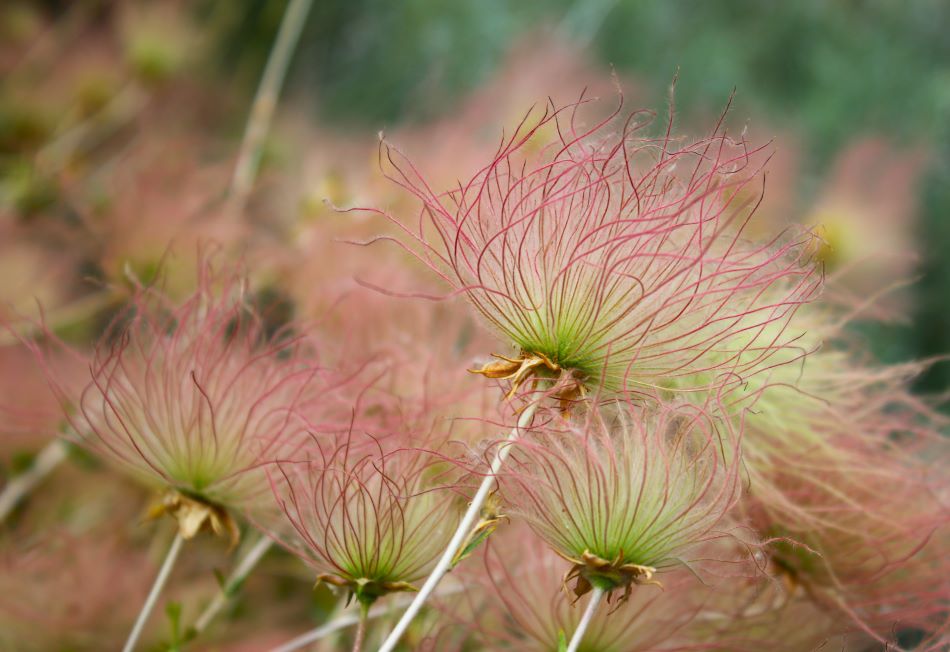
His poetry and my photo

This morning I went into the backyard with the camera and came away with this image from one of our blooming Apache Plumes.

The image reminded me of dancing fairies, delicate and airy. Later, I received an update and thank-you email from a fundraising campaign, sponsored by the Gaza Poets Society, to evacuate two young children from Gaza. The email update stated that due to the continued closure of the Rafah border, the campaign is shifting from evacuation to sustainability (food and basic supplies), and donations of any amount are gratefully accepted.  The thank-you portion of the email was a PDF of the Gaza Poets Society Anthology.

As I read through the poems, Dance with Me made me think of my blooming Apache Plume, and I wanted to share the pairing here. His poetry and my photo, connected across the miles, in honor of our shared humanity.

Dance with Me – Mohammed Moussa

I’ll dance with you
under the rain
in love and pain;
on the seashore of hope
we will sing for life and joy.
We’ll dance
on behalf of absence
in the streets, and
on the outskirts of our city
we’ll flap our wings
lift joy and love
and sing
         and sing

Day 261: it’s all connected, we’re all connected

On this 261st Day of Genocide in Gaza, I admit to being stunned that the carnage has not only not ceased, but has become increasingly depraved. I won’t go into details as the words and images are easily found due to IOF soldiers proudly documenting their depravity/lack of humanity on social media sites. To counteract the sadism, I decided to offer a poem by a Palestinian, and so went in search of something that resonated.

I landed on a poem by Mahmoud Darwish (1941-2008) who is “feted as Palestine’s national poet for his words expressing the longing of Palestinians deprived of their homeland, which was taken by Zionist militias to make way for present-day Israel. His poetry gave voice to the pain of Palestinians living as refugees and those under Israeli occupation for nearly a century.” And because this morning I began reading the Pulitzer Prize-winning Blood in the Water: The Attica Prison Uprising of 1971 and Its Legacy by Heather Ann Thompson, the Darwish poem I chose is “The Prison Cell.” Because just as the United States incarcerates more people than any country on earth (currently about 2 million people), Israel incarcerates thousands upon thousands of Palestinians and holds them without filing charges. It’s all connected. We’re all connected. And just as the incarcerated in the U.S. are treated as less-than and subjected to brutal conditions, so are the Palestinians. It doesn’t matter who we are or where we live on this planet: It’s all connected. We’re all connected.

In this spirit, I offer:

The Prison Cell
by Mahmoud Darwish
(Translated by Ben Bennani)

It is possible . . .
It is possible at least sometimes . . .
It is possible especially now
To ride a horse
Inside a prison cell
And run away . . .

It is possible for prison walls
To disappear,
For the cell to become a distant land
Without frontiers:

What did you do with the walls?
I gave them back to the rocks.
And what did you do with the ceiling?
I turned it into a saddle.
And your chain?
I turned it into a pencil.

The prison guard got angry.
He put an end to the dialogue.
He said he didn’t care for poetry,
And bolted the door of my cell.

He came back to see me
In the morning.
He shouted at me:

Where did all this water come from?
I brought it from the Nile.
And the trees?
From the orchards of Damascus.
And the music?
From my heartbeat.

The prison guard got mad.
He put an end to my dialogue.
He said he didn’t like my poetry,
And bolted the door of my cell.

But he returned in the evening:

Where did this moon come from?
From the nights of Baghdad.
And the wine?
From the vineyards of Algiers.
And this freedom?
From the chain you tied me with last night.

The prison guard grew so sad . . .
He begged me to give him back
His freedom.

—-

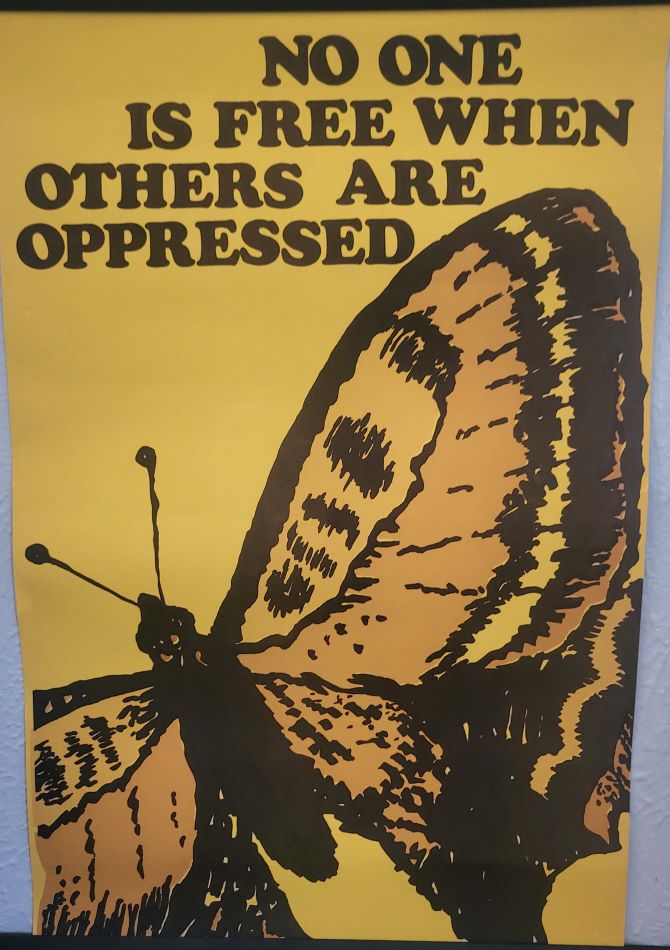
One final connection between Palestinians, the men in Attica in 1971, and me: this poster I unearthed in my basement yesterday, one I’d bought years ago (and possibly hung in my California classroom):


It’s all connected. We’re all connected.

“Pocketful of Warding Stones” by Rasha Abdulhadi

The following poem and image were published at Poetry Online (a nonprofit organization dedicated to sharing literature and art accessibly) on October 21, 2023.
Pocketful of Warding Stones by Rasha Abdulhadi
how much of the weight of time we carry
is the burden the murderers gave us,
and whose ends do we serve to hate
ourselves for not dying as easy as they wanted?
what firekeeper can scrape
the char of guilt from this burnt offering,
pull air over embers of grief & longing,
find some flint in the heart left to light?
how can we untie living grief from the longing
to have done more, and find instead what
more could yet by our breath be done?
we can hold ourselves, responsible yes,
refuse a rebellion captive or complicit
confess instead a broader bravery
on which to spend the coin of our lives.
we who untangle loss from creation by blowing it to bits—
why obscure grief, why hoard it or hide its face,
as if a siphon could drain an ocean, no—
let them hear the holes when we sing.
every death in war is a casualty, no matter the speed
or how exhausted, how unscaffolded the rebuilding.
i know a hurricane who reached through years and state lines
into lungs hearts and bowels, and snatched souls back to flood.
when the disaster of war or the war of disaster steals homes it steals lives,
and though it may take time to cash them, we know where the blame lies.
we ward against the guilt of war
the blistered blessing of surviving our kin, and
around the undefused bombs our bodies hide,
we build a larger house to live in.
though the house of sorrow be vast,
give grief her rooms to stalk through
let living longing paint the walls.
can we then deny guilt, that rent-free tenant,
the lease it seeks in the house of grief?
refuse them victory on this field at least:
our breathing belongs to us
and is not some shame we owe or stole,
or failed to lose like they wanted us to—
our bellows blow to break knees bent over any neck.
i won’t devolve the monument of my body
to the keeping of the state, won’t donate
the corpse of my dreaming
to service the desires of murderers
or their gracious paperwork proctors.
i won’t do the blamework for them.
our mothers have been here before, they know
there’s no antidote for the poisons sown in the fields of war
but i will refuse the death machine of the imagination any morsel more
at least in my heart, the war can’t have you, my friend—
and wherever the last domino of my body falls,
let me land as a gear-breaking wedge—
the murder wheel won’t win my shame.
i won’t let them kill me before i die
and i offer you the same.
——————————-
Rasha Abdulhadi is calling on you, dear reader, to join them in refusing and resisting the genocide of the Palestinian people. Wherever you are, whatever sand you can throw on the gears of genocide, do it now. If it’s a handful, throw it. If it’s a fingernail full, scrape it out and throw. Get in the way however you can. The elimination of the Palestinian people is not inevitable. We can refuse with our every breath and action. We must.

Palestinian poetry and artwork

The following poem by Palestinian-American Fady Joudah and artwork by children’s book illustrator Sohila Khaled come from the recently published Poems for Palestine which was created by Publishers for Palestine. They’ve provided a PDF of the chapbook and we are encouraged to share the work widely. (click to enlarge images)


I also wanted to share this TIME article (by Armani Syed)  from early January: How Poetry Became a Tool of Resistance for Palestinians which ends with this from  George Abraham, a Palestinian-American poet: “. . . it’s imperative that poetry is just one tool in the process for Palestinian liberation and resistance against ethnic cleansing. 

“Poetry can’t stop a bullet. Poetry won’t free a prisoner. And that’s why we need to do the political organizing work as well,” they say. “But if we can’t imagine a free liberated world in language, how can we build one?”

Free Palestine!

Day 155 of the genocidal war on Palestinians

Today is Day 155 of the brutal assault on Gaza. Over 30,000 have been killed, 70% of them women and children.  Sunset tomorrow marks the beginning of Ramadan, the Muslim holy month. Currently, 1.5 million Palestinians are crowded into Rafah, the southernmost city in Gaza, the region they fled to because the Israelis kept telling them to move south to “safe zones.” Every so-called safe zone has been bombed and destroyed and now those traumatized, starving, desperate people are facing the imminent Israeli ground invasion of Rafah, an invasion fully sponsored by the United States. (Genocide Joe is an ardent Zionist and in 1982 revealed to then-Prime Minister, Menachem Begin, Biden’s willingness to slaughter Palestinian women and children, a statement so callous it stunned the militant Zionist PM.)

The situation is horrifying on every single level. PLEASE continue to contact your reps (to make them uncomfortable, if nothing else), demanding an immediate and permanent ceasefire + an end to aid to Israel. Food and supplies must be allowed in!  The performative airdrops are literally killing Palestinians, as they are either targeted by Israel while trying to retrieve the food or are crushed by a pallet.

The following artwork and poem come from POEMS FOR PALESTINE. I shared another poem and illustration from this collection here and you may go here for a free download of the entire chapbook. Publishers for Palestine encourages us to read and share widely!

Artwork: Hassan Manasrah
@hassan.manasrah.illustrations

NOTE: The poem is a screenshot because I wanted to preserve the poet’s spacing. Click on it for an easier read.

Poem from Basman Aldirawi, Gazan poet

This Bread Was Born,
This Bread Was Killed
by Basman Aldirawi

Artwork: Aly S.Elsayed
@aly.selsayed

With clean hands,
he gently sifts the flour,
and adds a handful of yeast.
He pours the warm water
for the yeast particles to live,
then rolls and kneads and rolls
and kneads the dough.
He lets the soft mass rest.
With firm but gentle hands,
he rounds it into balls,
flattens them into shape,
and handles each one
delicately into the oven.
Soon, perhaps in half an hour,
the bread rolls are born fresh,
healthy and browned.
The newborn breads breathe,
yet dust chokes the air,
searing gasses penetrate
their thin, fragile crusts.
On the day of their birth, a missile,
a bakery, a scattering
of zaatar, flesh, and blood.

***************
This poem is from a chapbook issued today by Publishers for Palestine, a global collective of publishers. From their website:
Today we announce the launch of Poems for Palestine: Recent poems by nine Palestinian poets & actions you can take to stop genocide now. Publishers for Palestine have come together to create this free booklet of poetry, artwork, and resources for action, now available for both print and online dissemination. This chapbook is made not for resale, but please read and share as widely as you please!

I encourage you to check out this beautiful book. We must never stop talking about Palestine.

Refaat Alareer: rest in power and peace

Today I learned that Dr. Refaat Alareer, along with his brother, sister, and her four children, were targeted and murdered in an Israeli airstrike. Refaat was a translator, academic, and writer who also reported on life in Gaza. These last two months I got to “know” him on Twitter/X as he shared specific details of the violence and horrors inflicted upon Gazans. Despite the death and destruction, he was funny and hopeful. He struck me as a human being comfortable in his own skin.

At the end of October, I posted a glimpse into LIGHT IN GAZA, an anthology of Palestinian writers and artists sharing their lived experiences under military occupation. But it wasn’t until today that I made the connection that the Refaat from social media was the same man with an essay in LIGHT IN GAZA. Refaat wrote “Gaza Asks: When Shall This Pass?” (Note: You may download the anthology for free from Haymarket Books). I highly recommend reading the entire piece yourself in order to better understand the gift that Refaat was to this world.

In “Gaza Asks,” he shared memories of the random violence he experienced over the years, along with that of friends and family members, and how in each instance they comforted themselves with “It shall pass.” When Refaat was older, teaching world literature and creative writing at the Islamic University in Gaza (IUG), he told stories to his three children to distract them from the twenty-three-day onslaught by Israel’s military (Operation Cast Lead). He told stories as bombs and missiles exploded in the background. Refaat wrote “As a Palestinian, I have been brought up on stories and storytelling. It’s both selfish and treacherous to keep a story to yourself–stories are meant to be told and retold. If I kept a story to myself, I would be betraying my legacy, my mother, my grandmother, and my homeland.”  He went on to say “Telling stories was my way of resisting. It was all I could do. And it was then I decided that if I lived, I would dedicate much of my life to telling the stories of Palestine, empowering Palestinian narratives, and nurturing younger voices.” 

When that particular onslaught ended, Refaat returned to the classroom where he told his students “Writing is a testimony, a memory that outlives any human experience, and an obligation to communicate with ourselves and the world. We lived for a reason, to tell the tales of loss, of survival, and of hope.” He began assigning and training his students to write short stories based on their realities. Those stories were collected and edited by Refaat and published as GAZA WRITES BACK.

But that wasn’t all Refaat did in the classroom. As so succinctly expressed by his friend Dan Cohen, Refaat “used English-language literature and poetry to teach his students the difference between Judaism and Zionism, equipping them with the mental tools to resist Zionist propaganda that seeks to conflate the two.” You can read more about those classroom experiences in “Gaza Asks.”

Later in the essay, in regards to Israel later destroying the administration building at IUG, Refaat wrote “. . . to me, IUG’s only danger to the Israeli occupation and its apartheid regime is that it is the most important place in Gaza to develop students’ minds as indestructible weapons. Knowledge is Israel’s worst enemy. Awareness is Israel’s most hated and feared foe. That’s why Israel bombs a university: it wants to kill openness and determination to refuse living under injustice and racism.”

I’ll stop there because I can’t do justice to the eloquence of Refaat’s essay, and I hope you’ll forgive me for already revealing so much. It’s just that this entire essay touched my heart and I felt compelled to share.

I do want to highlight this poem that follows his essay in LIGHT IN GAZA. Refaat also posted the poem on his Instagram account one week ago:

I’ll end with this poem he’d pinned at the top of his Twitter/X account on November 1: “If I must die, let it be a tale.”

Rest in power and peace, Dr. Refaat Alareer.