Welcome back to Movement Mondays in which we discuss climate-related issues. Typically, I highlight a frontline community (people/place that’s bearing the worst effects of climate change) and then offer a quick action you can take on their behalf. Today I won’t ask you to take action and am, instead, merely offering info that triggered an aha moment when I read it. I’m all about sharing the aha wealth! 🙂
I considered myself fairly well-versed in the many ways that climate change is connected to various aspects of our lives. For instance, our physical and mental health, infrastructure, insurance premiums, poverty, racism, food, supply chains, etc. There’s really no escaping climate change’s many tentacles . But for all that awareness, I somehow never considered that the Federal Emergency Management Agency (FEMA) might play a major role in the continuation and acceleration of the climate crisis. I mean, FEMA’s job is to help people in the aftermath of disasters, so why would that agency take actions that ensure more climate-related disasters? Well, Center for Biological Diversity and a slew of other groups (energy justice , consumer and environmental) are suing FEMA for doing that very thing. From their May 2 press release:
Energy justice, consumer and environmental groups sued the Federal Emergency Management Agency and the Department of Housing and Urban Development today for withholding public records and failing to outline plans to use resilient renewable energy to rebuild communities ravaged by the climate emergency.
The groups also formally petitioned the agencies to craft new regulations to redirect taxpayer dollars these agencies are spending to prop up fossil fuels — the primary driver of human-caused climate change — toward distributed renewable energy recovery and mitigation projects. FEMA spent more than $14 billion last year in states across the country pummeled by floods, fires, hurricanes and other weather-related disasters made worse by burning oil, gas and coal.
The press release goes on to cite a 2018 congressional requirement that demands a definition of “resiliency” that could determine how much FEMA funding goes to environmental justice communities. When I read that, I realized how often “resilient” is thrown around (including by my own city’s “sustainability plan”) and how that term has become nearly meaningless in climate discourse. Because I’ve never asked my city to definite “resiliency,” I don’t even know if they have parameters or whether it’s just a feel-good word used to lull us into a false sense that something’s being done. My bet is on the latter.
I highly recommend reading the entire press release that also includes this reference to the Department of Housing and Urban Development: HUD also spends billions annually on public and assisted housing, further propping up the fossil-fuel economy, without significant effort to encourage the use of renewable energy.
I’m embarrassed to say I never thought about HUD being a willing accomplice in the climate crisis, either.
The press release ends with this: The proposed rules would redirect these funds, requiring that whenever the agencies provide energy funding, they prioritize efficiency and other demand reductions, zero-carbon technologies like rooftop solar and storage, and electric options for home heating and cooking rather than fossil gas.
After reading the press release, I went in search of more info and came across this excellent analysis of the lawsuit that highlights the disaster response in Puerto Rico: Lawsuit Challenges FEMA Funding to Rebuild Puerto Rico’s Fossil Fuel-Reliant Power Grid. The summary paragraph reads: Conservation and community groups filed a lawsuit today against the Federal Emergency Management Agency (FEMA) and the U.S. Department of Homeland Security over their plans to rebuild Puerto Rico’s centralized power grid from the return to the status quo of fossil fuels instead of investing in the distributed renewable energy that Puerto Ricans need.

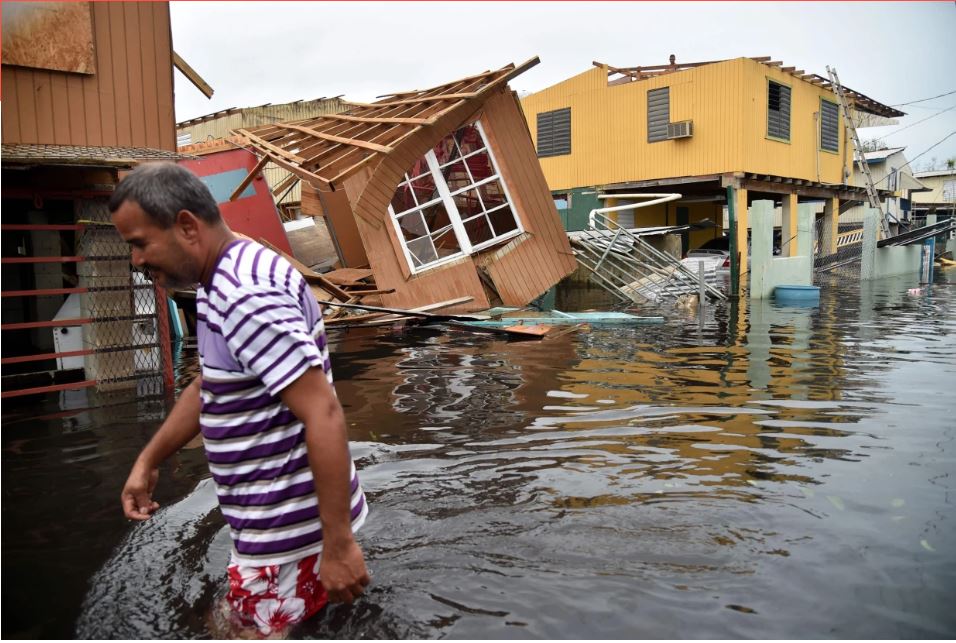
Catano, Puerto Rico, on Sept. 21, 2017. Hector Retamal / AFP – Getty Images file
The entirety of Puerto Rico is a frontline community in the climate crisis! The United States colonized Puerto Rico in 1898, exploiting the people and land ever since. The analysis includes this: Five years after Hurricane Maria devastated Puerto Rico, causing thousands of deaths and decimating the archipelago’s already fragile electrical grid, FEMA is planning to finally spend funds intended to alleviate the consequences of natural disasters in making permanent repairs to the network. However, the agency plans to invest at least $12 billion in projects that lock Puerto Ricans into dependence on fossil fuels. The FEMA project conflicts with the Puerto Rico Law of 2019 that establishes the goal of basing 100% of energy production on renewable sources by 2050 and Puerto Rico’s energy plan based on the production and storage of solar energy.
$12 billion is a HUGE investment in fossil fuels and, frankly, it’s grotesque that those billions would be used to prop up the very industry that caused Hurricane Maria. Why would FEMA do that, especially when Puerto Rico could generate enough renewable energy for its own needs? Well, perhaps it has something to do with this (from that same analysis): In 2021, Luma Energy, a private American-Canadian corporation, assumed control of the archipelago’s public distribution system. LUMA will be a major recipient of FEMA disaster recovery and mitigation funds. In January, Genera PR, a subsidiary of US liquefied natural gas company New Fortress Energy, was awarded a contract to take over power generation in Puerto Rico.
I haven’t done the research on this, but it’s fairly easy to surmise that politicians receive money from fossil fuel lobbyists and then pressure these agencies to grant funds to fossil fuel companies. Again, completely grotesque and also another example of how our government’s policies are solely driven by special interests.
My intention in posting all this is not to (further) demoralize anyone, but to shine light on what’s happening. We’re better positioned to call B.S. and fight back when we understand the intricacies of exploitation.
If you’ve read this far, thank you for being here with me. Solidarity with you, Puerto Rico, and frontline communities around the globe! ✊🏽


 Tracy Abell