Today I’m deviating from my usual Climate Movement Monday post to offer some info regarding what’s happening now between Palestine and Israel. We in the United States, whose government gives Israel’s military $3.8 billion per year, have been fed a narrative about the conflict between Israel and Palestine. We have been programmed to believe it’s a complex situation rather than clear-cut apartheid akin to South Africa. It can be intimidating to speak out on behalf of Palestinians because of the knee-jerk charges of anti-semitism, but the morality of the situation demands we do just that.

A boy waves a Palestinian flag, at the Israel-Gaza border, during clashes with Israeli troops, at a protest where Palestinians demand the right to return to their homeland, east of Gaza City, April 1, 2018.
(Reuters /Mohammed Salem)
I encourage you to read this October 7 piece from Haggai Matar “Gaza’s shock attack has terrified Israelis. It should also unveil the context. The dread Israelis are feeling after today’s assault, myself included, has been the daily experience of millions of Palestinians for far too long.”
Here’s an excerpt: “In Gaza, meanwhile, the ongoing siege is continuously destroying the lives of over two million Palestinians, many of whom are living in extreme poverty, with little access to clean water and about four hours of electricity a day. This siege has no official endgame; even an Israeli State Comptroller report found that the government has never discussed long-term solutions to ending the blockade, nor seriously considered any alternatives to recurring rounds of war and death. It is literally the only option this government, and its predecessors, have on the table.”
And for more background on the situation, Indigenous organizer, Kelly Hayes of Truthout, had an in-depth conversation with Palestinian American organizer, Lea Kayali, on Kelly’s “Movement Memos” podcast (transcript provided) in May 2021. The title of this episode is “What the Mainstream Media Never Told You About Palestine.”
Here’s an excerpt, a quote from Lea Kayli: “Our resistance will actually always be called violence, even if no physical human beings are actually being harmed and I think the characterizations of, for example, the Boycott, Divestment and Sanction movement, sort of clarifies how that can happen, but that really, forces us to ask this question about what is violence? In the Palestinian context, Israel has one of the world’s largest and most well-financed military, bankrolled by of course, that 3.8 billion dollars of U.S. tax money a year. When we ask ourselves, what is violence, I’d highlight that life expectancy in Israel is 10 years higher than it is the West Bank and Gaza. The infant mortality rate in Gaza is more than five times higher than it is in Israel and several times higher than it is in the U.S.. Palestinians … and obviously, within the U.S. there’s massive disparities in those numbers as well, when we look at racial breakdown. And to me, this characterization is essential, because all of these things are forms of violence and Palestinians in every corner of historic Palestine are facing violent dispossession. So the reality is that the State of Israel does not want Palestinians to live. That is the core violence. Population control and demographic supremacy is literally baked into the idea of Zionism, as with any ethnostate, and it’s written into the laws of the country, as we talked about earlier.”
One way to show solidarity with Palestinian people’s fight for freedom, justice, and equality is to check out the
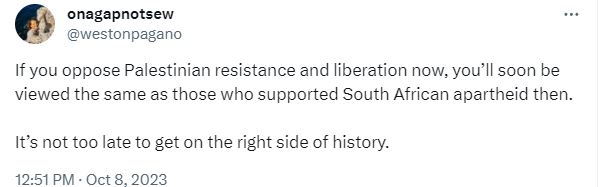
BDS Movement (Boycott, Divest, Sanctions). Another is to have conversations with friends and families, especially those who believe the situation is too complex for them to hold an opinion. This tweet from a couple days ago really resonated with me:
Wishing you all a good week! We’re headed out for a camping trip and will be without internet connection, but I’d love to engage with you on this upon my return. Until then, solidarity! ✊🏽











 Tracy Abell