Climate Movement Monday: deadly heat in Gaza

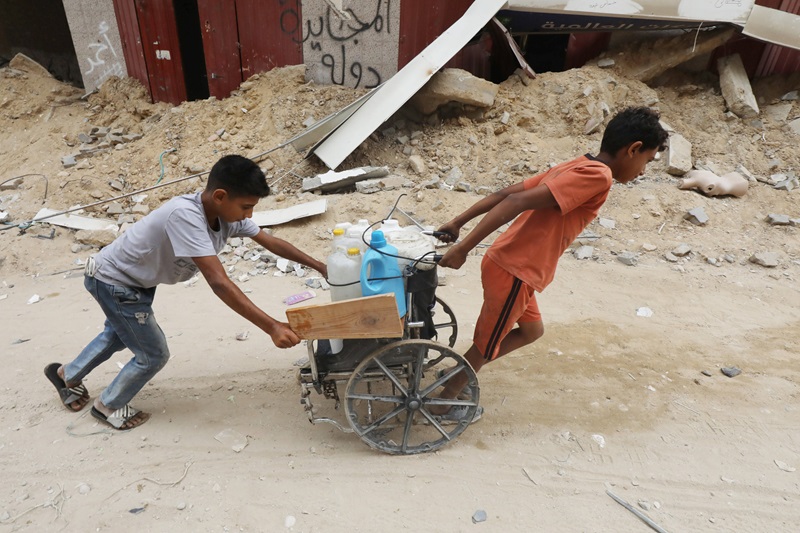
Welcome back to another Movement Monday in which we talk about the climate crisis and the communities already getting hit the hardest. Today’s post focuses on the people of Gaza who have not only been under attack since October–thousands and thousands of bombs raining down on them no matter where they go–but have also been under siege in terms of deprivation of food, water, medical supplies, and humanitarian aid.  On top of all that, displaced Palestinians faced a record-breaking heatwave that pushed temperatures over 100 degrees as they huddled in tents that became deathly hot. This article from Climate Home News points out the disparity between how the Israelis’ in Tel Aviv and Gazans living in refugee camps handle high temperatures. Spoiler alert:  people in Tel Aviv stay in their air-conditioned homes or travel to the sea to sit under beach umbrellas while Gazans forced to live in nylon tents are losing their children to heat stroke. This week, the temperatures will “only” be in the upper 80s and low 90s, but if you’ve ever slept in a tent not shaded by trees, you know how unbearably hot it gets inside.

Boys carry water bottles in Gaza on May 28, 2024. (Photo: Naaman Omar)

Here’s an excerpt from the Climate Home News article:
The predicament of Gazans forced to endure sweltering conditions in ill-equipped tents is not an isolated problem. Across the world, climate change and war are forcing more and more people out of their homes and into makeshift camps. More than 75 million people are currently displaced inside their own countries – 50% more than five years ago.

Read that last line again: More than 75 million people are currently displaced inside their own countries – 50% more than five years ago

If you’re like me, reading something like that can tip you precariously close to despair. But we can also have a different response. We can read something that feels overwhelmingly bad and ask ourselves “what can I do here and now to effect change?” Today I’m going to share some links for ways in which we can help Gazans.

  • MUNICIPALITY OF GAZA is working toward the restoration of sewage treatment, waste management, and access to clean water which will cut down on waterborne illnesses.  You can donate HERE (any amount helps!) If you appreciated Refaat Alareer’s work I shared here (including “If I must die, let it be a tale”), please note that he also ran the social media account for the Municipality of Gaza (@munigaza).
  • GAZA FUNDS is a project that connects people to crowdfunding campaigns for individuals and families from Gaza. Each time the page is reloaded, a different campaign appears. While the rotation is randomized, campaigns for the sick/injured and campaigns close to meeting their goals are prioritized. We never want any of these campaigns to go stagnant, so we make sure to also prioritize fundraisers that haven’t had a donation in a while. As existing fundraisers meet their goals, they will be replaced with other fundraisers that need your help. You can donate HERE. I’ve seen people on Twitter highlighting their $5 donations to several campaigns with the knowledge that those contributions add up as well as give Palestinians the much-needed boost of knowing they haven’t been forgotten by the rest of the world. (more info re the Gaza Funds volunteers here). Also, I’m including the below graphics that offer additional ideas on how to help plus social media account info.

One last note to help make the connection between the United States and what’s happening in Gaza: On May 31, multiple water mains in Atlanta burst and people were/are under a boil water advisory. Many parts of the city are still without water. As I write this, it appears there’s still no clear communication on the water situation and many Atlanta residents are calling out Mayor Andre Dickens for attending a fundraiser on Friday AFTER THE FIRST PIPE BURST. The water infrastructure failure further highlights that the push to build Cop City in Atlanta to the tune of $100 million is the absolute wrong “public safety” initiative needed when the city can’t even provide citizens clean, safe water.

If you’ve read this far, thank you for being here! We’re facing incredibly difficult realities, but we’re much stronger together. Solidarity!✊🏽

Raising a middle finger to A.I.

After this morning’s writing session in which I sought refuge from our current reality by working (some more) on chapter 8 of my middle grade novel, I came here to check my WordPress dashboard. In my Contacts spam folder, was the following:
Edited to add this gem from another spammer on 6.5.24:
This state-of-the-art web app allows you to create captivating children’s books using advanced AI technology. It takes care of both the writing and illustration, and all you need to do is input your ideas (or let the app come up with the idea too, LOL). No writing or illustration skills needed!

“Pocketful of Warding Stones” by Rasha Abdulhadi

The following poem and image were published at Poetry Online (a nonprofit organization dedicated to sharing literature and art accessibly) on October 21, 2023.
Pocketful of Warding Stones by Rasha Abdulhadi
how much of the weight of time we carry
is the burden the murderers gave us,
and whose ends do we serve to hate
ourselves for not dying as easy as they wanted?
what firekeeper can scrape
the char of guilt from this burnt offering,
pull air over embers of grief & longing,
find some flint in the heart left to light?
how can we untie living grief from the longing
to have done more, and find instead what
more could yet by our breath be done?
we can hold ourselves, responsible yes,
refuse a rebellion captive or complicit
confess instead a broader bravery
on which to spend the coin of our lives.
we who untangle loss from creation by blowing it to bits—
why obscure grief, why hoard it or hide its face,
as if a siphon could drain an ocean, no—
let them hear the holes when we sing.
every death in war is a casualty, no matter the speed
or how exhausted, how unscaffolded the rebuilding.
i know a hurricane who reached through years and state lines
into lungs hearts and bowels, and snatched souls back to flood.
when the disaster of war or the war of disaster steals homes it steals lives,
and though it may take time to cash them, we know where the blame lies.
we ward against the guilt of war
the blistered blessing of surviving our kin, and
around the undefused bombs our bodies hide,
we build a larger house to live in.
though the house of sorrow be vast,
give grief her rooms to stalk through
let living longing paint the walls.
can we then deny guilt, that rent-free tenant,
the lease it seeks in the house of grief?
refuse them victory on this field at least:
our breathing belongs to us
and is not some shame we owe or stole,
or failed to lose like they wanted us to—
our bellows blow to break knees bent over any neck.
i won’t devolve the monument of my body
to the keeping of the state, won’t donate
the corpse of my dreaming
to service the desires of murderers
or their gracious paperwork proctors.
i won’t do the blamework for them.
our mothers have been here before, they know
there’s no antidote for the poisons sown in the fields of war
but i will refuse the death machine of the imagination any morsel more
at least in my heart, the war can’t have you, my friend—
and wherever the last domino of my body falls,
let me land as a gear-breaking wedge—
the murder wheel won’t win my shame.
i won’t let them kill me before i die
and i offer you the same.
——————————-
Rasha Abdulhadi is calling on you, dear reader, to join them in refusing and resisting the genocide of the Palestinian people. Wherever you are, whatever sand you can throw on the gears of genocide, do it now. If it’s a handful, throw it. If it’s a fingernail full, scrape it out and throw. Get in the way however you can. The elimination of the Palestinian people is not inevitable. We can refuse with our every breath and action. We must.

On this Memorial Day

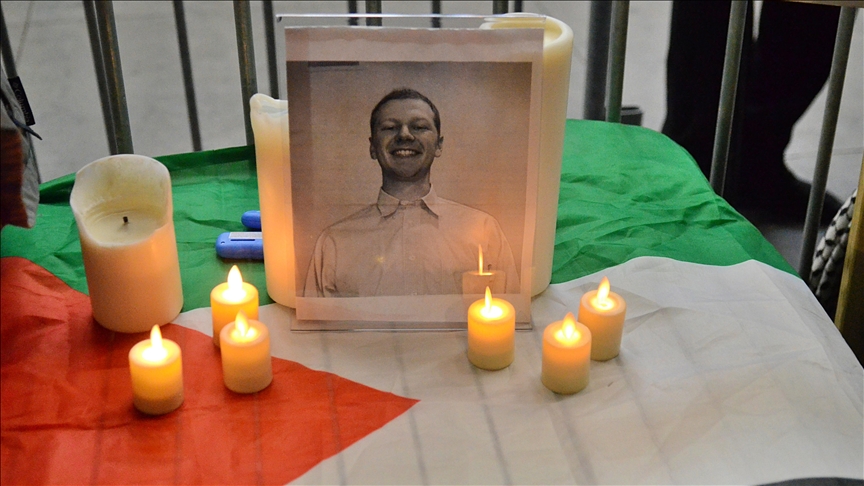
Today, as neighbors fly their red-white-and-blue flags and the U.S. government-sponsored slaughter of Palestinians in Rafah reaches new levels of horror, my thoughts are on Aaron Bushnell who was a 25-year-old active serviceman (U.S. Air Force). On February 25, Bushnell self-immolated in front of the Israeli Embassy in Washington. D.C.

Before setting himself on fire, Bushnell said this“I will no longer be complicit in genocide. I’m about to engage in an extreme act of protest, but compared to what people have been experiencing in Palestine at the hands of their colonizers it’s not extreme at all. This is what our ruling class has decided will be normal.”  His final words were “Free Palestine.”

I wanted to highlight Aaron Bushnell today, in part, because I also want to highlight the reality of the U.S. military that recruits desperate people who see no other way to build a future for themselves. Levi Pierpont went through basic training with Aaron Bushnell and the two became friends. After a year-long process, Pierpont was released from the military as a conscientious objector in 2023. In this opinion piece published after Bushnell’s death, Pierpont wrote of the talks he’d had with fellow service-people about wanting to get out of the military before their contracts expired:

During the process, I had so many conversations with fellow military members, a great many of whom could relate to the way I felt. One member spoke frankly with me, admitting that she had serious concerns with supporting the military. However, faced with the high costs of medical care outside the military, she commented: “If I have to sell my soul to the devil to get my children healthcare, that’s what I have to do.” [emphasis mine].

Think about that: because the elites have decided we in the U.S. can’t have universal healthcare, young people are forced to make the excruciating decision to inflict violence on strangers around the world–literally blowing up men, women, and children–so that their own children will get the medical care they need.

According to Pierpont, there are also those in the military who are unable to carry the burden of their role in violence and destruction. The above paragraph ends with this:  “Others were considering taking their lives as the only way to escape, and had no hope that they could make it to the end of their contract.”

I wonder how many of those flying flags today think about the despair felt by military personnel. How many of those flag-wavers would support service members who’ve served this country and now want out after realizing that what they’re being forced to do is an affront to their consciences and souls? What exactly does it mean to “support our troops”?

Today I honor Aaron Bushnell who made his own excruciating decision to very publicly protest the U.S.’s role in the genocide in Gaza. To be very clear, that’s not a death I wanted for him or for any of us who feel so much anger and despair about the slaughter and destruction being carried out in our names. Instead, I want an end to U.S. imperialism and the military industrial complex so that corporations no longer get rich off death and destruction. I want an end to people being forced to commit violence because their own country treats them violently via not providing for their material needs such as food, housing, healthcare, and clean air/water. In the meanwhile, I made a donation in honor of Bushnell and Pierpont to the non-profit Center on Conscience & War that “advocates for the rights of conscience, opposes military conscription, and serves all conscientious objectors to war.”

Aaron Bushnell’s final Facebook post (since removed) said this:
“Many of us like to ask ourselves, “What would I do if I was alive during slavery? Or the Jim Crow South? Or apartheid? What would I do if my country was committing genocide?”

The answer is, you’re doing it. Right now.”

Rest in power, Aaron Bushnell.

********

Final note: In reading more about Aaron Bushnell, I learned about an earlier act of self-immolation in December 2023 by an unidentified woman holding a Palestinian flag in New York City. At the time of the article’s publication, the woman remained hospitalized in stable condition.

Drunk on writing

On a personal level, 2024 has brought an awful lot of pain and hardship to people I love, making these first five months feel like an entire year has already passed. And when I factor in the horrors of the U.S.–sponsored genocide of Palestinians, the emotional weight of these days is almost more than I can bear. But I’m now finding consistent refuge in my writing because I’ve made it a daily priority.

Rather than trying to cram a writing session into whatever slots I could find in my days and then saying oh-well if it didn’t happen, writing is now (again) part of my morning routine. As a result, I’ve been making slow progress on the second draft of my middle grade novel. I typically work for 60-90 minutes and that’s enough to keep me (mostly) centered for the rest of the day. That routine and commitment to my creativity keep me afloat, although some days I look and feel like this disheveled Northern Shoveler.

Lake Hasty. April 2, 2024

As Ray Bradbury said, You must stay drunk on writing so reality cannot destroy you.

Climate Movement Monday: FEMA, Puerto Rico, and renewable energy

Welcome back to Movement Mondays in which we discuss climate-related issues. Typically, I highlight a frontline community (people/place that’s bearing the worst effects of climate change) and then offer a quick action you can take on their behalf. Today I won’t ask you to take action and am, instead, merely offering info that triggered an aha moment when I read it. I’m all about sharing the aha wealth! 🙂

I considered myself fairly well-versed in the many ways that climate change is connected to various aspects of our lives. For instance, our physical and mental health, infrastructure, insurance premiums, poverty, racism, food, supply chains, etc. There’s really no escaping climate change’s many tentacles . But for all that awareness, I somehow never considered that the Federal Emergency Management Agency (FEMA) might play a major role in the continuation and acceleration of the climate crisis. I mean, FEMA’s job is to help people in the aftermath of disasters, so why would that agency take actions that ensure more climate-related disasters? Well, Center for Biological Diversity and a slew of other groups (energy justice , consumer and environmental) are suing FEMA for doing that very thing. From their May 2 press release:

Energy justice, consumer and environmental groups sued the Federal Emergency Management Agency and the Department of Housing and Urban Development today for withholding public records and failing to outline plans to use resilient renewable energy to rebuild communities ravaged by the climate emergency.

The groups also formally petitioned the agencies to craft new regulations to redirect taxpayer dollars these agencies are spending to prop up fossil fuels — the primary driver of human-caused climate change — toward distributed renewable energy recovery and mitigation projects. FEMA spent more than $14 billion last year in states across the country pummeled by floods, fires, hurricanes and other weather-related disasters made worse by burning oil, gas and coal.

The press release goes on to cite a 2018 congressional requirement that demands a definition of “resiliency” that could determine how much FEMA funding goes to environmental justice communities. When I read that, I realized how often “resilient” is thrown around (including by my own city’s “sustainability plan”) and how that term has become nearly meaningless in climate discourse. Because I’ve never asked my city to definite “resiliency,” I don’t even know if they have parameters or whether it’s just a feel-good word used to lull us into a false sense that something’s being done. My bet is on the latter.

I highly recommend reading the entire press release that also includes this reference to the Department of Housing and Urban Development: HUD also spends billions annually on public and assisted housing, further propping up the fossil-fuel economy, without significant effort to encourage the use of renewable energy.

I’m embarrassed to say I never thought about HUD being a willing accomplice in the climate crisis, either.

The press release ends with this: The proposed rules would redirect these funds, requiring that whenever the agencies provide energy funding, they prioritize efficiency and other demand reductions, zero-carbon technologies like rooftop solar and storage, and electric options for home heating and cooking rather than fossil gas.

After reading the press release, I went in search of more info and came across this excellent analysis of the lawsuit that highlights the disaster response in Puerto Rico: Lawsuit Challenges FEMA Funding to Rebuild Puerto Rico’s Fossil Fuel-Reliant Power Grid. The summary paragraph reads: Conservation and community groups filed a lawsuit today against the Federal Emergency Management Agency (FEMA) and the U.S. Department of Homeland Security over their plans to rebuild Puerto Rico’s centralized power grid from the return to the status quo of fossil fuels instead of investing in the distributed renewable energy that Puerto Ricans need.

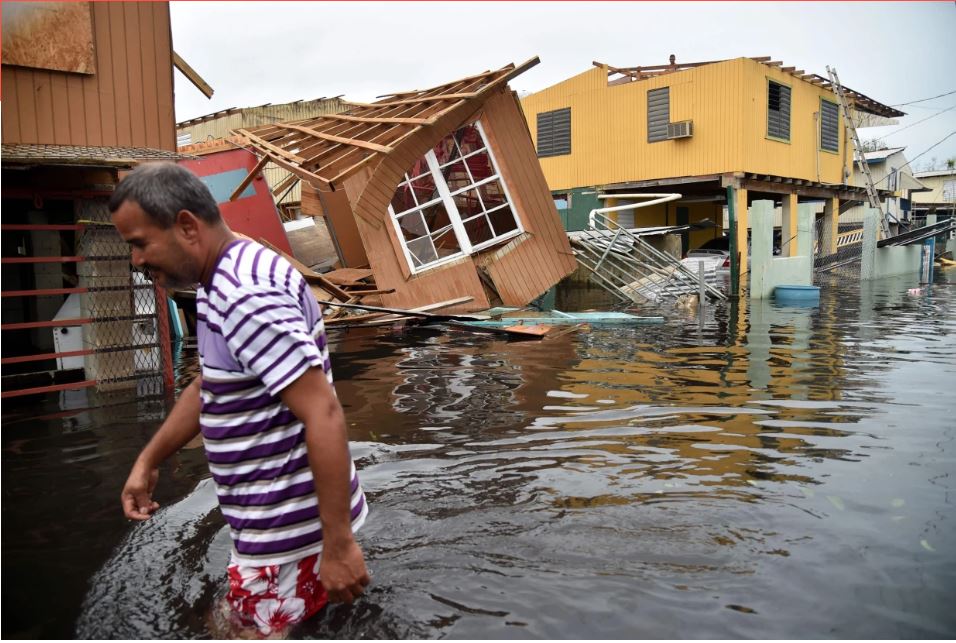
Catano, Puerto Rico, on Sept. 21, 2017.      Hector Retamal / AFP – Getty Images file

The entirety of Puerto Rico is a frontline community in the climate crisis! The United States colonized Puerto Rico in 1898, exploiting the people and land ever since. The analysis includes this: Five years after Hurricane Maria devastated Puerto Rico, causing thousands of deaths and decimating the archipelago’s already fragile electrical grid, FEMA is planning to finally spend funds intended to alleviate the consequences of natural disasters in making permanent repairs to the network. However, the agency plans to invest at least $12 billion in projects that lock Puerto Ricans into dependence on fossil fuels. The FEMA project conflicts with the Puerto Rico Law of 2019 that establishes the goal of basing 100% of energy production on renewable sources by 2050 and Puerto Rico’s energy plan based on the production and storage of solar energy.  

$12 billion is a HUGE investment in fossil fuels and, frankly, it’s grotesque that those billions would be used to prop up the very industry that caused Hurricane Maria. Why would FEMA do that, especially when Puerto Rico could generate enough renewable energy for its own needs? Well, perhaps it has something to do with this (from that same analysis): In 2021, Luma Energy, a private American-Canadian corporation, assumed control of the archipelago’s public distribution system. LUMA will be a major recipient of FEMA disaster recovery and mitigation funds. In January, Genera PR, a subsidiary of US liquefied natural gas company New Fortress Energy, was awarded a contract to take over power generation in Puerto Rico.

I haven’t done the research on this, but it’s fairly easy to surmise that politicians receive money from fossil fuel lobbyists and then pressure these agencies to grant funds to fossil fuel companies. Again, completely grotesque and also another example of how our government’s policies are solely driven by special interests.

My intention in posting all this is not to (further) demoralize anyone, but to shine light on what’s happening. We’re better positioned to call B.S. and fight back when we understand the intricacies of exploitation.

If you’ve read this far, thank you for being here with me. Solidarity with you, Puerto Rico, and frontline communities around the globe! ✊🏽

Friday Haiku: on democracy

try to guess the crime
protesting a genocide
state-sponsored terror

OR (because I’m all about revision)
criminalizing
protest against genocide
state-sponsored terror

Please add your own haiku in the comments (and feel free to revise)!

NOTE: The caption beneath that photo in Los Angeles Times: Hundreds of law enforcement personnel descended on UC Irvine to move hundreds of pro-Palestinian students, faculty and supporters protesting the UC system’s investments in Israel. (Robert Gauthier / Los Angeles Times)

On this Nakba Day

Today is Nakba Day. What is Nakba Day? A Brief History 

There are many, many heartbreaking stories of what Palestinians endured as a result of that ethnic cleansing and displacement. One of the faculty members who spoke at the Auraria Campus encampment commencement ceremony on Sunday told us of their father and grandparents’ Nakba experience in which they walked to Syria, only to be told they weren’t welcome, then walked to Lebanon where they were forbidden entrance, and finally ended up in Nazareth. According to the speaker, their father refused to accept life as a “refugee” and later came to the U.S.

Image from Wikimedia Commons

These stories are painful and filled with heartache and injustice, but we cannot pretend Nakba didn’t happen (or that it isn’t playing out again right now). Many in the Jewish community refuse to stay silent and are in solidarity with Palestinians. The following email came this morning from If Not Now and, in the final paragraph, has links to further resources about the Nakba, along with a link for Gaza donations:

Today we mark 76 years since the Nakba, or catastrophe, when over 750,000 Palestinians were ethnically cleansed from their homes and countless villages were wiped off the map during the establishment of the State of Israel. The Israeli government has continued the Nakba by carrying out a policy of land expropriation and deprivation of Palestinians’ fundamental rights from 1948 through today.

As we bear witness to the continuation of the Nakba over the decades, we recognize the chilling parallels between 1948 and today’s catastrophe in Gaza, as the Israeli military slaughters tens of thousands of Palestinians and forces over a million people from their homes – the largest displacement of Palestinians since 1948. 

This history — together with our history as Jews of facing ethnic cleansing and mass slaughter — compels us to call for an end to the Israeli military’s genocidal assault on Gaza and to work towards an equal, just, and thriving future for all Palestinians and Israelis, free from ethnic cleansing, violence, apartheid, and oppression that reckons with and addresses the Nakba and other injustices.

You can listen to the stories of Palestinians who lived through the Nakba at the Nakba Archive. Learn more about the history and its consequences at Zochrot. Follow, amplify, and contribute to @gazafunds on Twitter/X.

In Solidarity,
Em, IfNotNow

It’s Tracy again. If you’ve read this far, thank you.
Free Palestine!

On this Mother’s Day

Just got home from the Auraria Campus solidarity encampment in Denver. Students have been camping on the Tivoli Quad for, I believe, 18 days now. Despite serious fear-mongering from ace reporter Jim Hooley, Zippy and I saw no signs of weaponry or human waste today.

What we did see was lots of love and admiration for the approximately 20 young people from the encampment who received diplomas during “The People’s Graduation.” We heard from one of those graduates who was introduced as an organizing wizard (in just six hours, they organized three actions that spanned twelve hours) and  also heard from faculty members who are in solidarity with the students. As always, the speeches at these pro-Palestine gatherings brought tears while also filling my heart with love and hope.

It was a wonderful way to spend this Mother’s Day and it felt very fitting that the rainy, overcast skies cleared, allowing the sun to shine down on the events. I’ll leave you with this poem shared by one of the speakers.

Solidarity on behalf of all children!

Hope and grief can coexist

I don’t know about you, but it’s increasingly difficult for me to get out of bed in the morning. So far, I’ve been able to rally my energy rather than remain curled in the fetal position with the covers pulled over my head, but today I feel the need to return to one of my favorite resources, LET THIS RADICALIZE YOU (mentioned earlier here).

Sandhill Cranes from March 11, 2024, here representing Hope and Grief

The wise Kelly Hayes and Mariame Kaba wrote a chapter titled “Hope and Grief Can Coexist” which is filled with wisdom from their decades of organizing. The following was written in conjunction with paragraphs about climate collapse, but also applies to our broader experience (emphasis mine):

We feel deeply for those who are suffering and for the young people who have inherited this era of catastrophe. We share in their heartbreak and fury.

We also know this: hope and grief can coexist, and if we wish to transform the world, we must learn to hold and to process both simultaneously. That process will, as ever, involve reaching for community.

In a society where fellowship and connection are so lacking, where isolation and loneliness abound, we are often ill equipped to process grief. [   ]  Grief can also lead us to retreat and recoil and, too often, to abandon people to suffer in ways that we cannot bear to process and behold. 

. . . we, as people, do have power. Depending on our choices, we can turn away from injustice and let it continue, or we can confront our grief and move forward to shift the course of societal action in the face of a massive failure of leadership and institutional abandonment. Grief, after all, is a manifestation of love, and our capacity to grieve is in some ways proportional to our capacity to care. Grief is painful, but when we process our grief in community, we are less likely to slip into despair.

Personally, it helps to view my grief as a manifestation of love, maybe because it’s a reminder of my sense of humanity and connection to others, which makes the pain feel almost welcome. Maybe this perspective does the same for you. Later in the chapter, Hayes and Kaba write:

When we talk about hope in these times, we are not prescribing optimism. Rather, we are talking about a practice and a discipline–what Joanna Macy and Chris Johnstone have termed “Active Hope.” As Macy and Johnstone write,

Active Hope is a practice. Like tai chi or gardening, it is something we do rather than have. It is a process we can apply to any situation, and it involves three key steps. First, we take a clear view of reality; second, we identify what we hope for in terms of the direction we’d like to see expressed; and third, we take steps to move ourselves or our situation in that direction. Since Active Hope doesn’t require our optimism, we can apply it even in areas where we feel hopeless. The guiding impetus is intention; we choose what we aim to bring about, act for, or express. Rather than weighing our chances and proceeding only when we feel hopeful, we focus on our intention and let it be our guide.

Hayes and Kaba continue: This practice of hope allows us to remain creative and strategic. It does not require us to deny the severity of our situation or detract from our practice of grief. To practice active hope, we do not need to believe that everything will work out in the end. We need only decide who we are choosing to be and how we are choosing to function in relation to the outcome we desire and abide by what those decisions demand of us.

This practice of hope does not guarantee any victories against long odds, but it does make those victories more possible. Hope, therefore, is not only a source of comfort to the afflicted but also a strategic imperative.

Whew. Just typing out those words helped center me in my grief and to feel those stirrings of hope all over again. My wish is that they do the same for you. Solidarity, friends!

Climate Movement Mondays: on crushing dissent

It’s another Movement Monday post in which we discuss climate-related issues. Typically, I highlight a frontline community–those facing the worst effects of the climate crisis–and then offer a quick action you can take on behalf of people and planet. Today’s post is a bit different and is intended to educate regarding the considerable efforts being made to crush dissent, whether it’s climate protest, pro-Palestine protest, or protest aimed at police brutality. Long story short: the powers that be want us to remain docile and accepting of the many injustices inflicted on people and the environment, and they do not take well to organized protest.

Image by StockSnap from Pixabay

Last week, I wrote about student protest and authoritarianism. We’ve all seen the images of heavily militarized police coming onto campuses to attack and arrest students for daring to, among other things, demand their tuition money not be invested in the manufacture of weapons used in the ongoing genocide of Palestinians. Here’s a video of Virginia State Police threatening UVA students on May 4th, the anniversary of the four students murdered by the National Guard on the Kent State campus in 1970. Over and over again, students are being threatened and brutalized by the police. (edited to add: Oddly enough, the police didn’t intervene at UCLA when pro-Palestinian students were literally being attacked and beaten by Zionists.)

It hasn’t escaped these young people’s attention that the same police who stood outside as children were being slaughtered in a classroom are all too willing to don riot gear to wade into crowds of unarmed people who’ve gathered on behalf of an oppressed people. In Texas, students chanted “You failed Uvalde.” Also? A week ago yesterday, white supremacists were allowed to march in Charleston, West Virginia. Where were the police and their riot gear?

The willingness to send heavily armed police onto campuses is just one facet of what’s happening in this country in anticipation of rising unrest due to climate collapse, income inequality, nonstop wars, broken supply chains, etc. There are many other signs pointing to how any one of us will be treated in the near future if we dare voice opposition to the status quo.

On May 3 (as police continued to brutalize students and faculty), Biden put out a statement renewing his pleas for Congressional support for his “Safer America Plan.” Biden wants “Congress to invest $37 billion to support law enforcement and crime prevention, including by funding 100,000 additional police officers…” We don’t have universal healthcare and are not at all prepared for the ravages of climate collapse, but there’s always money/support for more cops! But this is who Biden’s always been; in the 90s he joined forces with segregationist Strom Thurmond to sponsor and pass the “Violent Crime Control Act” and in  2022, Biden used his state of the union speech to encourage the use of $350 billion in COVID recovery funds to hire more police.

I’ve written about Cop City in Atlanta multiple times and highly recommend also reading my post that connects the dots between civic actions, protest, militarized police response, and trumped up charges of terrorism that result in RICO charges. You might wonder why we should care about Atlanta. Well, guess what? The proposed urban warfare training center in Atlanta is just one of 69 proposed cop training centers in the country. Go here for an interactive map showing the status of proposed sites around the U.S.

There’s more oppression on the horizon. From Truthout: In April, the House of Representatives passed HR 6408 by a vote of 382-11. This legislation would grant the secretary of the treasury broad power to designate any charity as a “terrorist supporting organization” and remove its tax-exempt status within 90 days. The Senate introduced its companion measure, S 4136, shortly after. While that article primarily focuses on pro-Palestinian organizations, climate journalists and activists have pointed out this legislation would also make it very easy to target climate nonprofits (and any other organization that threatens the status quo). This legislation is even more alarming with the knowledge there’s a very real chance Trump will get another four years in the White House. Somehow, the Dems and Republicans always find a way to come together in order to oppress the people.

For no particular reason, ahem, I want to link to this earlier post about the U.S. government’s decade-long campaign against the anti-pipeline movement.

And one last note on our current reality: the United States incarcerates more people than any other country in the world. Two million people are in jail or prison. Prison Policy Initiative breaks it down here with easy to read graphs and info.

Finally, I have a book to recommend: NO MORE POLICE: A CASE FOR ABOLITION by Mariame Kaba and Andrea J. Ritchie.

If you’ve read this far, give yourself a cookie! I appreciate you taking the time to wade into all this information. It’s a lot, but it’s important we know what’s happening. I’d love to hear your thoughts on this so please talk to me in the comments. Solidarity! ✊🏽

Bird balm for the soul

This afternoon Zippy and I went to Belmar Park for an infusion of nature, and it was just what we needed. The Double-crested Cormorants were nesting and their grunting, pig-like sounds cracked me up.

I also enjoyed the Canada Geese and after downloading my pics was pleasantly surprised to discover this photo also includes an array of sunning Painted turtles.

We also saw a whole lot of Barn Swallows flying above the water, catching insects. A couple times we startled at whirring sounds as they flew inches from our heads. Here’s one taking a break.

Later, I saw this Tree Swallow perched in a tree. Always a thrill when swallows (or any bird, for that matter!) sit still long enough for identification and a decent photo.

There were other sightings (Red-winged Blackbirds, American Robins, Common Grackles), but I’m losing steam so will close with this fellow:

Although I had no idea what I was seeing, Zippy informed me this is a Greater White-fronted Goose. I was particularly taken by the orange feet and legs which is quite a dapper look. However, when Zippy walked past the second time there was some hissing.

But no biting, so all was well. No harm, no fowl!

Student protest and authoritarianism

My plan for today after last night’s multiple police attacks on student encampments around the country was to write (some more) about police response to peaceful protest, further connecting the dots between the many proposed “Cop Cities” around the U.S.  Instead, I’m going to delay my post in order to share a must-read piece from Sarah Kendzior: There’s a Sniper on the Roof of the School Where I Studied Authoritarianism. (You can learn more about Sarah here.)

Sniper on roof at yet another university: Ohio State 4.25.24  

Kendzior’s piece begins with this:

There are snipers on the roof of the school where I got my MA.

There are police beating students at the school where I got my PhD.

At each school, I studied authoritarian regimes and how they brainwash people into believing that state brutality is not only expected, but deserved.

That last sentence bears repeating: “… authoritarian regimes [  ] brainwash people into believing that state brutality is not only expected, but deserved.” We’re witnessing this in real time as people on social media sites and network news cheer on the brutalization of students making the very humane and reasonable demands that their tax dollars and their tuition NOT finance a genocide. Those gleeful and bloodthirsty responses to the violence aimed at students reveal a profound lack of humanity and an eager acceptance of authoritarianism.

Kendzior’s piece goes on to say:
The concrete demands of the students have been drowned out by smears from powerful officials — like Benjamin Netanyahu, who compares the students to German Nazis; or fanatical Zionist Senators like John Fetterman, who compares the students, many of whom are Jewish, to the neo-Nazis of Charlottesville who chanted “Jews will not replace us.”

The campus war is a propaganda war. [emphasis mine]

Ryan Grim of The Intercept wrote yesterday that “Americans who get their news primarily from cable are the only people who believe that Israel is not committing a genocide in Gaza, according to according to a new survey that examined the relationship between attitudes toward the war and news consumption habits.” Make no mistake, the cable news programs are following the Biden administration’s guidance on how they present information. They want us to believe that the students and Palestinians are the “terrorists” in this equation, distracting us with false claims of antisemitism so that we won’t look at the blood-soaked hands of Biden plus the Democrats and Republicans who’ve come together in a show of genocidal unity.

Kendzior goes on to write about the students of Gen Z:
Older people either rapturously proclaim that Gen Z will save America or demonize them as entitled. They are portrayed as saints or sinners, but rarely as human beings with a diverse array of opinions.

Every young generation faces this sneering dismissal. It happened to the Boomers, Gen X, and the Millennials too.

But there’s something cruel about ascribing great responsibility or great blame to a generation that has, in their short lives, endured a global plague, rising autocracy, the loss of civil rights, school shootings, catastrophic climate change, multiple economic crashes, and other atrocities often prefaced with the word “unprecedented”.

Each time I read those words, tears fill my eyes. Not only have we placed an incredible burden on these courageous and principled young people, many are ridiculing their humanity and willingness to fight for others. It’s grotesque. Instead of being physically  attacked by the police and verbally attacked by strangers, these young people deserve our gratitude and support (bail funds listing here).

I’ll stop now, but encourage you to read Sarah Kendzior’s piece in its entirety. None of us are safe with this rapid acceleration of authoritarianism.

Solidarity! ✊🏽

Climate Movement Monday: Lake Charles Methanol plant

Welcome back to Movement Mondays in which we discuss all things climate and then take a quick action on behalf of a frontline community. This week, we’re focusing on the people of Lake Charles, Louisiana, who are facing yet another proposed plant in an area that, according to the EPA, already has some of the worst air pollution in the country. But before I get into that I wanted to quickly update you on a previous action on behalf of people in Louisiana. I’m happy to report that The Vessel Project reached its $25,000 fundraising goal after their office was damaged by a tornado two+ weeks ago, and they are now back at work providing mutual aid, disaster relief, and environmental justice in their community. Yay!

Today’s post info comes from Healthy Gulf (highlighted here before) and this is the info I received via email:

In October 2023, Lake Charles Methanol (LCM) submitted a new application for an air operating permit to the Louisiana Department of Environmental Quality (LDEQ). This plant was previously given authorization in 2016, but despite the fact that they have yet to break ground, this polluting project is still being pushed on Lake Charles communities.

If given approval for this permit, LCM would be able to produce up to 10,000 metric tons of methanol per day, resulting in over 350 tons of toxic emissions per year.

This project is proposed for the heart of Southwest Louisiana, where many community members have been experiencing the effects of toxic industry buildout in their backyards. Many disenfranchised communities, as well as communities of color continue to be targeted and impacted by this buildout.

The deadline to submit comments has been extended to Wednesday, May 1. Please take action today and tell LDEQ to reject Lake Charles Methanol II’s request for an air operating permit.

For a healthy Gulf, 
Breon Robinson
——————————————–

I debated whether to make writing a comment today’s ask since we’re not living in that community, but then thought about how I’d appreciate people from other parts of the country speaking out in solidarity for my community’s health and well-being.  And to be clear, the people in those communities are being sacrificed on the altar of capitalism and consumerism. That’s where industries concentrate their toxic and hazardous plants and factories, and the people there are the first to suffer the effects of those pollutants AND the extreme weather caused by climate change. It’s not acceptable.

I personalized my letter to acknowledge that I don’t live in the community, but would not want those toxic chemicals in my community. Also? When I went to the Louisiana Tourism site and saw this quote at the top of the page: We have the best food, music, and culture in the world, but it’s our people that make Louisiana such a special place to visit!, I had another talking point: if Louisiana really considers their people the most important asset, then they should be protecting ALL citizens from toxic chemicals and poor health. It’s not necessary to personalize your letter, but it will carry more weight if you do.

Thank you for reading this far and taking action on behalf of people who are already dealing with a toxic environment that degrades public health and the environment. Solidarity! ✊🏽

A Palestinian Girl’s Fight For Freedom

Several weeks ago, I noted a book I was reading: They Called Me a Lioness: A Palestinian Girl’s Fight for Freedom by Ahed Tamimi and Dena Takruri. (A Palestinian activist jailed at sixteen after a confrontation with Israeli soldiers illuminates the daily struggles of life under occupation in this moving, deeply personal memoir.) As mentioned, I highly recommend reading this for a deeper understanding of what it’s like to be a Palestinian living under Israeli occupation.

We in the U.S. are shielded from the brutal truths of their lived experiences and so not everyone would, for instance, recognize the significance and hypocrisy of the Zionist adjunct professor at Columbia University who this past Monday could not fathom being prevented from going where he wanted to go, when he wanted to go. How dare they stop him?! Well, in the West Bank alone (which is where Ahed Tamimi and family live), there are hundreds of checkpoints, road blocks, and walls that prevent free movement. I read somewhere recently that workers must line up at some checkpoints at 3:00 a.m. in order to get to work on time. That entitled little professor wouldn’t last a week under those circumstances.

The occupation and apartheid are not only damaging to Palestinians, but also the Jewish population. Oppression is not good for anyone. This excerpt came in the final pages of They Called Me a Lioness:

We are seeing this loss of humanity and conscience in real time as Israeli soldiers post videos of themselves gleefully destroying Palestinian homes–ransacking clothing drawers and modeling lingerie, breaking toys, destroying food–and bulldozing warehouses of food and the last working bakery in a neighborhood. They are using drones that mimic the sounds of crying women and children in order to lure Palestinians from their camps in order to shoot them. Mass graves outside hospitals are being unearthed, with doctors in hospital gowns executed with their hands tied behind their backs, patients executed with catheters in them, and children executed while hands are tied. (Note: I don’t have the stomach to search for links to all these atrocities, but I assure you the info is available should you want to see it for yourself.)

Here is one more excerpt from Ahed Tamimi’s story:

I’d like to be able to report that Ahed Tamimi was able to freely continue her studies of international law after serving eight months in prison (as a 16-year-old!) for slapping an Israeli soldier who was raiding her village and harassing her family in their front yard. Unfortunately, that’s not the case. Ahed was arrested again in November 2023 and held for three weeks without being charged. She was released at the end of the month as part of the prisoner exchange, but reported that the women in Israel’s jails are beaten, and refused food and water.

The corporate media presents a very slanted perspective and we are not getting the full story, not at all. I encourage you to learn for yourself by reading  Ahed’s story.

Climate Movement Monday: human composting

Welcome back to Movement Mondays in which we discuss all things climate. Today also happens to be Earth Day which, to be honest, I’d like to ignore rather than get caught up in overly-optimistic and/or downright dishonest rhetoric (I’m looking at you, Biden, as you supply tens of thousands of tons of explosives so that Israel may continue blowing up Palestinians, their residences, infrastructure, and farmland). Those in power are not honoring the earth and its inhabitants, and they should all keep “Earth Day” out of their mouths. Okay, Tracy. *deep breaths*

Instead, let’s talk about human composting, otherwise known as Natural Organic Reduction! I’m interested in this topic for two reasons: (1) I plan to be composted upon my death and (2) because my work-in-progress is a middle grade novel about a girl and her family’s funeral home that pivots from conventional death care (embalming, burial in ornate coffins, flame cremation) to green burial and natural organic reduction. Fortunately for me, in March of 2023, I was able to (virtually) attend the very first human composting conference ever (organized by Seth Viddal of The Natural Funeral)! I learned so much and could talk your ear off about all this, but today will only provide a brief overview along with some resources.

Recompose vessel

In early 2021, Recompose became the first human-composting funeral home in the U.S. Katrina Spade is the founder of Recompose, and the person most responsible for spearheading the human composting  movement. Thanks to her efforts and those of advocates around the country, human composting is now legal not only in Washington, but also Colorado, Oregon, Vermont, California, New York, Nevada, and Arizona. Legislation has been introduced in another sixteen states (scroll down for list/links).

Why is human composting a climate matter? For every person who chooses Recompose over conventional burial or cremation, one metric ton of carbon dioxide is prevented from entering the atmosphere. In addition, our approach to human composting requires 1/8 the energy of conventional burial or cremation. Recompose allows you to choose an end-of-life option that strengthens the environment rather than depleting it. (This info came from Recompose, but the same applies for human composting via any funeral home’s process.)

From that same page: Current funerary practices are environmentally problematic. Each year, 2.7 million people die in the U.S., and most are buried in a conventional cemetery or cremated. Cremation burns fossil fuels and emits carbon dioxide and particulates into the atmosphere. Conventional burial consumes valuable urban land, pollutes the soil, and contributes to climate change through resource-intensive manufacture and transport of caskets, headstones, and grave liners. The overall environmental impact of conventional burial and cremation is about the same.

Not only does human composting avoid those environmental costs, the process produces soil! Why does that matter? Again, from Recompose: The breakdown of organic matter is an essential component in the cycle that allows the death of one organism to nurture the life of another. Soil is the foundation of a healthy ecosystem. It filters water, provides nutrients to plants, sequesters carbon, and helps regulate global temperature.

Human composting produces about a truck-bed full of soil. Families of the deceased are given the option of taking some or all of that soil OR donating it to land conservation and restoration sites. I’m not sure about other states, but know that here in Colorado the law prohibits the sale of the soil or using it on plants grown for food. The Colorado Burial Preserve in Florence, CO, accepts human composting soil for land restoration (in addition to being a green burial site).

I learned during the conference that many who choose human composting don’t make that choice based on climate concerns, but because it just feels right to be returned to the earth after death. One of the other human composting vendors said that people want more choice for their deaths and that natural organic reduction appeals to them on a “freedom” level. A while back, I wrote about death and how my decision to be composted has given me incredible peace of mind. Everyone should have the freedom to make a death-care choice that speaks to their values. There’s much more to be said about the grief process and how natural organic reduction allows for participation by family and friends, along with a timeline that supports gentle grieving as opposed to an abrupt “that’s-that” burial practice, but I’ll save that conversation for another post.

In the meanwhile, I’d like to offer resources:

  • Go here to learn more about pending legislation and how you can get involved in bringing human composting to your state
  • Visit “The Order of the Good Death” for lots of information about death care, including Calls to Action in support of a “good death” (Note: Founder Caitlin Doughty is an incredibly smart, funny, and compelling speaker/writer on this issue)

I’ll stop here, but PLEASE don’t hesitate to ask questions! As stated, I love talking about this issue and if I don’t have answers, I can point you in the right direction. It’s an exciting development in death care and I hope by sharing this information, some of you might experience a ping of recognition (as in, that’s what I want for me!)

Thank you for reading. Solidarity! ✊🏽

Day 192 of the genocidal war on Palestinians

Nobody but the military industrial complex, the Zionists, and AIPAC (American Israel Public Affairs Committee) recipients in the House and Senate want this slaughter to continue. I don’t want it and I’m guessing you don’t want it, either.

Billions and billions of dollars are being handed over to Israel, without condition, so that it may continue to destroy the people and infrastructure of Gaza. This would NOT be  possible without full-throated support from the United States. Biden could make one phone call to put an immediate stop to the carnage. Instead? Israel has been emboldened by U.S. support and is now opening slaughtering Palestinian children at a refugee camp playground.

Know what would be cool?  Sanctions against Israel. Instead, today the U.S. announced sanctions against Iran. Because, yanno, Iran’s drone program has killed over 34,000 people, mostly women and children, disabled thousands more, destroyed every hospital and university, and used mass starvation as a weapon . Oh, wait! It’s Israel (“the only democracy in the Middle East”) that’s killed over 34,000 people by dropping 70,000 tons of Made-in-the-U.S. explosives on the Palestinians.

There are so many grotesque layers to all this. For instance, Israeli Firms Are Working Overtime to Sell Stolen Palestinian Land to US Jews. And the suppression of pro-Palestinian voices continues as USC refuses to allow its Valedictorian to speak at graduation because she linked to a pro-Palestinian page on her Instagram account. You may read Valedictorian Asna Tabassum’s statement HERE. EDITED TO ADD: Right after posting, I saw that the House just passed a Resolution: Expressing the sense of the House of Representatives that the slogan, “from the river to the sea, Palestine will be free” is antisemitic and its use must be condemned. Truly pathetic.

I know many are tired of reading about Gaza, tired of thinking about the horrors, and tired of not being heard. When I made calls this morning to the the White House comment line and my Representative and two Senators, my blood pressure went into overdrive with the knowledge that my supposed representatives in this supposed democracy do not care one iota about my opinions. While that may be true, they still must hear from us. These genocide-enablers do not get a free pass! They need to know we are watching and understanding that this brutal assault on Palestinians could happen to any of us, anywhere around the world. They need to know we object.

Please don’t look away. Please don’t stop making noise and disrupting “business as usual.” Please remember our shared humanity and don’t allow your heart to harden. Palestine will be free.

Solidarity!

Climate Movement Monday: in support of The Vessel Project

Welcome back to Movement Mondays in which we talk all things climate and then take a quick action on behalf of people and planet. I was out of the loop this past week because Zippy had major surgery last Tuesday and was in the hospital until yesterday (he’s got a ways to go but is doing well!), and was blissfully unaware of anything happening outside the ICU and then Room 5921. For instance, I didn’t know there were tornados in Louisiana last week.

I’ve written before about frontline communities along the Gulf being poisoned by petrochemical and fossil fuel facilities, including how Roishetta Ozane lives next to Westlake Chemical plant. Roishetta is the founder of The Vessel Project which is “a grassroots mutual aid, disaster relief, and environmental justice organization founded in Southwest Louisiana in response to several federally declared disasters, including hurricanes Laura and Delta, winter storm Uri, and the May flood of 2021.” Their office in Lake Charles, Louisiana, was severely damaged on April 10th in an EF2 tornado that touched down shortly after 6am with damaging winds of over 115 mph. (Video of that tornado.) And now they need our help!

One of The Vessel Project’s missions is helping their community after disasters. Per the website: After a disaster, we assist the affected with their most immediate needs, whatever they may be. Whether it is emergency shelter, food, formula, diapers, oxygen tanks, cleaning supplies, application assistance, or document recovery—we have learned that the best way to help people is by asking them what will help.

I’m here today soliciting donations on behalf of Roishetta and the entire organization that works tirelessly to support their community. Any amount helps! If you can, PLEASE donate to this GoFundMe in support the rebuilding efforts for The Vessel Project. Clean up, repair, and new office equipment are needed!

These are very hard days on the planet but people are taking care of each other, and that gives me great hope. Thank you for reading this far. Solidarity! ✊🏽