Rest in power, beautiful sister

My sister died on Tuesday. I’m both relieved the cancer can no longer hurt her and heartbroken her life was cut short by that insidious disease.
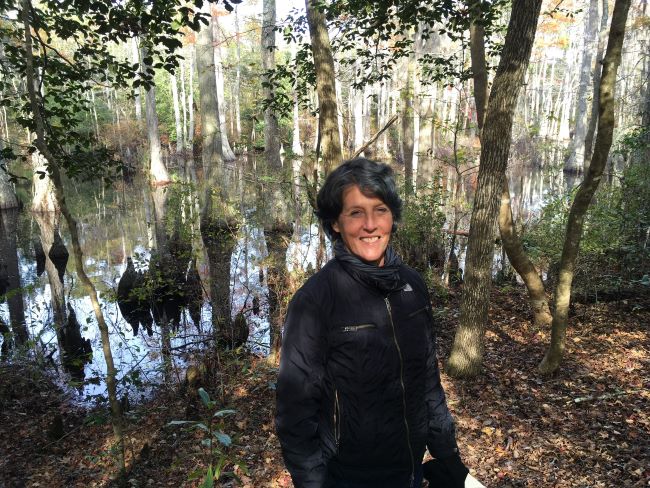
The good news is that Zippy and I were with her in July, and had a very nice visit. We  talked about books (I was reading There There by Tommy Orange which they’d both already read and she was reading Kafka’s The Metamorphosis which I haven’t yet read but now will) and we all expressed admiration for Percival Everett’s James. We watched the Tour de France which was great fun despite the oftentimes baffling  “rules” of the event with its various stages and jerseys, sharing a particular fondness for young rider Ben Healy of Ireland (although we cheered on pretty much every cyclist not riding for Israel). We savored the applesauce she taught me to make when I discovered the bag of overripe apples while cleaning out her refrigerator. My sister also taught me to recognize the song of the Red-eyed Vireo and we put out sugar water for the hummingbirds and peanuts for the jays, and enjoyed all the birds including the male Northern Cardinal who kept throwing himself against the windows as he attacked his own reflection. Edited to add: We also watched a quite large black bear amble through the yard. Kate was doing a personalized Spanish class and the two of us put our heads together to dissect various sentences, searching for the direct and indirect objects which, while not my favorite activity, was still fun because it was in collaboration. My sister loved learning.

Zippy flew back home as scheduled and I stayed another week to help out as her health worsened. Those were hard days but I’ll be forever grateful I could be there for her. When it became clear she needed medical help, I drove her back to the city. It was there, in the hospital, we learned there was nothing more that could be done to stop the cancer.

My sister died in her home, sons and a brother by her side.

The many emotions I’m experiencing are a natural part of the cycle of life and death, I know this. I also know (as did my sister) that she lived a privileged life and accessed topnotch medical care up until her death. Something I don’t know? How the Palestinians who are daily losing their children/spouses/parents/siblings–sometimes all at once–can possibly bear the many emotions of loss and grief they’re experiencing. From where I sit, mourning the loss of a sister, the scale of what the Palestinians are experiencing is unfathomable. Everyone should be allowed to process their grief.

I’m sharing the obituary I wrote (with a few additions by nephew Alex) so that you may know a bit more about my beautiful sister, Kate.

Katherine Marie Abell, formerly of Pardeeville, died at home on September 23, 2025. She was 70.

Kate was born in Milwaukee and moved with her parents (Joanne and Earl) and four younger siblings (Christine, Peter, Tracy, Steve) to Pardeeville when she was in 8th grade. After graduation Kate went to Swarthmore College where she met Bob Martin, sharing 46 years of marriage until his death in 2022. Kate and Bob made a life together in New York City and, united in their fight for tenant rights, squatted in a building to prevent the landlord from evicting the tenants. That apartment eventually became their lifelong home where they later raised sons Alex and James.

Kate was a woman of many interests and talents. She belonged to a book group, a writing group, and founded The Math Collective, a group dedicated to collaborative work around math education. She traveled around the world, played tennis wherever she could find a court, jumped in rivers on cross-country drives, patronized museums, ate a grub in Yosemite, downhill skied, climbed dozens of 14ers in Colorado, and generally reveled in nature. Kate was a labor organizer, poet, and mathematician. After attending Bank Street College, Kate was first a classroom teacher in NYC then a math coach for over 20 years, riding her bike to schools around the city.

Kate treasured time with family and friends, and she and Bob hosted many Thanksgiving gatherings over the years. She valued togetherness and learning, equally happy to organize games of Fictionary, examine insects with her grandchildren, Lilou and River, or discuss literature and social justice with daughters-in-law Megan and Aimee. Kate’s friend group was vast, many of those friendships spanning decades.

Kate cared about community and acted accordingly up to the end of her life, working with neighbors to improve their collective condition. She is already missed.

In lieu of flowers, donations may be made to the following movements Kate supported:
Palestinian Refugees: UNRWAUSA.org
Families in Gaza (vetted Go Fund Me’s): gazafunds.com
The Algebra Project INC (focused on equitable math education and programming): algebra.org

A memorial will be held in New York City at a later date.

Rest in power, sister Kate.
In gratitude and grief

For 10 months, I felt a close connection to a person in Gaza. I didn’t know their name and they didn’t know mine. That didn’t matter. What did matter was a Palestinian needed help and I was able to provide assistance. Our shared humanity brought us together.

Because Israel targeted (and continues to target) internet infrastructure in Gaza, it’s incredibly difficult for Palestinians to communicate with family, friends, and the world beyond the open air prison in which they live. Imagine not only being under constant bombardment while enduring forced starvation, but also desperately wanting the ability to say one last goodbye. This is why Egyptian writer and journalist Mirna El Helbawi stepped in to provide free esims to the people of Gaza. As explained in that article, “Despite the name, eSIM cards aren’t physical cards at all but pieces of software that act like traditional SIM cards, allowing people to activate a new cellular plan with phone and internet access on their existing phone.”

When I learned about El Helbawi’s efforts via Connecting-Humanity.org, I purchased esims to donate. Several esims were never activated and then one was, and my heart soared! Starting on August 10, 2024, I kept an open tab on my laptop for the Nomad esim site where I could monitor the 10 GB data usage. Each time I opened the tab, I made a silent wish that the data amount had gone down. Day after day, I cheered on the Palestinian recipient, sending thoughts of strength and solidarity. Each decrease in data was proof of Palestinian resiliency. Whenever the data usage reached 7-8 GBs, I topped off the esim, adding another 10 GB that would be ready when the other ran out.

Month after month, I was connected to that Palestinian in Gaza. A student doing online studies? A journalist? Healthcare worker or street medic? Mother of four? Older brother caring for younger siblings? I had no way of knowing who might be accessing the internet but my heart was filled with gratitude for El Helbawi and the other volunteers who provided vital assistance to my Palestinian “friend” and thousands of others while also providing people such as myself a way to make a tangible difference in Gaza.

Today, after 10 months of usage, that Nomad esim expired with 6.37 GB of data remaining. For the past three weeks or so, the usage had remained the same despite me  checking and rechecking the Nomad site. My Palestinian friend used only 3.63 of the 10 GB before the esim quietly expired.

Obviously, I have no way of knowing what happened. Maybe their phone was dropped and damaged. Maybe their phone got lost. Or maybe the genocidal Israeli forces dropped a bomb on their tent or denied them access to life-saving medicine or lured them to a humanitarian aid station in order to gun them down. Or maybe my Palestinian friend got thrown in prison along with the thousands of Palestinians that Israel holds on administrative detention.

I will never know what happened to that courageous and resilient Palestinian who used their phone to survive those many months of horror. My pain of not-knowing is the tiniest fraction of the pain Palestinians endure as their families, friends, and communities are destroyed, and tens of thousands remain buried beneath rubble. I can barely imagine the depth of their pain and trauma.

What is being done to Palestinians is horrific. Full stop. But the damage doesn’t end with the death and destruction that’s been live-streamed since October of 2023. This genocide damages all of us as we avert our gazes and harden our hearts in futile efforts to protect ourselves from the violence and trauma. Israel and the United States and every other genocide-enabling government — whether actively aiding and abetting the death and destruction or merely remaining quiet — are counting on us becoming numb. They are purposely normalizing genocide, ethnic cleansing, displacement, colonialism, and state-sanctioned brutality so that we quit feeling compassion for others. Make no mistake, there’s a direct connection between what’s happening in Gaza and what’s happening in Los Angeles. Israel’s IDF trains ICE and police to use IDF’s brutal tactics.

In honor of my Palestinian friend I never met, I invite you to make a donation to Crips for esims for Gaza  which is “a collaboration between Jane Shi, Leah Lakshmi Piepzna-Samarasinha, and Alice Wong. Disabled people around the world are raising funds to get as many eSims as we can into Gaza.” This group has raised $2.4 million to buy esims for Gaza. They’re doing good and compassionate work.

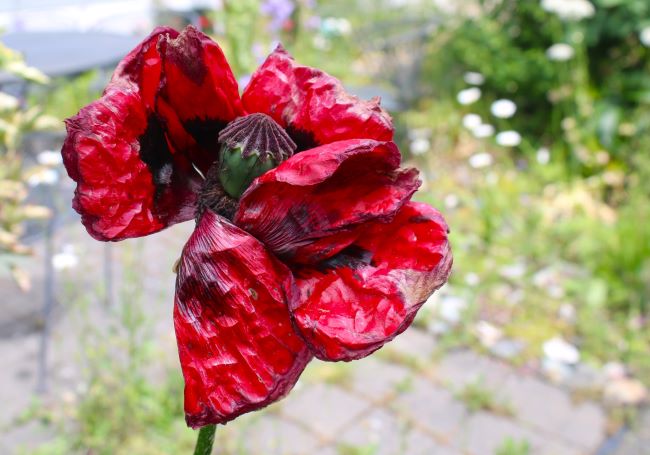
Finally, also in honor of my Palestinian friend, I post this image from my yard. While it’s been battered and bruised by the elements, this red poppy still shines bright. It will rise up again next spring. There’s a reason the poppy is the national flower of Palestine.

From the river to the sea, Palestine will be free.

Sunday Confessional: dance drought

The past year was incredibly difficult on a personal and global level and, unfortunately, it continues into this new year. I’ve unintentionally dropped many good habits–running, hoop dancing, posting here–as a result of the grief and sheer exhaustion of bearing witness to the suffering of so many. Today, however, I finally summoned the energy to do something I’ve dearly missed: hoop-dancing. For twenty minutes, I danced and spun in my hoop, singing along with the music. Emma was happy to see my dancing again and we howled together for several minutes, me grinning as her tail wagged and wagged.

A dancing Sandhill Crane at Monte Vista National Wildlife Refuge. March 12, 2024

Today I reclaimed my joy. My intention is to dance again tomorrow . . . and to continue dancing in the days and months to come.  Dance as a revolutionary act!

Grief is the opposite of indifference

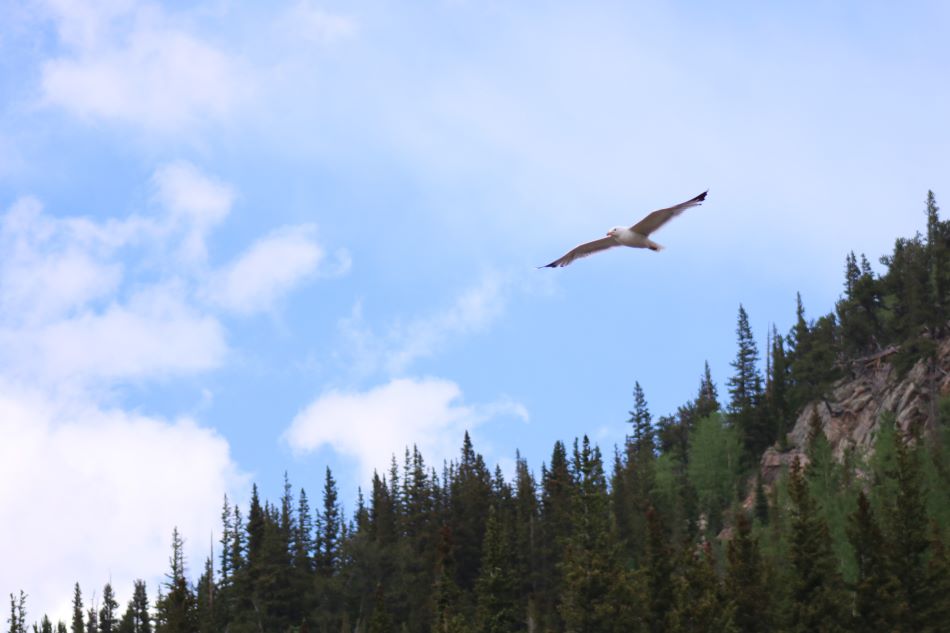
Gull gliding above Jefferson Lake, July 1, 2024

Becoming aware of grief gives us more choices about how to respond to grief and opens up possibilities to approach grief not only with compassion for self and others, but also with joy. Joy is not the opposite of grief. Grief is the opposite of indifference. Grief is an evolutionary indicator of love — the kind of great love that guides revolutionaries.
~ Malkia Devich-Cyril 

Note: I found that quote in Let This Radicalize You: Organizing and the Revolution of Reciprocal Care by Kelly Hayes & Mariame Kaba (it comes from this essay) and wanted to share it in response to my grief on many fronts: genocide in Gaza, climate collapse, political cowardice, abandonment during a global pandemic, etc. It also feels like a worthy companion to the excerpt shared in Rosaliene Bacchus’s post: Sighting the Storm which resonated with me.

Hope and grief can coexist

I don’t know about you, but it’s increasingly difficult for me to get out of bed in the morning. So far, I’ve been able to rally my energy rather than remain curled in the fetal position with the covers pulled over my head, but today I feel the need to return to one of my favorite resources, LET THIS RADICALIZE YOU (mentioned earlier here).

Sandhill Cranes from March 11, 2024, here representing Hope and Grief

The wise Kelly Hayes and Mariame Kaba wrote a chapter titled “Hope and Grief Can Coexist” which is filled with wisdom from their decades of organizing. The following was written in conjunction with paragraphs about climate collapse, but also applies to our broader experience (emphasis mine):

We feel deeply for those who are suffering and for the young people who have inherited this era of catastrophe. We share in their heartbreak and fury.

We also know this: hope and grief can coexist, and if we wish to transform the world, we must learn to hold and to process both simultaneously. That process will, as ever, involve reaching for community.

In a society where fellowship and connection are so lacking, where isolation and loneliness abound, we are often ill equipped to process grief. [   ]  Grief can also lead us to retreat and recoil and, too often, to abandon people to suffer in ways that we cannot bear to process and behold. 

. . . we, as people, do have power. Depending on our choices, we can turn away from injustice and let it continue, or we can confront our grief and move forward to shift the course of societal action in the face of a massive failure of leadership and institutional abandonment. Grief, after all, is a manifestation of love, and our capacity to grieve is in some ways proportional to our capacity to care. Grief is painful, but when we process our grief in community, we are less likely to slip into despair.

Personally, it helps to view my grief as a manifestation of love, maybe because it’s a reminder of my sense of humanity and connection to others, which makes the pain feel almost welcome. Maybe this perspective does the same for you. Later in the chapter, Hayes and Kaba write:

When we talk about hope in these times, we are not prescribing optimism. Rather, we are talking about a practice and a discipline–what Joanna Macy and Chris Johnstone have termed “Active Hope.” As Macy and Johnstone write,

Active Hope is a practice. Like tai chi or gardening, it is something we do rather than have. It is a process we can apply to any situation, and it involves three key steps. First, we take a clear view of reality; second, we identify what we hope for in terms of the direction we’d like to see expressed; and third, we take steps to move ourselves or our situation in that direction. Since Active Hope doesn’t require our optimism, we can apply it even in areas where we feel hopeless. The guiding impetus is intention; we choose what we aim to bring about, act for, or express. Rather than weighing our chances and proceeding only when we feel hopeful, we focus on our intention and let it be our guide.

Hayes and Kaba continue: This practice of hope allows us to remain creative and strategic. It does not require us to deny the severity of our situation or detract from our practice of grief. To practice active hope, we do not need to believe that everything will work out in the end. We need only decide who we are choosing to be and how we are choosing to function in relation to the outcome we desire and abide by what those decisions demand of us.

This practice of hope does not guarantee any victories against long odds, but it does make those victories more possible. Hope, therefore, is not only a source of comfort to the afflicted but also a strategic imperative.

Whew. Just typing out those words helped center me in my grief and to feel those stirrings of hope all over again. My wish is that they do the same for you. Solidarity, friends!

For Dillon

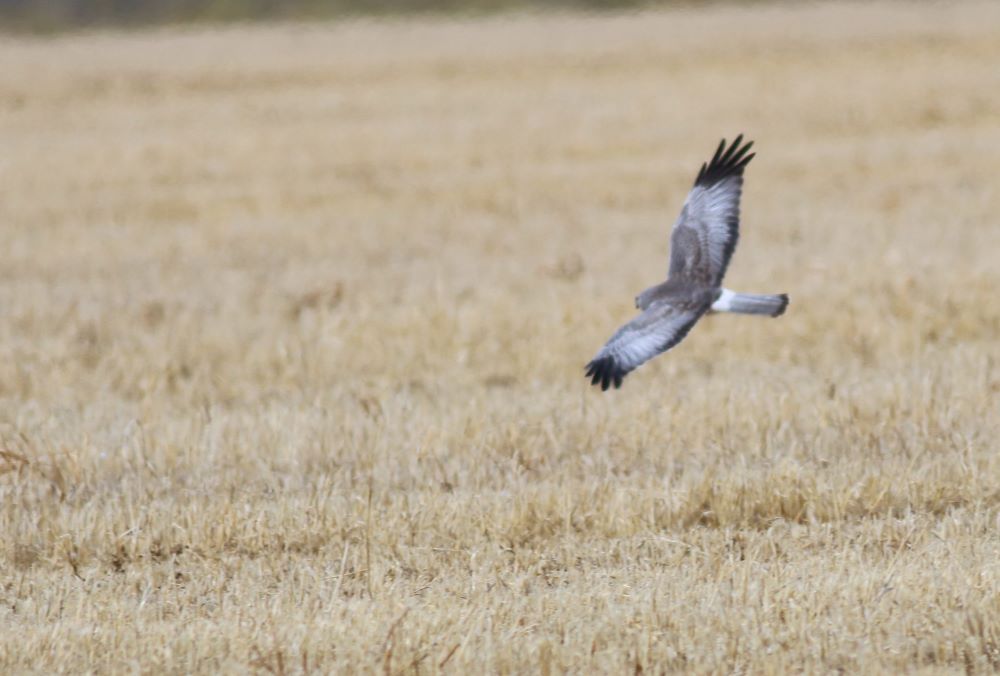
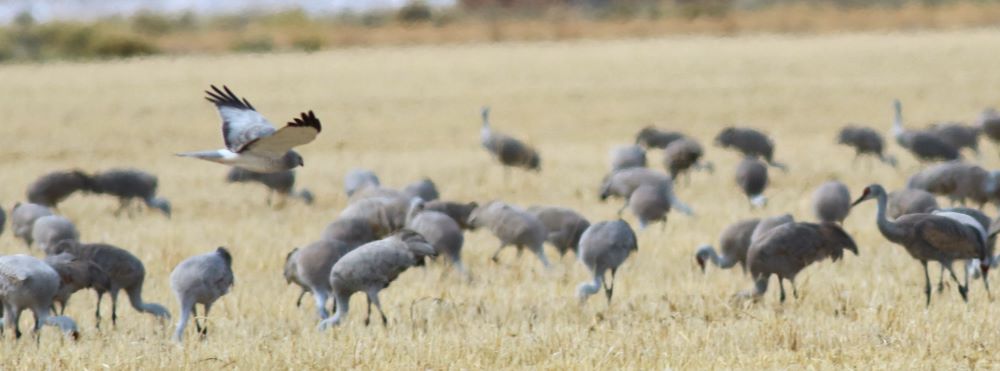
You never got to see a Northern Harrier, so here are two slightly blurred but fully authentic photos of the harrier I told you about exactly one week ago when we were shoveling that heavy snow together, when you were being your typical generous self and helping clear the enormous snowplow-created snow berm so that Zippy and I would be able to get out of our driveway if needed.

Both images by Zippy. March 11, 2024

You delighted in the fact I’d just learned from Zippy: Northern Harriers have owl-like faces that help them hear prey as they fly low above the ground. I wish you’d had the chance to see and identify one when working with your surveying crew so that you would’ve won the “Raptor ID Pie” for that week.

Even more, I wish you were still here with your easy smile and enormous heart. I wish we could have more conversation about birds and nature and dogs and streams, just a sampling of the many things that brought you joy, but I’m grateful for the time we did share and I hold those memories close.

My heart is shattered. I hope you knew how much you meant to me.

Rest in peace, Dillon.

Refaat Alareer: rest in power and peace

Today I learned that Dr. Refaat Alareer, along with his brother, sister, and her four children, were targeted and murdered in an Israeli airstrike. Refaat was a translator, academic, and writer who also reported on life in Gaza. These last two months I got to “know” him on Twitter/X as he shared specific details of the violence and horrors inflicted upon Gazans. Despite the death and destruction, he was funny and hopeful. He struck me as a human being comfortable in his own skin.

At the end of October, I posted a glimpse into LIGHT IN GAZA, an anthology of Palestinian writers and artists sharing their lived experiences under military occupation. But it wasn’t until today that I made the connection that the Refaat from social media was the same man with an essay in LIGHT IN GAZA. Refaat wrote “Gaza Asks: When Shall This Pass?” (Note: You may download the anthology for free from Haymarket Books). I highly recommend reading the entire piece yourself in order to better understand the gift that Refaat was to this world.

In “Gaza Asks,” he shared memories of the random violence he experienced over the years, along with that of friends and family members, and how in each instance they comforted themselves with “It shall pass.” When Refaat was older, teaching world literature and creative writing at the Islamic University in Gaza (IUG), he told stories to his three children to distract them from the twenty-three-day onslaught by Israel’s military (Operation Cast Lead). He told stories as bombs and missiles exploded in the background. Refaat wrote “As a Palestinian, I have been brought up on stories and storytelling. It’s both selfish and treacherous to keep a story to yourself–stories are meant to be told and retold. If I kept a story to myself, I would be betraying my legacy, my mother, my grandmother, and my homeland.”  He went on to say “Telling stories was my way of resisting. It was all I could do. And it was then I decided that if I lived, I would dedicate much of my life to telling the stories of Palestine, empowering Palestinian narratives, and nurturing younger voices.” 

When that particular onslaught ended, Refaat returned to the classroom where he told his students “Writing is a testimony, a memory that outlives any human experience, and an obligation to communicate with ourselves and the world. We lived for a reason, to tell the tales of loss, of survival, and of hope.” He began assigning and training his students to write short stories based on their realities. Those stories were collected and edited by Refaat and published as GAZA WRITES BACK.

But that wasn’t all Refaat did in the classroom. As so succinctly expressed by his friend Dan Cohen, Refaat “used English-language literature and poetry to teach his students the difference between Judaism and Zionism, equipping them with the mental tools to resist Zionist propaganda that seeks to conflate the two.” You can read more about those classroom experiences in “Gaza Asks.”

Later in the essay, in regards to Israel later destroying the administration building at IUG, Refaat wrote “. . . to me, IUG’s only danger to the Israeli occupation and its apartheid regime is that it is the most important place in Gaza to develop students’ minds as indestructible weapons. Knowledge is Israel’s worst enemy. Awareness is Israel’s most hated and feared foe. That’s why Israel bombs a university: it wants to kill openness and determination to refuse living under injustice and racism.”

I’ll stop there because I can’t do justice to the eloquence of Refaat’s essay, and I hope you’ll forgive me for already revealing so much. It’s just that this entire essay touched my heart and I felt compelled to share.

I do want to highlight this poem that follows his essay in LIGHT IN GAZA. Refaat also posted the poem on his Instagram account one week ago:

I’ll end with this poem he’d pinned at the top of his Twitter/X account on November 1: “If I must die, let it be a tale.”

Rest in power and peace, Dr. Refaat Alareer.

I refuse to be desensitized

It’s another Monday which, in the past, meant a Climate Movement Monday post about a frontline community suffering the worst effects of climate change plus a suggested action or two to take on their behalf. I’ve got nothing to offer.

Confession: I can’t stop thinking about Palestinian people and have spent much of today in tears. Over 5,000 Palestinians dead since October 7, including 2,000 children. That equals 128 dead children per day. This is genocide and the U.S. government is sponsoring it. The military industrial complex is getting richer off the slaughter of Palestinians and my two Senators and one Representative can’t be swayed to step down from their “I stand with Israel ” stances. Nonetheless, I continue to call them daily to demand a ceasefire and today felt a slight shift in the tones of the two staffers who took my calls (I left a voicemail for the other). One said that all calls received at that office were demanding a ceasefire. The other was someone I’ve spoken with multiple times, someone who has exhibited clear disdain for my position, but who today listened to me speak through my tears and then sincerely thanked me for calling. It’s not much, but I’m clinging to those shifts in tone.

PLEASE call your representatives to demand a #CeaseFireNOW.
U.S. Capitol switchboard: (202) 224-3121

Millions of people around the globe have taken to the streets demanding a #CeasefireNOW!

Boston march for Palestine this past weekend. (found on Twitter along with this video of the march)

This is reminiscent of the millions of us taking to the streets in 2003 to demand the U.S. not invade Iraq. We were ignored then and know how that turned out. And same as twenty years ago, Islamophobia is now on the rise due to those fanning the flames. In case you missed it, a six year-old Palestinian-American boy (Wadea Al-Fayoume) in Chicago was fatally stabbed 26 times by his landlord who also stabbed the boy’s mother a dozen times. She survived and was released from the hospital today.

What is the point of me sharing all this? I cannot remain silent during an ongoing genocide because silence normalizes the policy. Just as I refuse to “return to normal” during the ongoing Covid-19 epidemic, I refuse to look the other way while an occupied people are being bombed out of existence. One of the most important acts of resistance is the refusal to be desensitized to the suffering of others.

It would make me very happy to engage with people here on what’s happening, so please let me know how you’re doing and whether you’ve made headway with your representatives or attended a march. Basically, any and all comments are welcome!

In the meanwhile . . . solidarity! ✊🏽

Twofer Tuesday: two anniversaries

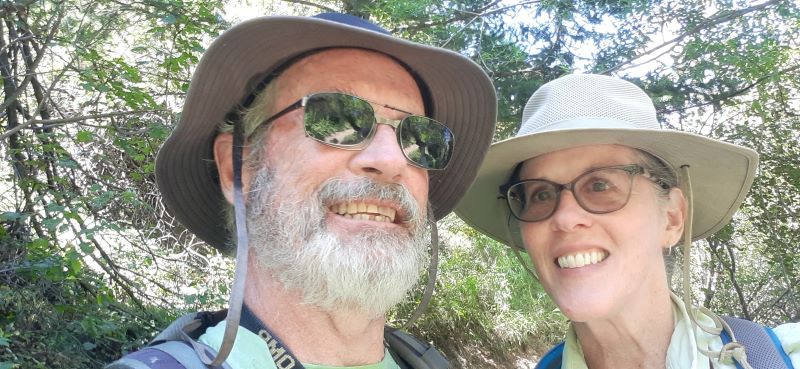
Today is a bittersweet day for Zippy and me. It’s the one year anniversary of his mother’s death and also our wedding anniversary. He suggested we go for a hike to soothe our aching hearts while also celebrating us. So, we got ourselves together and headed to nearby White Ranch Park where neither of us had been before. Here are two selfies taken along the trail, one by me and the other by Zippy.


The temperature was in the upper 80s which was pretty darn warm, but portions of the trail were shaded. And, to Emma’s delight, we had to cross a stream on the way out AND the way back, so twice she was able to be belly-down in cold water.

I also had the double pleasure of seeing an American Kestrel on the way out and way back, both times in the same area. And my second sighting included two kestrels! I was a great distance away so my photos aren’t great, but here’s a twofer of those majestic birds (click to enlarge).


Despite them being an invasive species, I’m very fond of thistles and their many, many permutations. Here are two I especially liked.

We only saw a couple Rocky Mountain Beeplants during the hike, but this one caught my eye for being two-headed. While I didn’t examine it closely, it truly appeared to have one bloom growing out of another.

It was a good afternoon and hike, the perfect excursion for today. We’re all glad to be back inside where it’s cooler. Zippy and Emma are already cleaned up and napping, and I’m guessing our sweet little doggie is dreaming of that refreshing mountain stream.

“May I please stay here forever?”

My mother-in-law was no stereotype

Monday evening, my mother-in-law died.

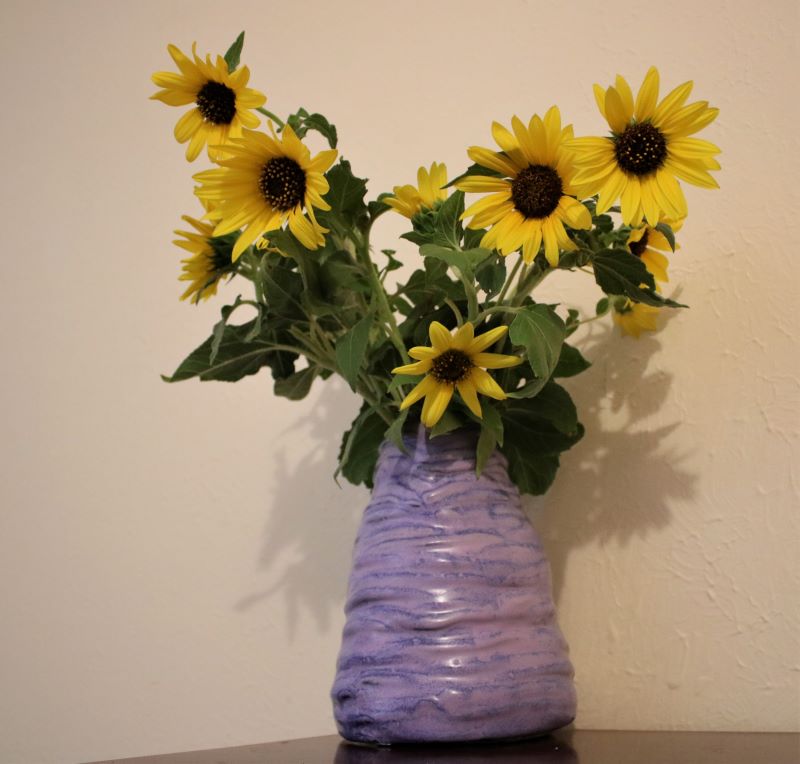
Bouquet from yard in vase made by young Wildebeest, given to Alice on day before her death.

Contrary to what books and movies would have us believe, not all mothers-in-law are control freaks who believe no one is good enough for their sons. Some are kind, loving, and supportive.

It didn’t feel that way at the start. The first time I met Alice was when Zippy brought me to his parents’ home in Colorado for Christmas in 1988. At the time, he and I had a long-distance relationship between our two California cities. When it was bedtime, Alice showed me where I’d sleep, which wasn’t where Zippy was sleeping. I remember the depths of loneliness I felt lying in that room in an unfamiliar house filled with people I didn’t know. Loneliness plus resentment for the uptight mother of my boyfriend.

That’s the first and last thing she ever did to upset me. No exaggeration. And after I got to know Alice, I realized her decision to put me in that bedroom by myself wasn’t a comment on me or my relationship with her son, but because she didn’t want to make assumptions.

Alice welcomed me with open arms and later extended her endless love to Wildebeest and Zebu. If Alice was a stereotype, it was as a devoted grandmother. She genuinely loved spending time with her grandchildren. Wildebeest told me a story yesterday about the time Alice and Stu took care of Zebu and him for a weekend while Zippy and I went out-of-state for my high school reunion. He’s foggy on the details — maybe he and his brother were fighting over a toy or complaining of boredom — but he remembers it was the only time Grandma got mad at them.

I believe it. Alice was the queen of easy-going. She loved family and friends, and was always the first to laugh at herself. She’d do something — such as accidentally sitting on her camera in the church pew at her other son’s wedding — then let out her trademark “woooo,” followed by a giggle. One time, she agreed to help me make curtains for the boys’ bedroom. After many, many laughter-filled minutes trying to figure out how to thread the sewing machine needle and bobbin, we gave up and called her capable seamstress neighbor who set things right while Alice and I laughed some more.

Once, Alice agreed to accompany me to a doctor’s appointment where she stayed out in the car with the boys. Toddler Zebu was still very attached to me and didn’t handle separation well. When he began crying, Alice struggled to get him out of the car seat, growing more confused as his wailing reached epic proportions. In later years, Alice told the story of how Wildebeest leaned in at that moment to say, “Read the directions, Grandma.” She then read the instructions on the car seat and was able to release Zebu and calm him. But in her telling, all credit went to Wildebeest.

Alice was generous to a fault. She feared and disliked cats, yet cut out cat pictures for the birthday cards she’d make me. When she flew to Alaska to help out after Zebu was born, she told me to let her know if any of her behavior bothered me. She said this knowing that the recent visit from my own mother had caused more problems than it alleviated. Once, after Stu and I had a spirited conversation about our differing political views, in which he was literally hopping mad and called me a communist, Alice forced him to phone me the next day to apologize. Honestly, I thought it was pretty funny seeing my father-in-law so wound up, but Alice didn’t want to risk hurt feelings. Family mattered.

Alice was nineteen when she had Zippy (Stu was twenty-one). Alice had four children by the time she was thirty, a mind-boggling realization when I had my first child at 30 years and barely considered myself mature enough to be a parent. Over the years, Alice and Stu apologized to their kids for supposed mistakes they’d made and opportunities they hadn’t provided. But from my perspective, that young and very poor couple accomplished a miracle: they raised four well-adjusted children who not only loved their parents very much, but also love and support each other.

Over the three weeks following Alice’s heart surgery at the end of July, those four children worked together to help their ailing mother. They coordinated efforts so Alice, who was deaf and suffering dementia, would never be alone in an unfamiliar place. Under increasingly scary and difficult circumstances, those four hung together in their shared goal to ease their mother’s discomfort.

And now Alice’s smile and laughter are only memories. Our hearts are shattered, but I’m deeply grateful for the years I had with my mother-in-law. My wish for her now, wherever she is, is that there are buffets rather than menus. Because for her many fine qualities, Alice struggled to make decisions. Eating out with her was a study in patience. But maybe there are menus and waitstaff. In which case, as Alice was fond of saying, “I hope it all works out.”

Honoring Bob

This past weekend, a whole lot of people gathered to honor and celebrate my brother-in-law‘s life.

I’ve known for decades that Bob was a stellar human being (one of the very best on the planet), but it was still incredible to hear that sentiment expressed over and over again. Every single speaker mentioned the very things that made me love Bob so much: his kindness and lack of judgment, the way he listened so that you felt heard and valued. His generosity and tenacity in his lifelong fight for tenants’ rights and consumer protection. How he used his sense of humor and intellect to punch up, never down. His passion for life and love for his family. His enormous heart.

I laughed and cried throughout the program.

Many comments resonated throughout, but one theme in particular spoke to me: Bob never turned cynical or stopped hoping and believing in a better world.

I felt called-out because this country’s collapse and slide into fascism while the so-called “better party” is in power has made me hugely cynical. I’ve been tempted to give up. But Bob never gave up on justice. He continued fighting for society’s vulnerable and voiceless, up until the very end of his life. If I’m to truly honor Bob’s life,  I must do the same.

I love and miss you so much, Bobaloo. Rest in power, brother.

Rest in power, brother

Late Wednesday night, my brother-in-law died peacefully after a six-year battle with illness. Bob has been in my life since I was 12 or 13 years old — the vast majority of my time on the planet — and I’m struggling to adjust to a world without him.  I last saw him in person in March 2020 right before the pandemic hit hard and while I don’t remember specifics of any conversations, I’m positive there was much laughter. Bob and I always laughed.

Well, not always. Back when I was still a kid, my younger brother and I took the train from Wisconsin to Minneapolis where Bob and my sister were living at the time. Within minutes of our arrival, I managed to knock the tea kettle off the stove and make a big mess. When Bob pretended to be mad, I took his gruffness seriously and withdrew into myself. It took a while for him to convince me he’d been joking and throughout the rest of our lives, he’d tease me about our Teapot Dome Scandal.

I found ways to get back at him, though. During one of the many trips he and my sister and sons made to Colorado, I snuck a random item in Bob’s luggage right before he left. Ha, joke was on him! Except the next time he visited, he returned with that random item and locked it to the rod in our coat closet. Eventually, he gave in and provided the combination.

Another trip, he caught a later flight to Denver than the rest of his family and while someone distracted Bob at the baggage claim area, I grabbed his duffel bag off the carousel, removed his contents, and replaced them. When Bob unzipped his “oddly light” bag, he discovered a plastic pig mask staring up at him from a bed of popcorn. (Full disclosure: Bob wasn’t quite as enthused by this prank as the rest of us.)

While our relationship was laughter-based, it was deeper than that. Bob was my safe refuge. Our interactions were stress-free because Bob accepted me for who and what I was, without judgment. (With the exceptions of giving me shit about wearing socks with my Tevas and never ironing my clothes). I gravitated toward him whenever we were in a group setting. Bob was friendly and easy to be around.

He could also be intense, as in his commitment to health and strength. We frequently ran together (Bob easily transitioned from sea level to exercise at Colorado elevation) but that wasn’t enough for him, not even on vacation. He’d also lift weights, do yoga, push-ups and sit-ups, and climb 14ers. Bob was lean and mean his entire life.

Bob mid-yoga pose in August 2007.

Bob was devoted to his family. Here he is with my sister and their sons in 1994. They came to Alaska to visit during the summer, but didn’t think to pack for winter.  🙂  (My sister and nephew are each wearing one of my hats, the other nephew is wearing Zippy’s hat, and I think that’s my oversized jean jacket on Bob — but note that he’s bare-headed and impervious to cold!) Two vivid non-Bob-specific memories from that visit: the younger nephew, who was only six, carried his own pack the entire steep hike up to the Harding Ice Field AND that hike included my only black bear sighting of the six years I lived in Alaska.

A chilly tour of Kenai Fjords

Bob loved kids — his own and everyone else’s. Here he is conversing with Zebu.

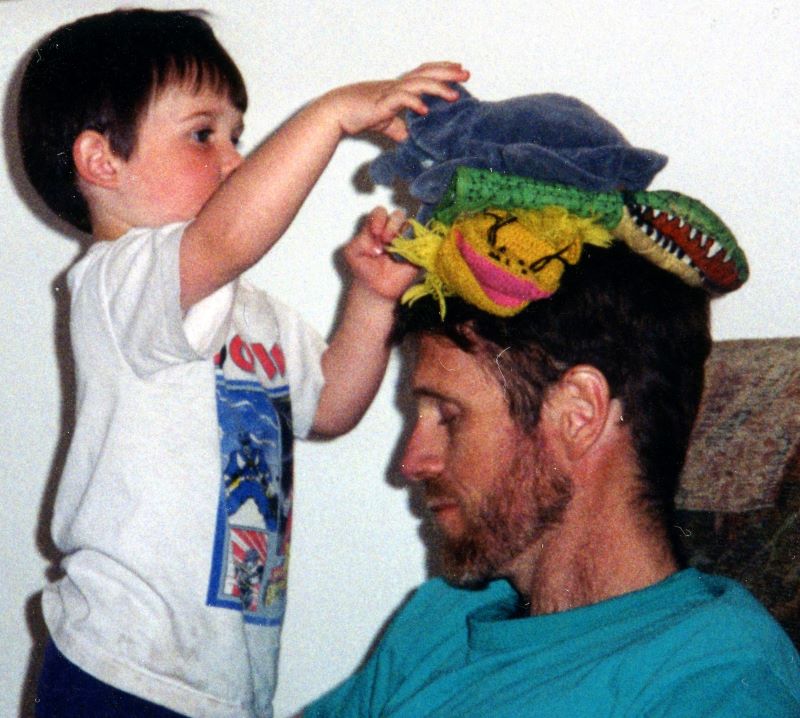
And patiently enduring the construction of a stuffed animal tower on top of his head.

Bob was also a fierce advocate for people he’d never met. He was a lawyer who used his powers for good. Even while undergoing treatment, he led tenant meetings and fought for housing justice. In myriad ways, Bob worked to make this world a better place. I admired him greatly. And loved him even more. A quick search didn’t turn up any photos of the two of us and I’m too raw right now to dig deeper. But that’s okay because his smile and voice are imprinted on my heart.

Rest in power, Bobaloo.

Wordful Wednesday

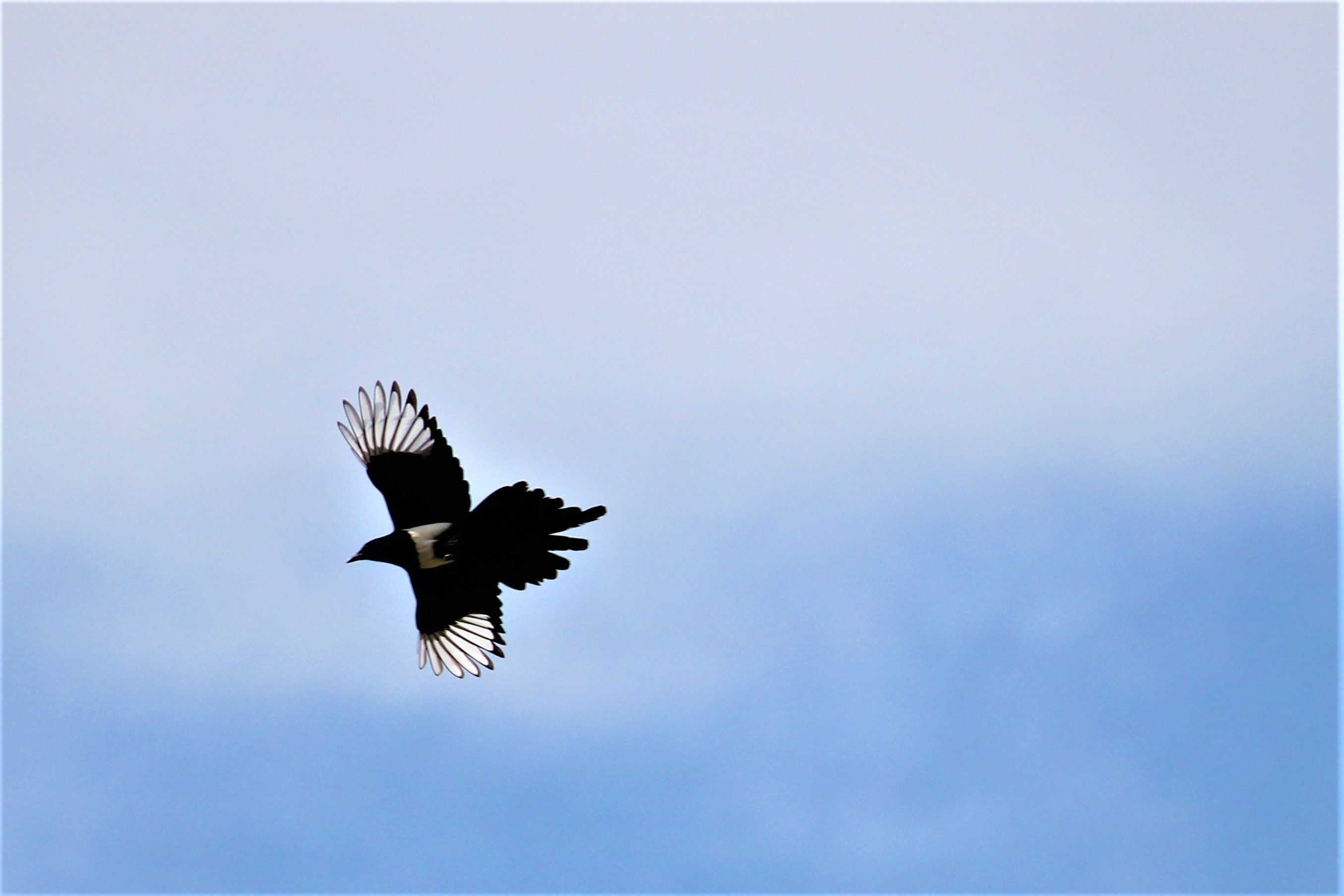
I photographed this Black-billed Magpie at the beginning of the pandemic when I escaped to the open space with a blanket, binoculars, and my camera. It’s not a particularly good photo, but it captures the elegance of a magpie’s flight feathers. I remember the emotional boost I experienced while watching and listening to this bird and the other magpies. They were so raucous that day and I felt honored when several gathered in a tree close to my blanket, squawking and carrying on.

April 1, 2020

Yesterday, I shared some sad magpie news. Today I’m filled with sorrow over that senseless death, but also gratitude for my many magpie sightings, visits, and interactions over the years. They never fail to enchant.

Gratitude and grief

Because I’m an introvert, I’m maybe better equipped for this quarantine than others. But even though I recharge my batteries by being alone, that doesn’t mean I don’t still crave the company of others. And today, I’m missing my friends of the Sunrise Movement.

Phlox. August 6, 2020.

The entire time I fought alongside them, I was mindful of my very privileged position as a young-at-heart welcomed into the ranks of passionate young people fighting for a livable future. I was also completely unprepared for how quickly that situation could shift. I had no idea that in the very near future I wouldn’t see them regularly at hub meetings, trainings, art builds, and actions. While I didn’t take any of it for granted, it never occurred to me there’d come a time in which we wouldn’t trade smiles across a room and share hugs. I’m writing this with tears in my eyes and a hole in my heart. In addition to the obvious, this pandemic and our government’s botched response has destroyed so much. It hasn’t stopped Sunrise Colorado or those friendships, but it’s completely altered the landscape of each. Today I’m grateful for what we had and mourning all we’ve lost.

Saying goodbye to an old friend

In a few minutes, a kind veterinarian is going to arrive at our home to help us say goodbye to Zoey. She’s lived with us the past 13+ years which is more than half of Wildebeest and Zebu’s lifetimes. This morning Wildebeest said goodbye before  heading back to his home that’s a six-hour drive from here. Zebu will be with Zoey at the end.

Zoey’s last trip to Westcliffe. August 12, 2017

We’d originally hoped to say goodbye to Zoey tomorrow because it’s my birthday today. But when the vet offered to come this afternoon it seemed the best option. Zoey’s tired and has had enough, and it felt wrong to delay the inevitable. We’ve definitely made the right decision for her, but the mood is less than festive.

Rest in peace, our sweet Zotato.

For Savannah

In a few minutes, I’m heading to a memorial. I’ve spent the past half-hour trying to find the words to express what I’m feeling and all I’ve managed is this:

Savannah, you are loved.

Thankful Thursday

I’ve kept a gratitude journal on and off for a number of years, but am currently in an off phase. I hope to resume my bedtime ritual of listing five things I’m grateful for, but in the meanwhile:

Today I am grateful . . .

  • my sister helped me feel more at peace about a friend’s death.
  • my critique group gifted me another week to finish the draft of my work-in-progress and that
  • I am, indeed, making progress on that work.
  • I enjoyed a calm, non-aggressive walk in the warm sunshine with Emma, even though we passed other dogs.
  • I completed my four-minute plank despite learning the hard way that Led Zeppelin’s Four Sticks is absolutely not a good motivational song. Nope, not even close.

Thanks for the memories

Today’s been a difficult day.

I’ve had no energy and stayed in my jammies until 2:30 when I dragged myself off the couch so I could walk Emma and get some sun. Despite the sunshine and blue sky, I felt weepy as we walked, and kept tearing up. And then it hit me: January 23rd…Scott’s birthday. My childhood friend should be making a wish on his candles and eating cake, except that he died almost exactly twenty-five years ago.

Oddly enough, figuring out why I was feeling so down improved my mood. (Well, that plus the sunshine and exercise.) Because then I started remembering. Odd conversations about olive loaf and Salsa Rio Doritos; Scott’s old blue Pinto; the St. Patrick’s Day we spent together; his English class demonstration in which he taught us how to keep score in bowling, but became confused and had to step back from the board to figure out exactly out where the score had gone wrong; the Sears catalog poses he’d do for me whenever I asked; singing Victor Banana songs together; laughing until we cried. Laughing some more.

Here’s the photo I keep on my desk:

Scott’s smiling.
And now I am, too.

Happy birthday, friend.