Day 261: it’s all connected, we’re all connected

On this 261st Day of Genocide in Gaza, I admit to being stunned that the carnage has not only not ceased, but has become increasingly depraved. I won’t go into details as the words and images are easily found due to IOF soldiers proudly documenting their depravity/lack of humanity on social media sites. To counteract the sadism, I decided to offer a poem by a Palestinian, and so went in search of something that resonated.

I landed on a poem by Mahmoud Darwish (1941-2008) who is “feted as Palestine’s national poet for his words expressing the longing of Palestinians deprived of their homeland, which was taken by Zionist militias to make way for present-day Israel. His poetry gave voice to the pain of Palestinians living as refugees and those under Israeli occupation for nearly a century.” And because this morning I began reading the Pulitzer Prize-winning Blood in the Water: The Attica Prison Uprising of 1971 and Its Legacy by Heather Ann Thompson, the Darwish poem I chose is “The Prison Cell.” Because just as the United States incarcerates more people than any country on earth (currently about 2 million people), Israel incarcerates thousands upon thousands of Palestinians and holds them without filing charges. It’s all connected. We’re all connected. And just as the incarcerated in the U.S. are treated as less-than and subjected to brutal conditions, so are the Palestinians. It doesn’t matter who we are or where we live on this planet: It’s all connected. We’re all connected.

In this spirit, I offer:

The Prison Cell
by Mahmoud Darwish
(Translated by Ben Bennani)

It is possible . . .
It is possible at least sometimes . . .
It is possible especially now
To ride a horse
Inside a prison cell
And run away . . .

It is possible for prison walls
To disappear,
For the cell to become a distant land
Without frontiers:

What did you do with the walls?
I gave them back to the rocks.
And what did you do with the ceiling?
I turned it into a saddle.
And your chain?
I turned it into a pencil.

The prison guard got angry.
He put an end to the dialogue.
He said he didn’t care for poetry,
And bolted the door of my cell.

He came back to see me
In the morning.
He shouted at me:

Where did all this water come from?
I brought it from the Nile.
And the trees?
From the orchards of Damascus.
And the music?
From my heartbeat.

The prison guard got mad.
He put an end to my dialogue.
He said he didn’t like my poetry,
And bolted the door of my cell.

But he returned in the evening:

Where did this moon come from?
From the nights of Baghdad.
And the wine?
From the vineyards of Algiers.
And this freedom?
From the chain you tied me with last night.

The prison guard grew so sad . . .
He begged me to give him back
His freedom.

—-

One final connection between Palestinians, the men in Attica in 1971, and me: this poster I unearthed in my basement yesterday, one I’d bought years ago (and possibly hung in my California classroom):
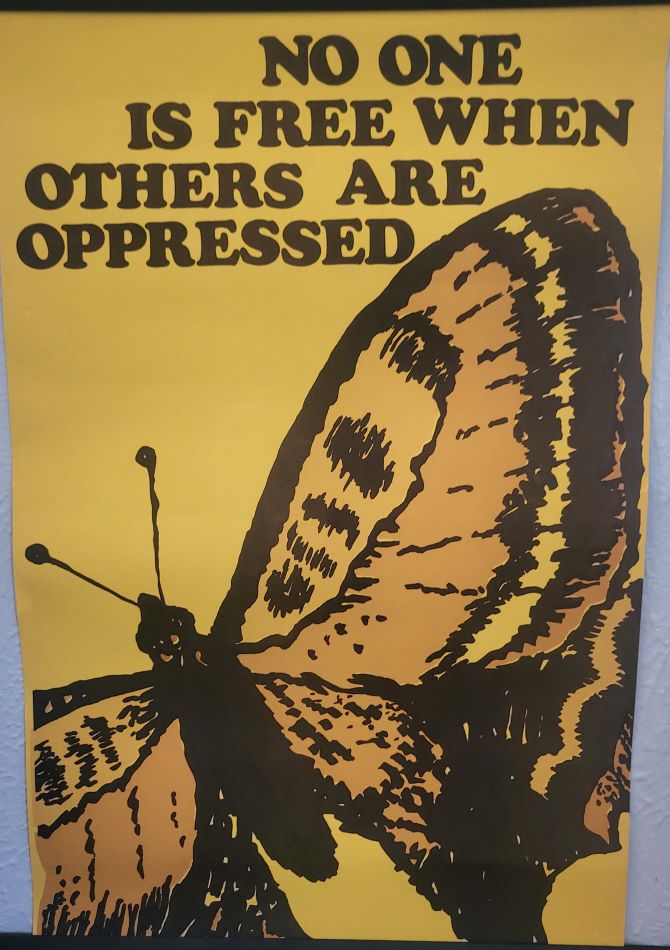


It’s all connected. We’re all connected.
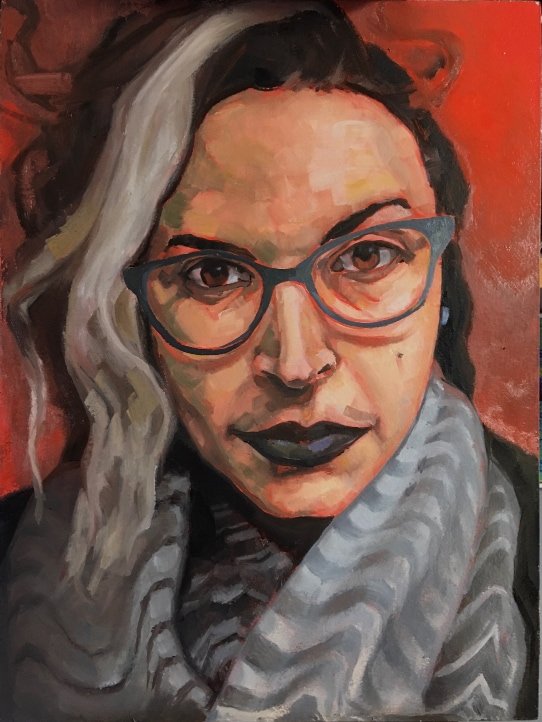
“Pocketful of Warding Stones” by Rasha Abdulhadi

The following poem and image were published at Poetry Online (a nonprofit organization dedicated to sharing literature and art accessibly) on October 21, 2023.
Pocketful of Warding Stones by Rasha Abdulhadi
how much of the weight of time we carry
is the burden the murderers gave us,
and whose ends do we serve to hate
ourselves for not dying as easy as they wanted?
what firekeeper can scrape
the char of guilt from this burnt offering,
pull air over embers of grief & longing,
find some flint in the heart left to light?
how can we untie living grief from the longing
to have done more, and find instead what
more could yet by our breath be done?
we can hold ourselves, responsible yes,
refuse a rebellion captive or complicit
confess instead a broader bravery
on which to spend the coin of our lives.
we who untangle loss from creation by blowing it to bits—
why obscure grief, why hoard it or hide its face,
as if a siphon could drain an ocean, no—
let them hear the holes when we sing.
every death in war is a casualty, no matter the speed
or how exhausted, how unscaffolded the rebuilding.
i know a hurricane who reached through years and state lines
into lungs hearts and bowels, and snatched souls back to flood.
when the disaster of war or the war of disaster steals homes it steals lives,
and though it may take time to cash them, we know where the blame lies.
we ward against the guilt of war
the blistered blessing of surviving our kin, and
around the undefused bombs our bodies hide,
we build a larger house to live in.
though the house of sorrow be vast,
give grief her rooms to stalk through
let living longing paint the walls.
can we then deny guilt, that rent-free tenant,
the lease it seeks in the house of grief?
refuse them victory on this field at least:
our breathing belongs to us
and is not some shame we owe or stole,
or failed to lose like they wanted us to—
our bellows blow to break knees bent over any neck.
i won’t devolve the monument of my body
to the keeping of the state, won’t donate
the corpse of my dreaming
to service the desires of murderers
or their gracious paperwork proctors.
i won’t do the blamework for them.
our mothers have been here before, they know
there’s no antidote for the poisons sown in the fields of war
but i will refuse the death machine of the imagination any morsel more
at least in my heart, the war can’t have you, my friend—
and wherever the last domino of my body falls,
let me land as a gear-breaking wedge—
the murder wheel won’t win my shame.
i won’t let them kill me before i die
and i offer you the same.
——————————-
Rasha Abdulhadi is calling on you, dear reader, to join them in refusing and resisting the genocide of the Palestinian people. Wherever you are, whatever sand you can throw on the gears of genocide, do it now. If it’s a handful, throw it. If it’s a fingernail full, scrape it out and throw. Get in the way however you can. The elimination of the Palestinian people is not inevitable. We can refuse with our every breath and action. We must.

Poem from Basman Aldirawi, Gazan poet

This Bread Was Born,
This Bread Was Killed
by Basman Aldirawi

Artwork: Aly S.Elsayed
@aly.selsayed

With clean hands,
he gently sifts the flour,
and adds a handful of yeast.
He pours the warm water
for the yeast particles to live,
then rolls and kneads and rolls
and kneads the dough.
He lets the soft mass rest.
With firm but gentle hands,
he rounds it into balls,
flattens them into shape,
and handles each one
delicately into the oven.
Soon, perhaps in half an hour,
the bread rolls are born fresh,
healthy and browned.
The newborn breads breathe,
yet dust chokes the air,
searing gasses penetrate
their thin, fragile crusts.
On the day of their birth, a missile,
a bakery, a scattering
of zaatar, flesh, and blood.

***************
This poem is from a chapbook issued today by Publishers for Palestine, a global collective of publishers. From their website:
Today we announce the launch of Poems for Palestine: Recent poems by nine Palestinian poets & actions you can take to stop genocide now. Publishers for Palestine have come together to create this free booklet of poetry, artwork, and resources for action, now available for both print and online dissemination. This chapbook is made not for resale, but please read and share as widely as you please!

I encourage you to check out this beautiful book. We must never stop talking about Palestine.

Palestinian poetry, part 2

Running Orders
By Lena Khalaf Tuffaha

They call us now,
before they drop the bombs.
The phone rings
and someone who knows my first name
calls and says in perfect Arabic
“This is David.”
And in my stupor of sonic booms and glass-shattering symphonies
still smashing around in my head
I think, Do I know any Davids in Gaza?
They call us now to say
Run.
You have 58 seconds from the end of this message.
Your house is next.
They think of it as some kind of
war-time courtesy.
It doesn’t matter that
there is nowhere to run to.
It means nothing that the borders are closed
and your papers are worthless
and mark you only for a life sentence
in this prison by the sea
and the alleyways are narrow
and there are more human lives
packed one against the other
more than any other place on earth
Just run.
We aren’t trying to kill you.
It doesn’t matter that
you can’t call us back to tell us
the people we claim to want aren’t in your house
that there’s no one here
except you and your children
who were cheering for Argentina
sharing the last loaf of bread for this week
counting candles left in case the power goes out.
It doesn’t matter that you have children.
You live in the wrong place
and now is your chance to run
to nowhere.
It doesn’t matter
that 58 seconds isn’t long enough
to find your wedding album
or your son’s favorite blanket
or your daughter’s almost completed college application
or your shoes
or to gather everyone in the house.
It doesn’t matter what you had planned.
It doesn’t matter who you are.
Prove you’re human.
Prove you stand on two legs.
Run.
Lena Khalaf Tuffaha, “Running Orders” from Water & Salt.  Copyright © 2017 by Lena Khalaf Tuffaha. 
___________________________________________________________

Blood
By Naomi Shihab Nye

“A true Arab knows how to catch a fly in his hands,”
my father would say. And he’d prove it,
cupping the buzzer instantly
while the host with the swatter stared.
In the spring our palms peeled like snakes.
True Arabs believed watermelon could heal fifty ways.
I changed these to fit the occasion.
Years before, a girl knocked,
wanted to see the Arab.
I said we didn’t have one.
After that, my father told me who he was,
“Shihab”—“shooting star”—
a good name, borrowed from the sky.
Once I said, “When we die, we give it back?”
He said that’s what a true Arab would say.
Today the headlines clot in my blood.
A little Palestinian dangles a truck on the front page.
Homeless fig, this tragedy with a terrible root
is too big for us. What flag can we wave?
I wave the flag of stone and seed,
table mat stitched in blue.
I call my father, we talk around the news.
It is too much for him,
neither of his two languages can reach it.
I drive into the country to find sheep, cows,
to plead with the air:
Who calls anyone civilized?
Where can the crying heart graze?
What does a true Arab do now?
Naomi Shihab Nye, “Blood” from Words Under the Words: Selected Poems (Portland, Oregon: Far Corner Books, 1995). Copyright © 1995 by Naomi Shihab Nye.

Yes I Do Want to Punch

See this squirrel’s clenched paw?

May 15, 2022

That little fist is a result of me tapping on the window to stop it from eating the peanuts we put out for birds* and, for the longest time, I thought it was the same brazen squirrel making a fist at me in response to my tapping. But then I realized it couldn’t be the same squirrel every single day and that ALL squirrels do that. Their immediate reaction to threat is a fist.

I can relate. Maybe I should enlist some squirrels to join me because, Yes I Do Want to Punch / fascists in the face.

*the squirrel food is on the back fence

Reverie

To make a prairie it takes a clover and one bee,
One clover, and a bee.
And revery.
The revery alone will do,
If bees are few.   ~ Emily Dickinson

July 18, 2019

While this photo is of a bee and lavender (not clover) in my yard (rather than the prairie), the image still induces a reverie.

Too long

American Robin. January 21, 2020.

A wind has blown the rain away and blown the sky away and all the leaves away, and the trees stand. I think, I too, have known autumn too long.   ~ e.e. cummings

I believe

American Robin. February 14, 2020.

You have to believe in happiness,
Or happiness never comes …
Ah, that’s the reason a bird can sing –
On his darkest day he believes in Spring.
~  Douglas Malloch

In a pine tree

In a pine tree,
A few yards from my window sill,
A brilliant blue jay is springing up and down, up and down,
On a branch.
I laugh, as I see him abandon himself
To entire delight, for he knows as well as I do
That the branch will not break.
~ James Wright

Poem: Egrets by Mary Oliver

Poetry intimidates me so I usually avoid it.  But my sister insisted I’d appreciate Mary Oliver’s poems.  And I do.  Especially this one since right now I’m missing all those amazing birds I saw everywhere in Florida.  The very last, um, stanza? (calling[info]kellyrfineman) gets me where I live.

EGRETS
by Mary Oliver

Where the path closed

 down and over,

   through the scumbled leaves,

     fallen branches,

through the knotted catbrier,

  I kept going.  Finally

    I could not

      save my arms

        from thorns; soon

the mosquitoes

  smelled me, hot

    and wounded, and came

      wheeling and whining.

        And that’s how I came

to the edge of the pond:

  black and empty

    except for a spindle

      of bleached reeds

at the far shore

  which, as I looked,

    wrinkled suddenly

      into three egrets – – –

a shower

  of white fire!

    Even half-asleep they had

      such faith in the world

that had made them – – –

  tilting through the water,

    unruffled, sure,

      by the laws

of their faith not logic,

  they opened their wings

    softly and stepped

      over every dark thing.